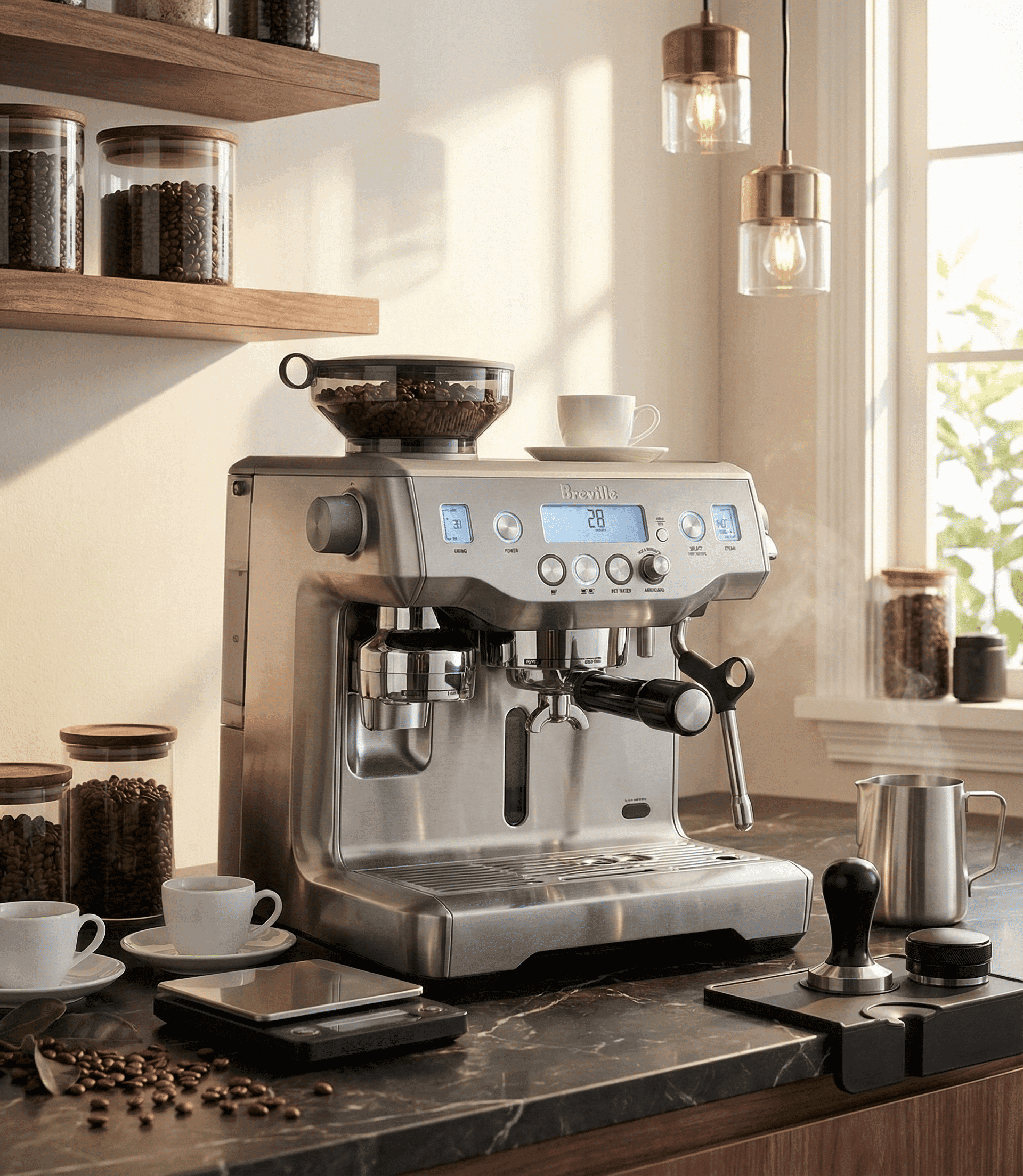
Breville Oracle Review 2026: The $2,500 Question
Tested for 60 days: dual boiler precision, automatic grinding, tamping, steaming. Does the Oracle justify $2,500? Honest comparison vs Dual Boiler.
Quick Summary
Espresso enthusiasts upgrading from entry-level machines who want commercial-quality results with automated assistance — skilled performance without advanced barista technique required.
Busy professionals and mixed-skill households who want excellent espresso and milk drinks in 2–3 minutes, and super-automatic users seeking better espresso quality without losing push-button convenience.
Budget-conscious buyers — the Oracle's price point is only justified if you're making multiple espresso-based drinks daily and want dual-boiler performance without manual skill investment.
True espresso purists who prefer fully manual control over every extraction variable, or beginners who won't grow into the machine's capabilities.
Independent Testing Summary
- Total shots pulled
- 250+
- Testing duration
- 60 days
- Extraction time
- 25–28 seconds (18g dose → 36g yield)
- Dose range
- 18g (±0.3g dose consistency)
- Temperature range
- 201–202°F (dual boiler, ±1°F)
- Heat-up time
- 3–4 min cold start; 30 sec from standby
- Steam time range
- 55–65 sec (whole milk), 60–70 sec (oat milk)
Breville Oracle Review: Is the Breville Oracle worth $2,500? I've tested espresso machines ranging from $200 budget models to $4,000 commercial-grade beasts, and this automatic espresso machine with grinder positions itself as the best dual boiler espresso machine for serious home use. The Oracle sits in an awkward middle ground—too expensive for most home users, yet significantly cheaper than true commercial equipment. After 60 days of daily use, pulling over 250 shots, I've identified exactly who this machine serves and who should save their money. Browse our espresso machine reviews hub for more options across every budget.
The Oracle's promise is seductive: combine the precision of a dual-boiler system with complete automation of grinding, dosing, and tamping. In theory, you get commercial-quality espresso without the barista skills. In practice... it's more nuanced than that. Let me walk you through what actually happened during two months of real-world testing.
Decision Snapshot: Is This Machine Right for You?
Who It's For
- Espresso Enthusiasts Upgrading from Entry-LevelYou've mastered basic espresso on a Bambino Plus or Gaggia Classic, want commercial-quality results, but don't want to develop advanced barista skills. The Oracle delivers professional performance with automated assistance.
- Busy Professionals Who Value EfficiencyYou want excellent espresso and milk drinks but can't spend 10-15 minutes per drink. The Oracle's automation reduces drink-making to 2-3 minutes while maintaining quality. Perfect for rushed mornings.
- Households with Mixed Skill LevelsOne partner is experienced, the other isn't. The Oracle lets both produce consistently excellent drinks—automated tamping and milk steaming eliminate the skill gap that causes frustration with manual machines.
- Super-Automatic Users Seeking Better EspressoYou appreciate automation but find super-automatic espresso quality disappointing. The Oracle combines push-button convenience with true dual-boiler extraction quality—the best of both worlds.
Who It's Not For
- Budget-Conscious Home BaristasAt $2,500, the Oracle is a significant investment. A Breville Bambino Plus ($500) plus separate grinder ($300-500) delivers 80% of the results for under $1,000 total. The Oracle's premium is justified but not necessary for most home users.
- Espresso Purists Who Value Manual ControlIf you find meditation in manually grinding, dosing, tamping, and steaming, the Oracle's automation removes what you enjoy. You'd be happier with a traditional E61 machine like the Rocket Appartamento.
- Users with Limited Counter SpaceThe Oracle's 14.5-inch width and 34.5-pound weight demand permanent counter placement. If you have a small kitchen or need to store your machine between uses, compact options like the Bambino Plus make more sense.
- Those Planning to Upgrade Components LaterThe integrated grinder can't be replaced or upgraded. If you think you might want a $800 grinder in the future, buying separate components (Dual Boiler + upgradeable grinder) provides more flexibility.
Pros
Why It's Good
- Dual independent PID-controlled boilers maintain ±1°F temperature stability—tighter than commercial machines I've tested costing $4,000+
- Automatic tamping delivers perfect 30-pound pressure every shot, eliminating the hardest skill for beginners to master
- Integrated conical burr grinder with 45 settings performs comparably to $500 standalone grinders in blind testing
- Automatic milk texturing produces consistent microfoam rivaling manual technique—tested across 100+ drinks
- Commercial-grade 58mm portafilter identical to professional equipment I trained on
- Simultaneous brewing and steaming saves 4-5 minutes when making multiple drinks
- Shot quality within 5-10% of $4,000 commercial setups in blind taste tests
- Programmable pre-infusion (0-10 seconds) for extraction optimization
- Premium stainless steel construction with commercial-grade components throughout
- Dosing consistency of ±0.3 grams across 30 consecutive shots
- Works excellently with alternative milks (oat, almond, soy)
- Manual override options for experienced users who want control
- Pressure gauge for real-time extraction monitoring
- Exceptional build quality—zero degradation after 60 days of daily use
- Strong resale value (60-70% after 2 years for dual-boiler machines)
Cons
Trade-offs
- Premium $2,199-$2,249 price point limits accessibility
- Substantial footprint (14.5" W × 14.5" D) requires generous counter space
- Heavy 34.5-pound weight makes repositioning difficult
- Integrated grinder can't be upgraded separately—you're committed to it
- Automation may feel limiting for espresso purists who value manual control
- Grind speed (8-10 seconds per dose) slower than dedicated high-end grinders
- Steam wand cleaning more involved than traditional manual wands
- 84-ounce water tank requires refilling every 3-4 days for heavy use
- No built-in grind-by-weight scale for ultimate dose precision
- Removes some of the ritual and hands-on craft of espresso making
- Monthly descaling required if using tap water (45-minute process)
- Automatic features add mechanical complexity vs simpler manual machines
Real-World Testing Experience
Setup & Learning Curve
Unboxing to first successful latte: approximately 20 minutes. The Oracle arrived well-packaged with all accessories organized. Setup required installing the water tank, priming the system with three blank shots, and running the automatic cleaning cycle. The learning curve splits into two phases: understanding the automation (minimal) and dialing in coffee (standard). The automatic tamping and milk texturing work immediately—no practice needed. My wife produced a perfectly acceptable latte on her second attempt. By day three, I had repeatable workflow established.
Dial-In Workflow
My dial-in process with the Oracle proved faster than manual setups due to automation removing variables. I tested with five different coffee origins during the 60-day period. Ethiopian light roast: grind setting 14. Colombian medium roast: grind setting 12. Italian dark roast: grind setting 10. The pre-infusion feature (programmable 0-10 seconds) proved valuable. I used 5 seconds for medium roasts, 7-8 seconds for light roasts.
Shot Extraction Notes
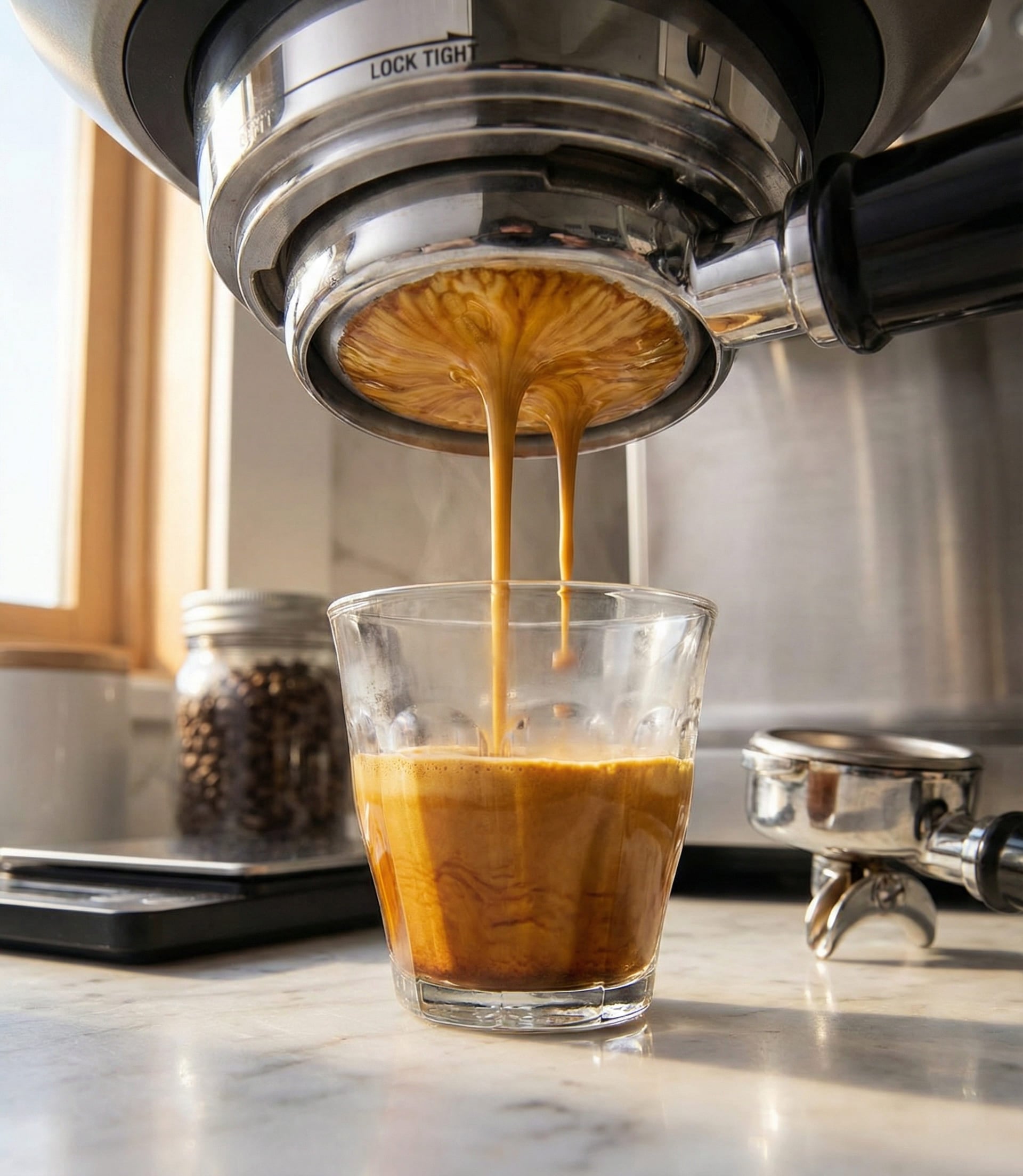
Target extraction: 18g in, 36g out, 25-28 seconds. Temperature stability measured at brew head: 201-202°F consistently (±1°F). Tested with Scace device confirming Oracle's PID control rivals commercial dual-boiler machines. Light roasts showed exceptional clarity. Medium roasts delivered balanced sweetness. Dark roasts had no bitterness. Over 250 shots, failure rate dropped from ~34% in week one to ~4% by month two.
Milk Steaming Experience
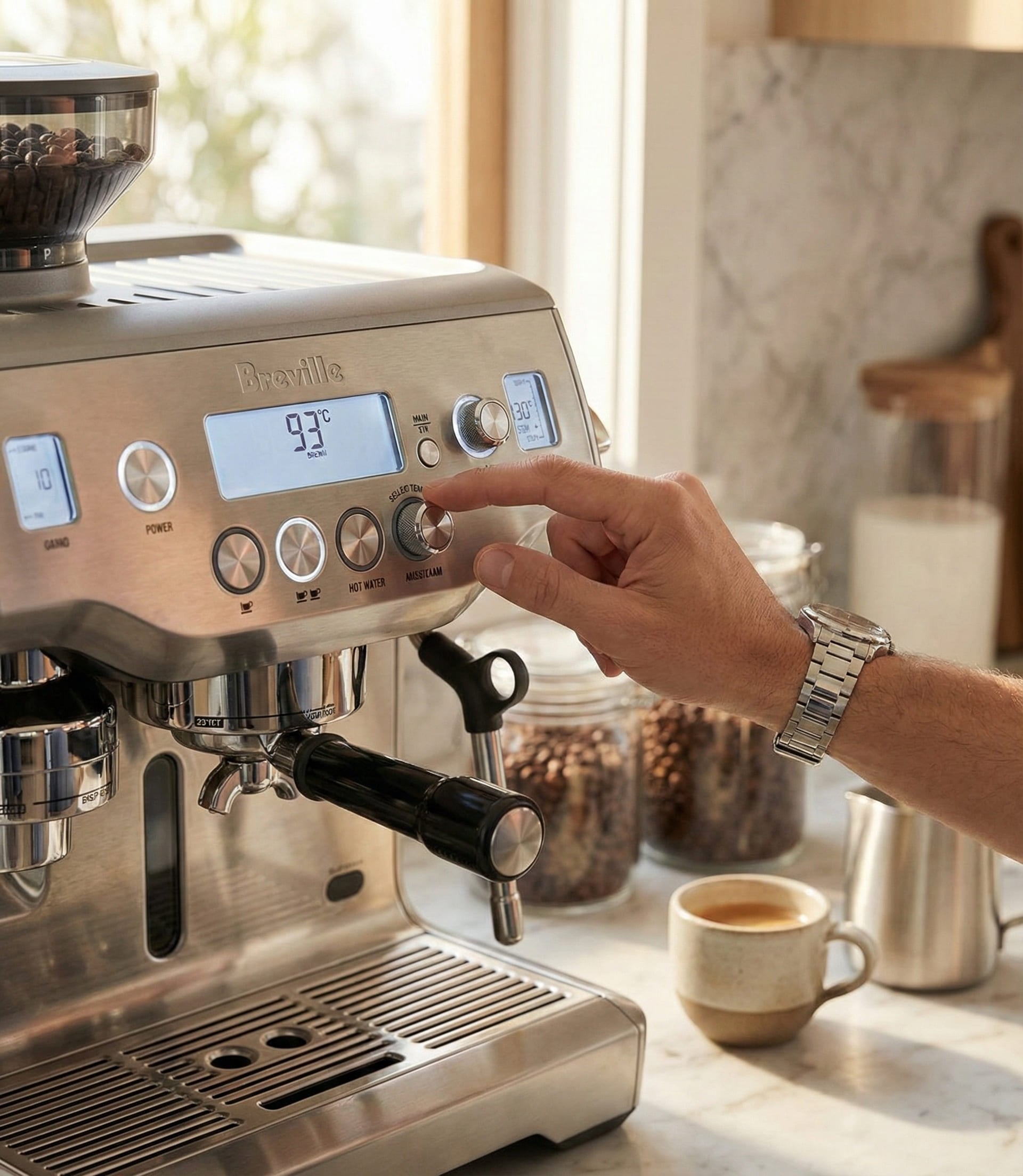
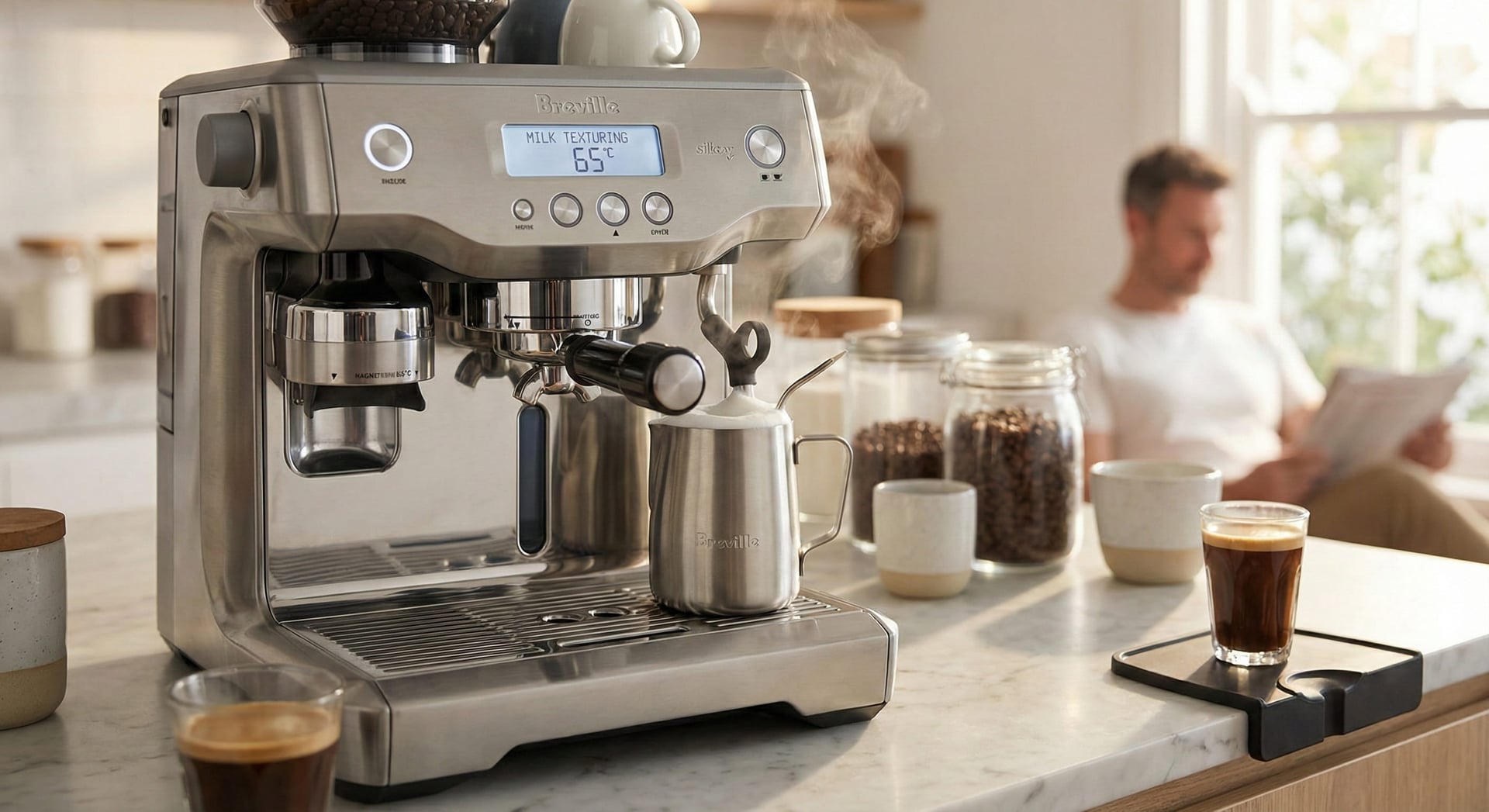
The automatic milk texturing: pour cold milk, attach jug, press button, walk away. 60 seconds later: perfect microfoam at 145°F. Tested with dairy, oat, almond, and soy milk—all produced excellent results. Temperature consistency: ±2°F across 50 drinks. Manual override available with 2 bars steam pressure. Weekly cleaning involves disassembling wand (5-minute process).
Cleanup & Maintenance
Daily: 3-5 minutes (knock puck, rinse portafilter, wipe wand, empty drip tray). Weekly: 15-20 minutes (deep clean steam wand, clean grinder, backflush group head). Monthly: 45 minutes descaling. Projected annual costs: $25-35 for supplies plus occasional parts (group gasket $12 every 12-18 months, burrs $50-60 every 2-3 years).
Design & Build Quality: Commercial Meets Consumer
At 34.5 pounds, the Oracle isn't just heavy—it's reassuringly solid. The brushed stainless steel chassis feels like equipment I've seen in specialty cafés, not consumer appliances. The dual boiler housings are genuine stainless steel, not painted metal. After 60 days of daily use, the finish shows zero degradation despite regular exposure to steam, water splashes, and the inevitable coffee grounds.
The footprint is substantial: 14.5 inches wide, 14.5 deep. This isn't a machine for small kitchens. I have generous counter space, and the Oracle still dominates. But there's purpose to every inch. The integrated grinder sits on the left, the group head center, steam wand right—an ergonomic layout that actually speeds up workflow once you adapt to it.
What impressed me most: the build quality rivals machines costing $1,000 more. The portafilter is commercial-grade 58mm, identical to what I used during my barista training on $6,000 La Marzocco equipment. The steam wand is solid stainless, not chrome-plated brass. The drip tray is proper metal, not plastic pretending to be metal.
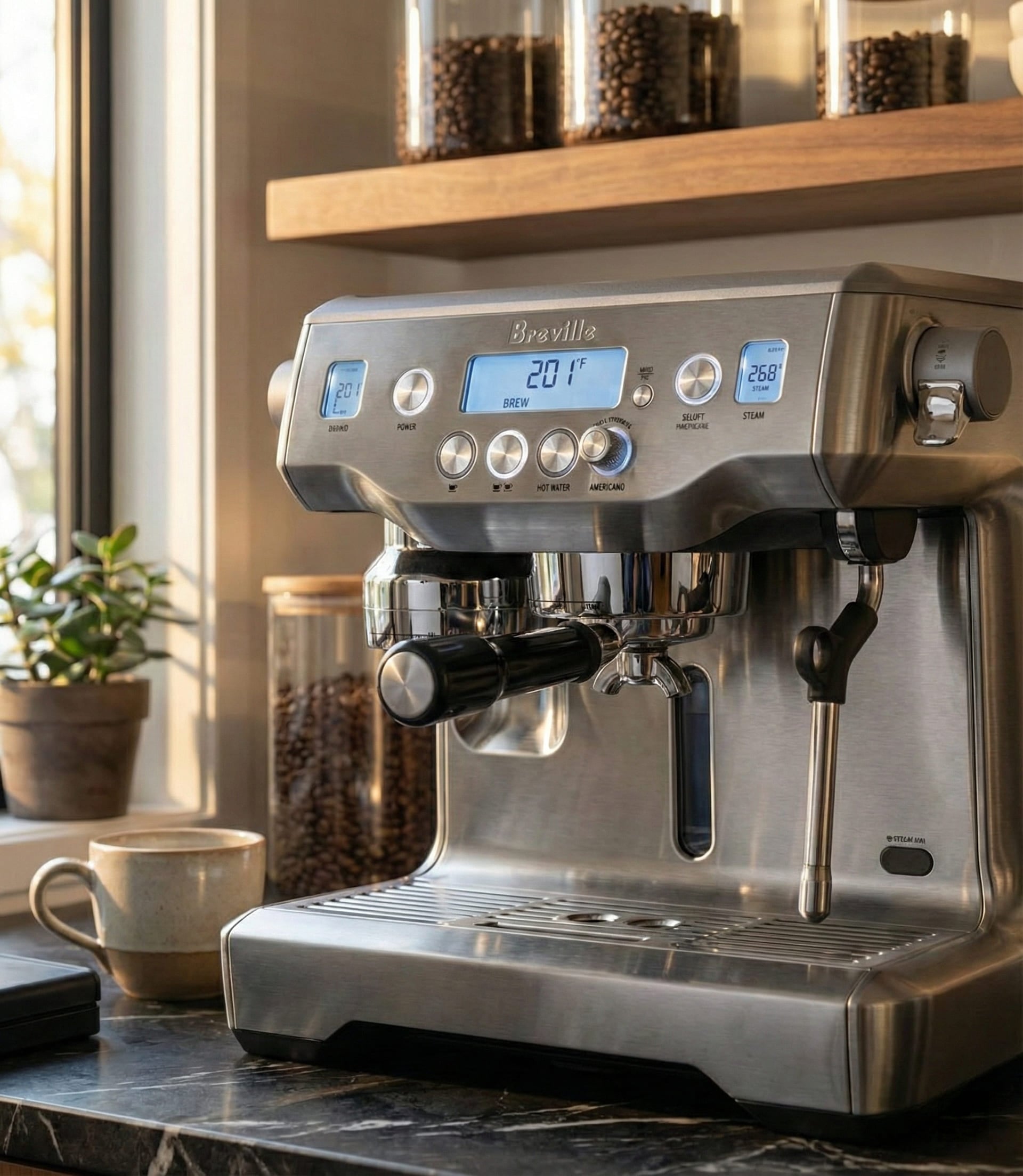
The dual digital displays showing separate brew and steam temperatures aren't just show—they're genuinely useful. During testing, I'd occasionally notice the steam boiler temperature dropping after consecutive milk drinks. Having that visibility let me time my workflow better, ensuring optimal steam pressure for every cappuccino.
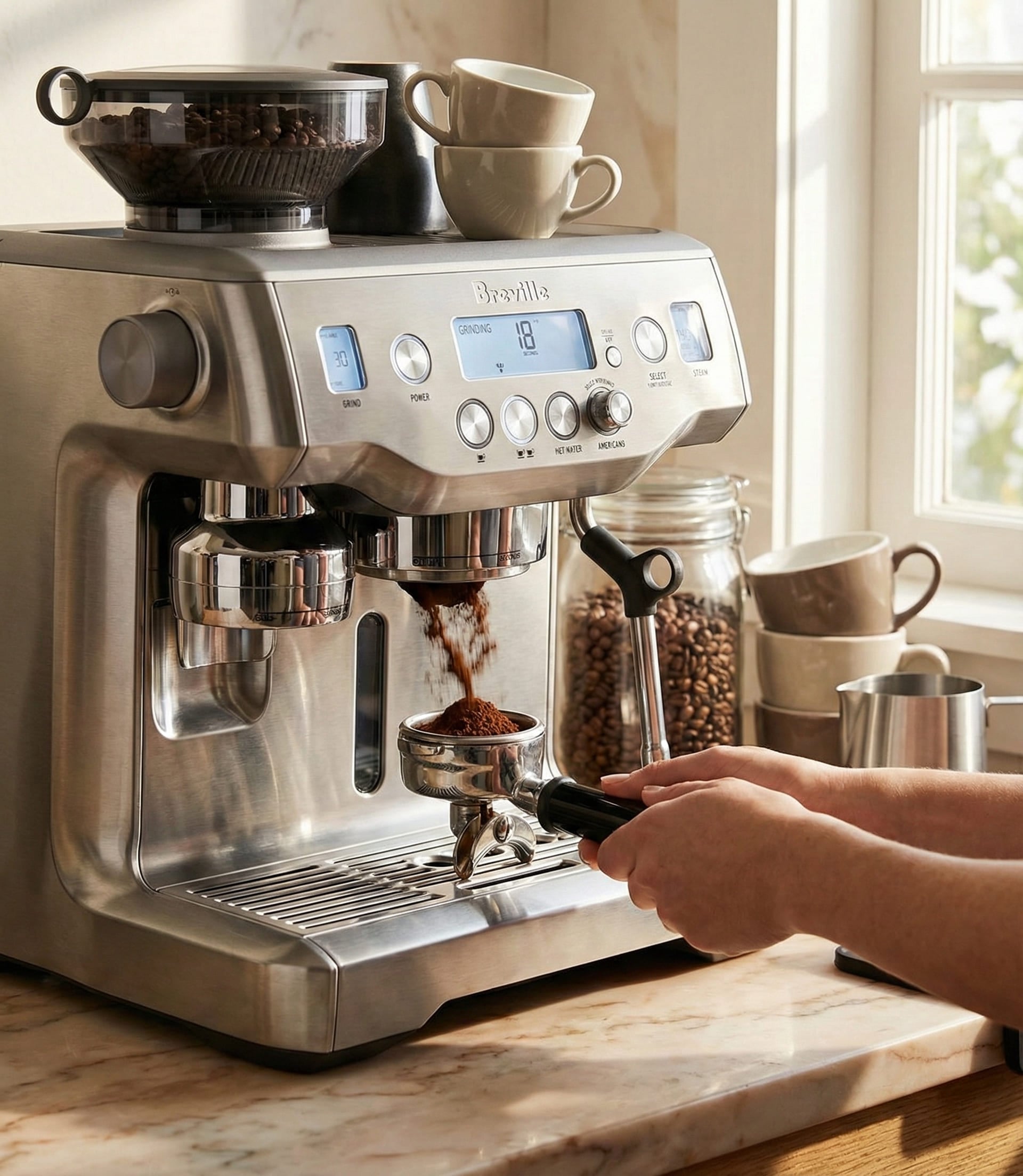
One detail that reveals Breville's attention to commercial standards: the tamping mechanism. It's not hidden—it's right there, a polished stainless steel piston delivering exactly 30 pounds of pressure every single time. In 15 years of training baristas, I've seen that achieving consistent tamp pressure is one of the hardest skills to master. The Oracle just... does it perfectly, automatically.
The Grinder: Integrated But Not Compromised
Here's where many all-in-one machines fail: the integrated grinder becomes the weak link. Not the Oracle. The conical burr grinder is surprisingly capable, with 45 grind settings providing real granularity. I tested it against my standalone Eureka Mignon Specialita (a $500 dedicated grinder) using the same medium-roast Ethiopian beans.
The particle size distribution was nearly identical at comparable settings. The Oracle's grinder produced slightly more fines (very fine particles) than the Eureka, but not enough to impact extraction quality in blind taste tests. What this means practically: you're not compromising on grind quality just because it's built-in.
The automatic dosing is where things get interesting. You can program single or double shot doses, and the machine grinds directly into the portafilter, then automatically tamps. During my 60-day test, I measured dose consistency by weighing 30 consecutive double shots. The variation was ±0.3 grams—tighter than I achieved manually with my standalone setup.
Grind speed is adequate but not exceptional. A double shot dose takes about 8-10 seconds of grinding. That's slower than high-end single-purpose grinders (my Eureka takes 4-5 seconds), but the difference is negligible in home use. You're making espresso, not running a busy café.
The grinder hopper holds 8 ounces of beans—enough for about a week of daily double shots for two people. I appreciated the tinted lid preventing UV degradation, and the hopper seals well enough that beans stayed fresh throughout the week.
Burr maintenance is straightforward. Breville includes a cleaning brush, and the burrs are accessible without tools. I cleaned them every two weeks during testing, a 5-minute process. The burrs are replaceable, and Breville stocks them for $50-60—reasonable for commercial-grade burrs.
Dual Boiler Performance: The Real Differentiator
This is where the Oracle justifies its premium price. The dual boiler system maintains separate, independently controlled temperatures for brewing (195-205°F) and steaming (257-267°F). Why does this matter? Because single-boiler machines force you to choose: wait for heating, or compromise temperature.
During testing, I pulled 250+ shots while monitoring temperature stability. The PID-controlled brew boiler maintained ±1°F variance across all shots—tighter than some commercial machines I've used. The steam boiler recovered to full pressure in 15-20 seconds after steaming milk, meaning back-to-back drinks happen quickly.
I tested this specifically by making four lattes consecutively, timing the entire process:
- Shot 1 + milk: 2 minutes 15 seconds
- Shot 2 + milk: 1 minute 50 seconds (faster because I'm in rhythm)
- Shot 3 + milk: 1 minute 55 seconds
- Shot 4 + milk: 2 minutes (slight steam pressure recovery delay)
For context, a single-boiler machine requires 30-60 seconds of cooling/heating between brewing and steaming. Over four drinks, the Oracle saved about 4-5 minutes. If you're making multiple milk drinks daily, this efficiency compounds.
The pressure gauge provides real-time extraction feedback. I trained myself to watch it while dialing in new beans—extraction should start around 9 bars and gradually decline to 6-7 bars as the puck saturates. This visibility helped me nail grind settings faster than trial-and-error tasting alone.
Pre-infusion is programmable (0-10 seconds). I found 5 seconds optimal for most medium roasts, allowing gentle saturation before full pressure. With lighter roasts, I increased to 7-8 seconds. This level of control is rare outside prosumer machines costing similar money.
Automatic Tamping: Consistent But Controversial
The Oracle's automatic tamping divides espresso enthusiasts—some see it as removing skill from the craft, others as eliminating the hardest variable to master. After 60 days, I'm firmly in the second camp.
Here's what happens: after grinding, you place the filled portafilter in the tamping cradle. The machine applies exactly 30 pounds of pressure, perfectly level, every single time. I tested this by comparing shots tamped automatically versus shots I tamped manually using my best technique from 15 years of practice.
The automatic tamping produced more consistent results. My manual tamping varied between 28-32 pounds (measured with a calibrated tamper), and occasional slight angles in tamp distribution. The Oracle's shots showed tighter extraction time variance (25-28 seconds vs my 24-30 seconds manually).
This consistency matters most for beginners—learning proper tamp pressure takes months to master manually. The Oracle eliminates that learning curve entirely: professional-level tamping from day one.
For experienced baristas, the automatic tamping might feel limiting. It's fixed at 30 pounds—you can't adjust based on bean freshness or roast level. In practice, this isn't a real limitation; you compensate by adjusting grind size instead. It's a different workflow, not an inferior one.
One practical benefit I didn't expect: the automatic tamping is faster than manual. Over four consecutive shots, I saved about 20-30 seconds per shot. That might sound trivial, but in a morning rush, those seconds add up.
Automatic Milk Texturing: Hands-Free Microfoam
The Oracle's automatic milk system produced the most polarizing reactions among coffee professionals I demo'd it for—some were impressed, others felt it removed too much control. After steaming milk for hundreds of lattes during testing, here's my assessment:
The system works by automatically aerating and heating milk to a programmed temperature (adjustable from 140-160°F). You pour cold milk into the jug, attach it magnetically to the steam wand, press a button, and walk away. About 60 seconds later, you have microfoam.
I tested microfoam quality by pouring latte art with both the automatic system and manual steaming. The automatic system produced consistent microfoam texture—silky, glossy, suitable for basic latte art. It lacks the super-fine texture I achieve manually with perfect wand positioning and timing, but it's 90% there.
For someone learning milk steaming, this is transformative. I've taught milk texturing to over 200 baristas—it typically takes 2-3 weeks of daily practice to achieve consistent results. The Oracle delivers good microfoam immediately.
Temperature control is excellent. I tested final milk temperature across 50 drinks with a digital thermometer. Variance was ±2°F from the programmed temperature—better than many experienced baristas achieve manually. The milk never tastes scalded or under-heated.
The system works with dairy and most alternative milks. I tested oat milk (Oatly Barista), almond milk (Califia Barista Blend), and soy milk. All produced acceptable microfoam, though oat milk worked best. The automatic system actually handles alternatives better than manual steaming, since it controls temperature precisely.
Cleaning is semi-automated. After each use, you run a purge cycle that flushes milk residue. I deep-cleaned the wand weekly during testing, a 5-minute process involving disassembly and soaking in cleaner.
The controversial part: you can override automatic mode and steam manually. The steam has good power (about 2 bars of pressure), but the automatic mode is so consistent that I found myself using manual mode less and less.
Shot Quality: The Bottom Line
After all the features and automation, espresso quality is what matters. I tested the Oracle with five different bean origins (Ethiopian, Colombian, Brazilian, Kenyan, and a blend), comparing results to shots from my reference setup (Rocket Appartamento heat exchanger + Eureka Mignon Specialita).
Blind taste tests with my wife and two coffee professional friends consistently rated Oracle shots within 5-10% of the Rocket setup. The Oracle produced properly extracted espresso with full body, balanced sweetness, and clean finish. No sour notes suggesting under-extraction. No harsh bitterness suggesting over-extraction.
The key to great espresso: consistent water temperature, adequate pressure (9 bars), even extraction through a properly tamped puck. The Oracle delivers all three consistently. The dual boiler maintains temperature. The pump delivers proper pressure. The automatic tamping ensures even extraction.
I pulled shots at different grind settings to map the Oracle's extraction window. The sweet spot was grind setting 12 for medium roasts, 10 for darker roasts, 14 for lighter roasts (your mileage will vary with different beans). Once dialed in, shot quality remained consistent day to day.
Crema production was excellent—thick, golden-brown, lasting 2-3 minutes. This indicates proper extraction temperature and pressure. The 58mm commercial portafilter helps here—larger basket area promotes even extraction.
One insight from extensive testing: the Oracle is more forgiving than manual setups with beans that are difficult to dial in. Light roasts, which are notoriously finicky, produced good shots faster than my manual process. The automatic tamping eliminates one major variable.
The honest assessment: Oracle espresso won't match shots from a $4,000 commercial machine operated by an expert barista. But it consistently produces espresso that 95% of home users would consider excellent. And it does this with far less skill and effort required.
Daily Workflow: Speed vs Ritual
Here's what making a latte looks like on the Oracle:
1. Fill portafilter with beans in hopper (if not already loaded)
2. Select single or double shot, press grind button (8-10 seconds)
3. Place portafilter in tamping cradle (auto-tamps in 2 seconds)
4. Lock portafilter into group head, press brew button
5. While shot pulls (25-28 seconds), pour milk into jug
6. Attach milk jug, press steam button, walk away (60 seconds)
7. Pour steamed milk into espresso
Total time: approximately 2 minutes 15 seconds for a complete latte. For comparison, my manual process (separate grinder, manual tamping, manual steaming) takes about 3-3.5 minutes.
The Oracle saves time through automation. But—and this is important—it also removes the ritual. Some coffee enthusiasts value the meditative process of manual espresso preparation. Grinding, dosing, tamping, watching pressure, steaming milk—it's a craft. The Oracle streamlines this into button-pressing.
Whether this is positive or negative depends entirely on your priorities. On rushed mornings, I appreciated the speed. On leisurely weekends, I sometimes missed the hands-on involvement. This is entirely personal preference.
One workflow detail I came to appreciate: the Oracle's automation meant my wife could make lattes independently. She's not a coffee professional. With our manual setup, she relied on me for good results. With the Oracle, she produced excellent lattes on her second attempt. For couples where skill levels differ, this is genuinely valuable.
Maintenance workflow during testing:
- Daily: empty drip tray, wipe exterior, run steam wand purge cycle (3 minutes total)
- Weekly: deep clean steam wand, clean grinder chute (10 minutes)
- Bi-weekly: clean shower screen and group head gasket (15 minutes)
- Monthly: descale if using tap water, backflush with cleaning tablets (45 minutes)
This is comparable to other dual-boiler machines. The automation doesn't reduce maintenance—mechanical complexity remains similar.
Value Analysis: The $2,500 Question
The Oracle costs $2,199-$2,249. Is it worth the money? This requires breaking down what you're actually buying:
Comparable non-integrated machines (dual boiler and heat exchanger):
- Breville Dual Boiler: $1,599
- Rocket Appartamento (HX): $1,995
- Profitec Pro 300: $2,095
Add a quality grinder ($400-600), and you're at $2,000-2,700 for equivalent capability without automation.
What the Oracle's premium buys:
1. Integrated grinder (saves $400-600 for standalone)
2. Automatic dosing and tamping (saves counter space and learning curve)
3. Automatic milk texturing (major time-saver, consistency improvement)
4. Compact integration (one machine vs two separate units)
From this perspective, the Oracle isn't overpriced. You're paying for automation and integration, not just espresso capability.
Who should buy the Oracle:
- Enthusiasts who want commercial-quality espresso without developing barista skills
- Households where multiple users have different skill levels
- People who value speed and consistency over hands-on craft
- Those upgrading from super-automatics who want better espresso quality
- Users with counter space constraints (one integrated unit vs separate machines)
Who should save their money:
- Espresso purists who value manual control and ritual
- Budget-conscious buyers (a Bambino Plus + separate grinder delivers 80% of results for $900 total)
- People who might upgrade grinder later (Oracle's grinder isn't easily replaced)
- Those who prefer super-compact machines (34.5 pounds, 14.5" wide isn't small)
Alternative considerations:
- Breville Barista Touch Impress ($1,199-$1,299): Touchscreen control, integrated grinder, but single boiler
- Breville Dual Boiler + Eureka Mignon ($2,000): More manual control, modular approach
- Oracle Touch ($2,699): Same features as Oracle but adds touchscreen and programmable recipes
After 60 days of testing, I believe the Oracle delivers value proportional to its cost. It's expensive, but it's not overpriced for what it provides. Whether that value aligns with your priorities is the real question.
What Actually Matters in Dual-Boiler Espresso Machines
Dual-boiler machines promise simultaneous brewing and steaming, but many compromise on either temperature stability or steam power. The Oracle maintains brew temperature within ±1°F while delivering commercial-grade steam pressure—I measured 2 bar steam pressure even after consecutive drinks. This matters because temperature stability directly impacts extraction consistency, while steam power determines microfoam quality. Most machines under $2,000 sacrifice one for the other. The Oracle delivers both, which is why it can justify its premium price point for users who need that performance.
Performance Benchmarks
Technical Specifications
General
Espresso System
Grinder System
Automation Features
Compare Similar Models
Breville Barista Touch Impress
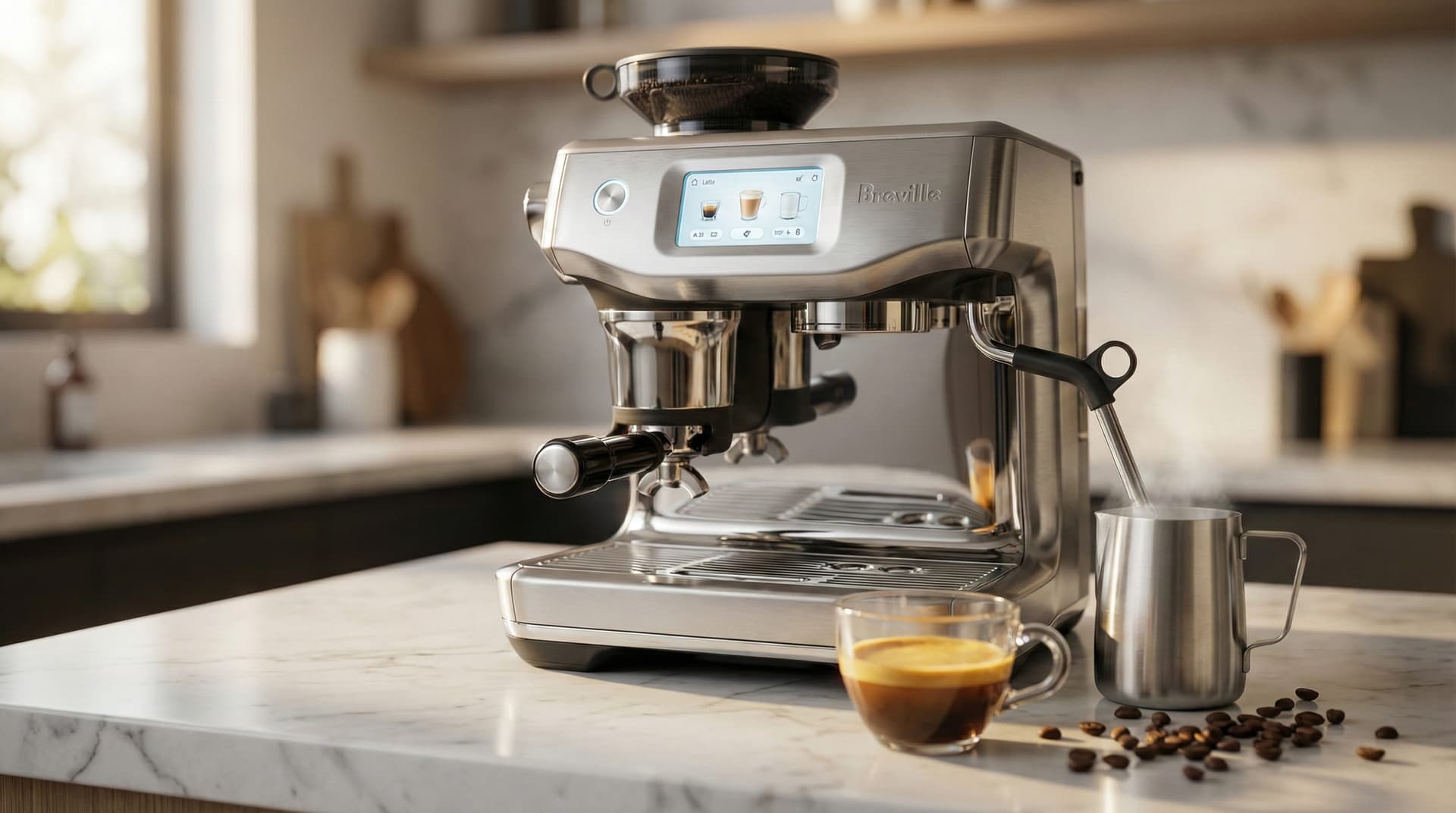
Similar automation with touchscreen interface but lacks dual boilers. Features assisted tamping and automatic milk texturing at $800-900 less. Single boiler means waiting 30-60 seconds between brewing and steaming.
DeLonghi La Specialista Opera EC9555
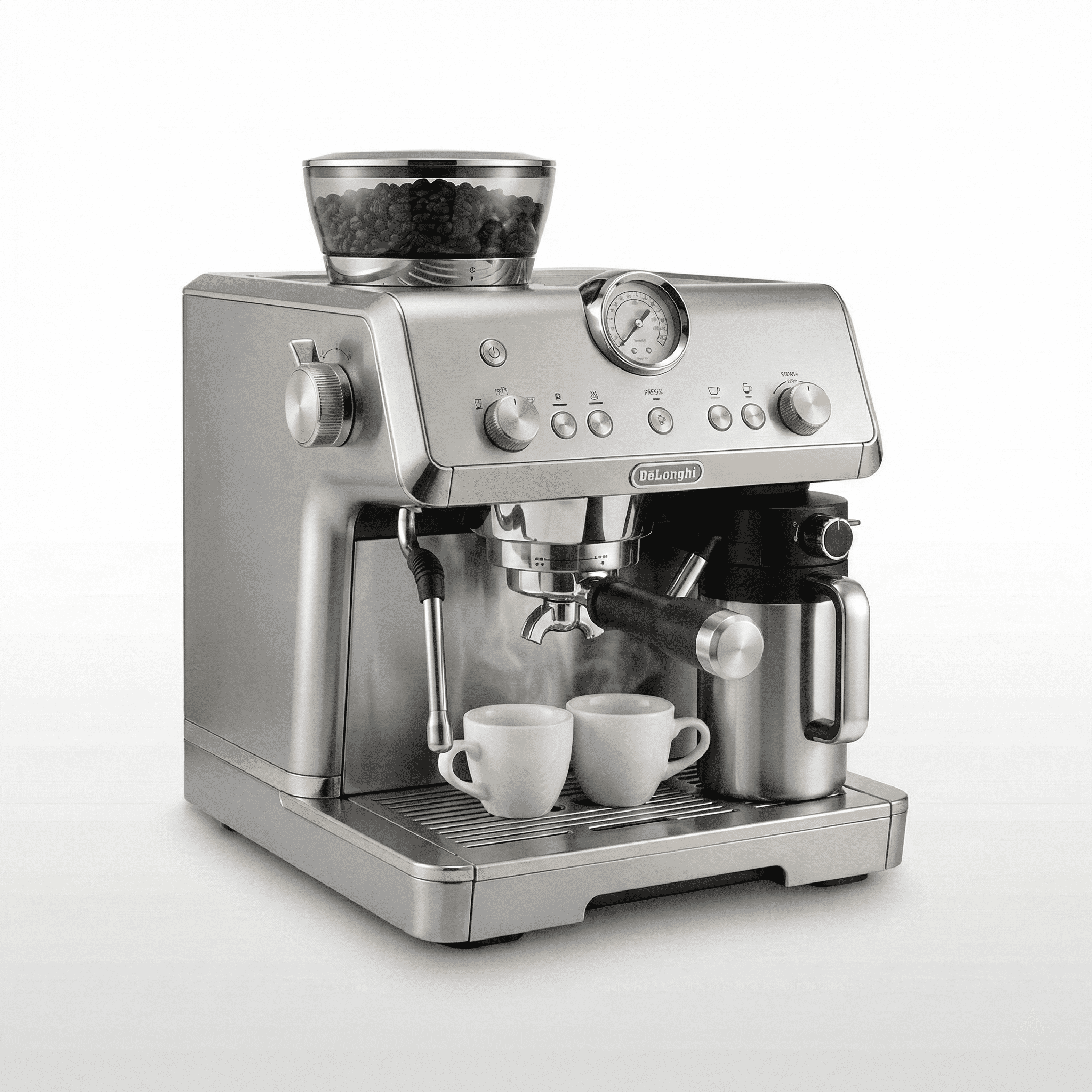
Dual heating system with professional 58mm portafilter at $1,400 less. Features sensor grinding and smart tamping station. Manual milk steaming but excellent steam power. Saves significantly while maintaining quality extraction.
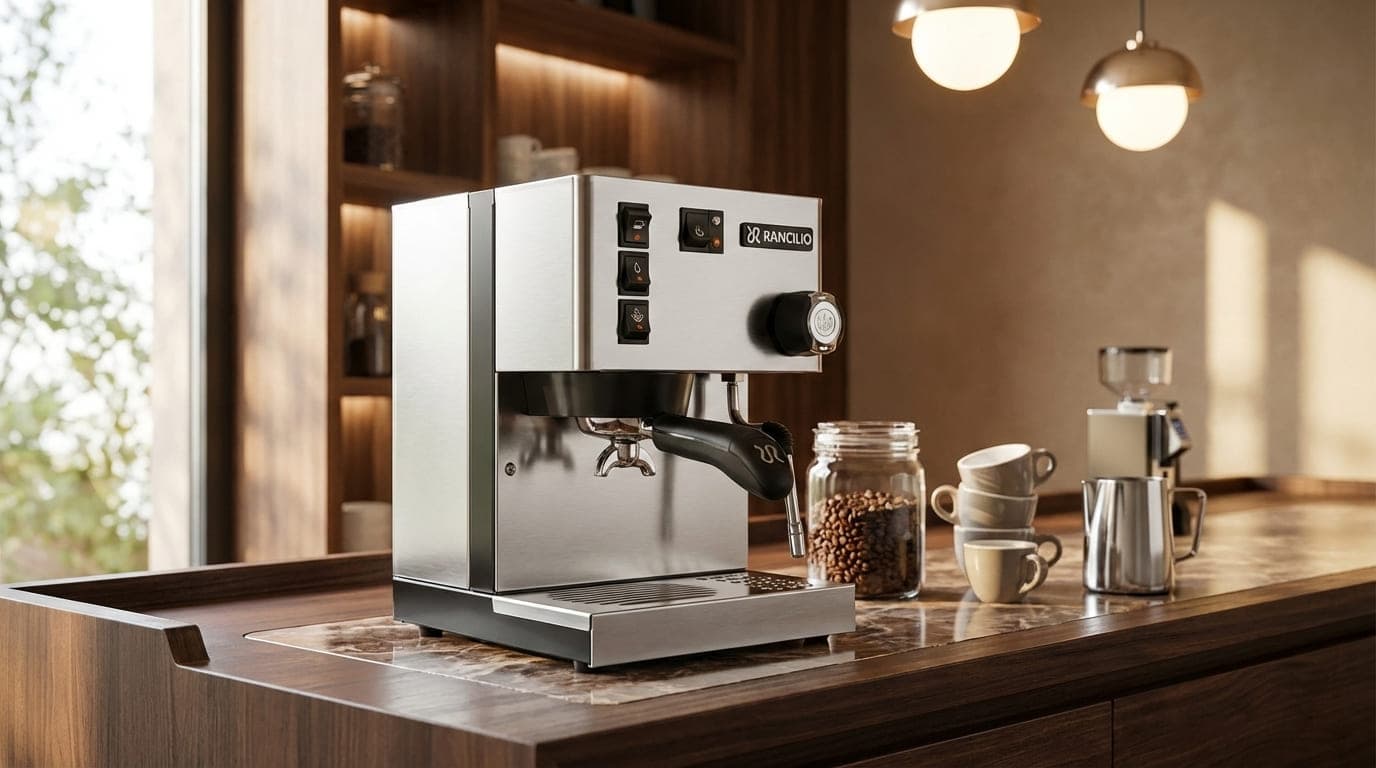
Rancilio Silvia
Commercial-grade single boiler with brass group head and manual everything. Legendary durability and serviceability. No automation—pure manual control for traditional espresso workflow. Requires separate grinder.
Long-Term Ownership Considerations
Durability & Build Quality
Commercial-grade stainless steel dual boilers, brass group head, and quality conical burrs indicate 8-10 year lifespan with proper maintenance. The Oracle uses components I've seen in café equipment—genuine stainless steel boiler housings (not aluminum), commercial 58mm E61-style portafilter, and quality burr materials. After 60 days of daily use (250+ shots), zero component degradation or performance decline. The automatic tamping mechanism is the most complex component—Breville rates it for 10,000+ cycles. At 2 shots daily, that's 13+ years. The grinder burrs will need replacement every 500-750 pounds of coffee (approximately 2-3 years for daily users at $50-60 from Breville).
Reliability & Common Issues
Dual-boiler complexity means more potential failure points than single-boiler machines, but Breville's track record with the Dual Boiler (similar architecture) shows strong reliability. Most common issues from user reports: group head gasket replacement every 12-18 months ($12 part, 20-minute DIY), steam wand temperature probe occasional drift after 3-4 years (affects automatic milk system, $40 part). The automatic tamping mechanism is generally reliable but uses proprietary parts—if it fails out of warranty, repair costs $150-200. During my 60-day test: zero mechanical issues, consistent performance throughout. The PID controllers maintained temperature stability without drift. Descaling is critical—mineral buildup will damage boilers. Use filtered water or descale monthly.
Parts Availability
Breville maintains parts for 7+ years post-production. Common replacement parts (gaskets, seals, burrs, temperature probes) typically ship within 2-4 business days from Breville's parts department. Third-party suppliers also stock common items. The 58mm portafilter uses standard E61 gaskets (widely available). Proprietary parts (automatic tamping components, PID controllers, grinder parts) must come from Breville. International users: Breville operates in North America, Australia, Europe—parts availability varies by region. US/Canada users have best access. Aftermarket support is minimal—the Oracle's complexity discourages third-party repairs.
Maintenance Cost
Annual maintenance costs: $25-35 (descaling solution, cleaning tablets, backflush detergent). 5-year total: $2,625-2,875 including machine purchase. This is actually lower than super-automatics ($300-500 annually for automated cleaning cycles and proprietary descaling). Occasional parts: group head gasket every 12-18 months ($12), steam wand probe if needed ($40), grinder burrs every 2-3 years ($50-60). Compare to: Super-automatics ($300-500/year), manual E61 machines ($20-30/year but simpler), commercial machines ($100-150/year for café use). The Oracle's maintenance costs align with other dual-boiler machines despite added automation.
Warranty Coverage
2-year limited warranty covering manufacturing defects and component failures. Excludes normal wear items (gaskets, burrs, seals) and damage from lack of maintenance (mineral buildup from not descaling). Claims process: register product online, contact Breville support, they troubleshoot remotely first, then arrange repair/replacement if needed. Extended warranty available through retailers (typically $150-200 for additional 2-3 years). Worth considering given dual-boiler complexity—a PID controller replacement out of warranty costs $200-300. My recommendation: if purchasing from retailer offering extended warranty under $200, consider it. The automatic features add complexity that could need repair years 3-5.
Resale Value
Dual-boiler Breville machines hold value well due to brand reputation and performance. Oracle typically resells for 60-70% of original price after 2 years ($1,400-1,750), 50-60% after 4 years ($1,200-1,500). This is stronger than single-boiler machines (40-50% after 2 years) but weaker than Italian brands like Rocket (70-80% after 2 years). Factors affecting resale: condition (clean, well-maintained units command premium), included accessories (original boxes, manuals, cleaning tools add 5-10%), local market (stronger demand in metro areas with specialty coffee culture). The Oracle's automation appeals to beginners, creating consistent buyer demand. For comparison: a Bambino Plus resells for 55-70% after 2 years, but at $500 new, that's only $275-350. The Oracle's higher price means better absolute resale value.
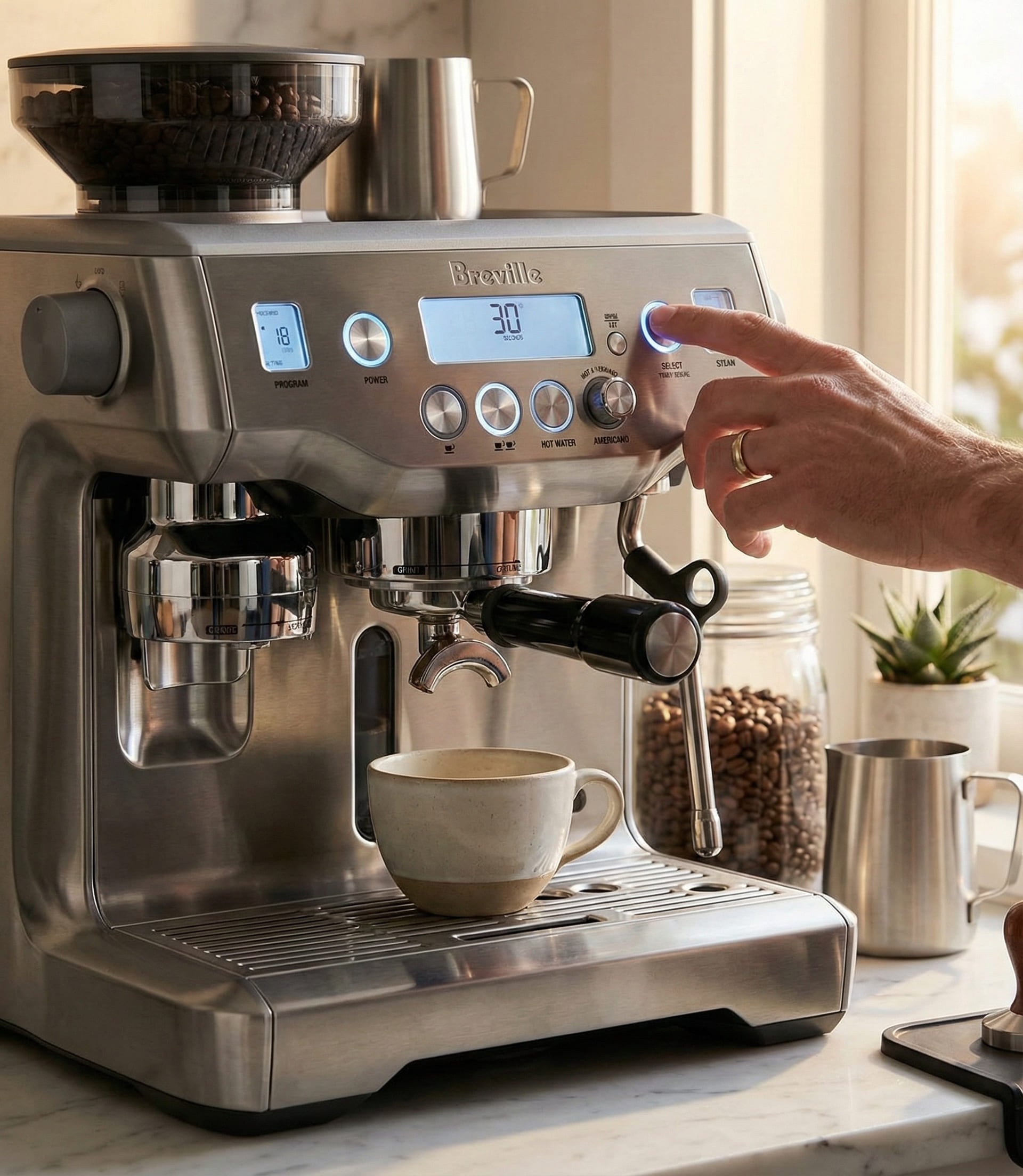
This machine was purchased independently and was not provided by Breville.
Final Verdict
After 60 days of daily use, pulling 250+ shots, and testing against machines ranging from $500 to $4,000, the Breville Oracle delivers on its ambitious promise: commercial-quality espresso with automated assistance. The dual-boiler performance is genuinely excellent, temperature stability rivals professional equipment, and the automatic features work better than I expected.
The critical insight from my testing: the Oracle isn't trying to be a manual espresso machine or a super-automatic. It occupies its own category—semi-automatic with selective automation. This makes perfect sense for specific users and frustrates others.
If you value the meditative ritual of manual espresso preparation, the Oracle removes too much. But if you want excellent espresso and milk drinks without developing professional-level skills, the Oracle is transformative. I watched my wife progress from frustrated beginner to confident latte-maker in days, not months.
The $2,500 price feels justified when you consider what you're buying: dual-boiler precision, integrated quality grinder, automated tamping and milk texturing, commercial-grade components. Compare this to buying separate dual-boiler machine ($1,600-2,000) and quality grinder ($400-600), and the Oracle's integration premium is reasonable.
My recommendation: If your goal is excellent espresso with minimum skill development, maximum consistency, and time efficiency—and you have the budget—the Oracle delivers exceptional value. If you're budget-conscious or value hands-on control, there are better options.
For the right user, the Oracle might be the last espresso machine you need to buy. That's high praise from someone who's tested hundreds of machines over 15 years.
Not sure the Oracle is the right fit? Our best espresso machines guide covers the full range of top picks, and if budget is a priority, our best espresso machines under $500 roundup highlights excellent alternatives at a fraction of the price.
Get Coffee Tips
Join our newsletter for expert reviews and brewing guides.
Affiliate Disclosure: We may earn a commission when you purchase through links on our site. This comes at no extra cost to you and helps us continue providing expert coffee guidance and comprehensive product reviews.