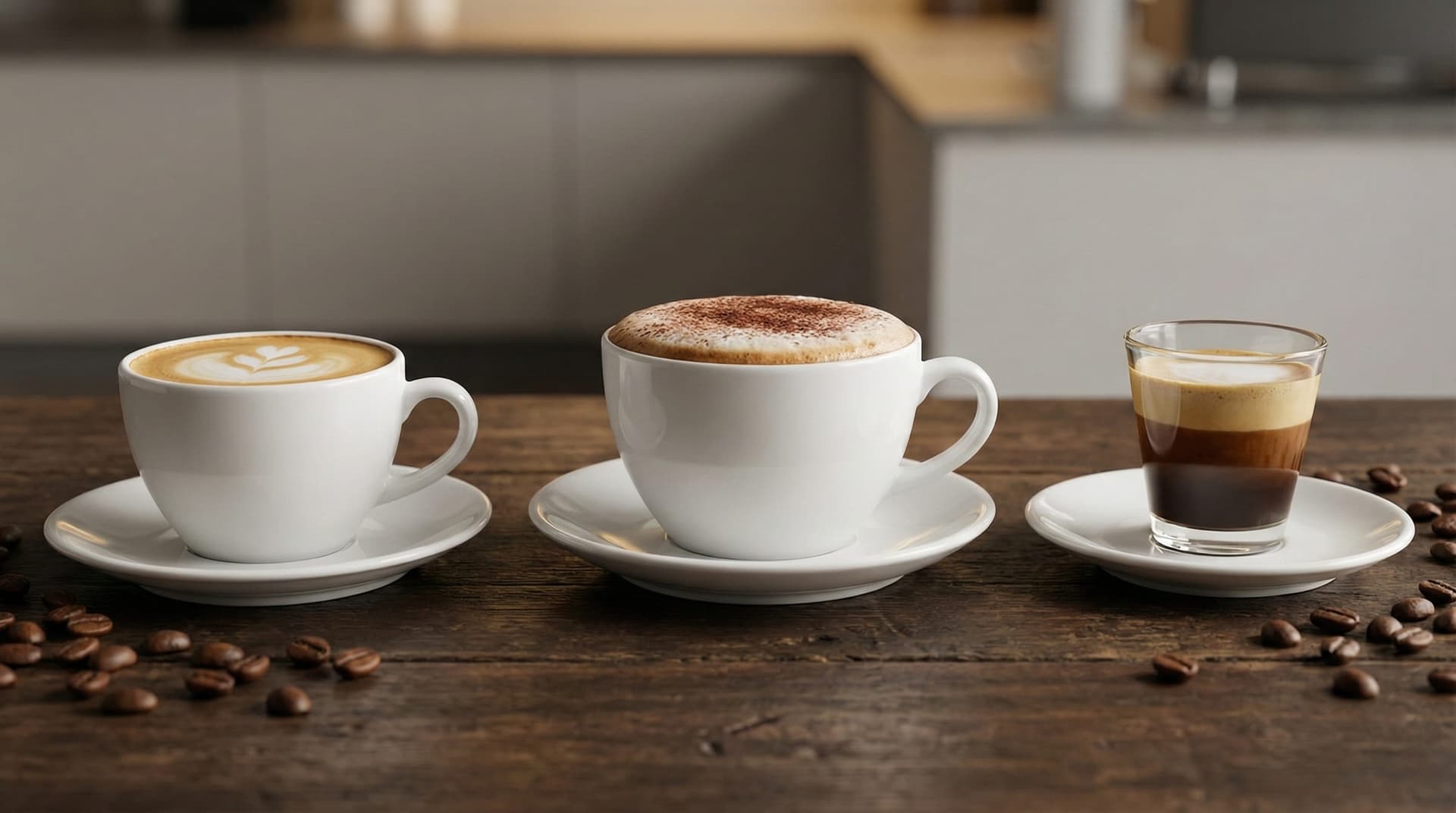
Flat White vs Cappuccino vs Cortado: Key Differences Explained
Expert breakdown of three espresso classics—ratios, foam, technique, and taste
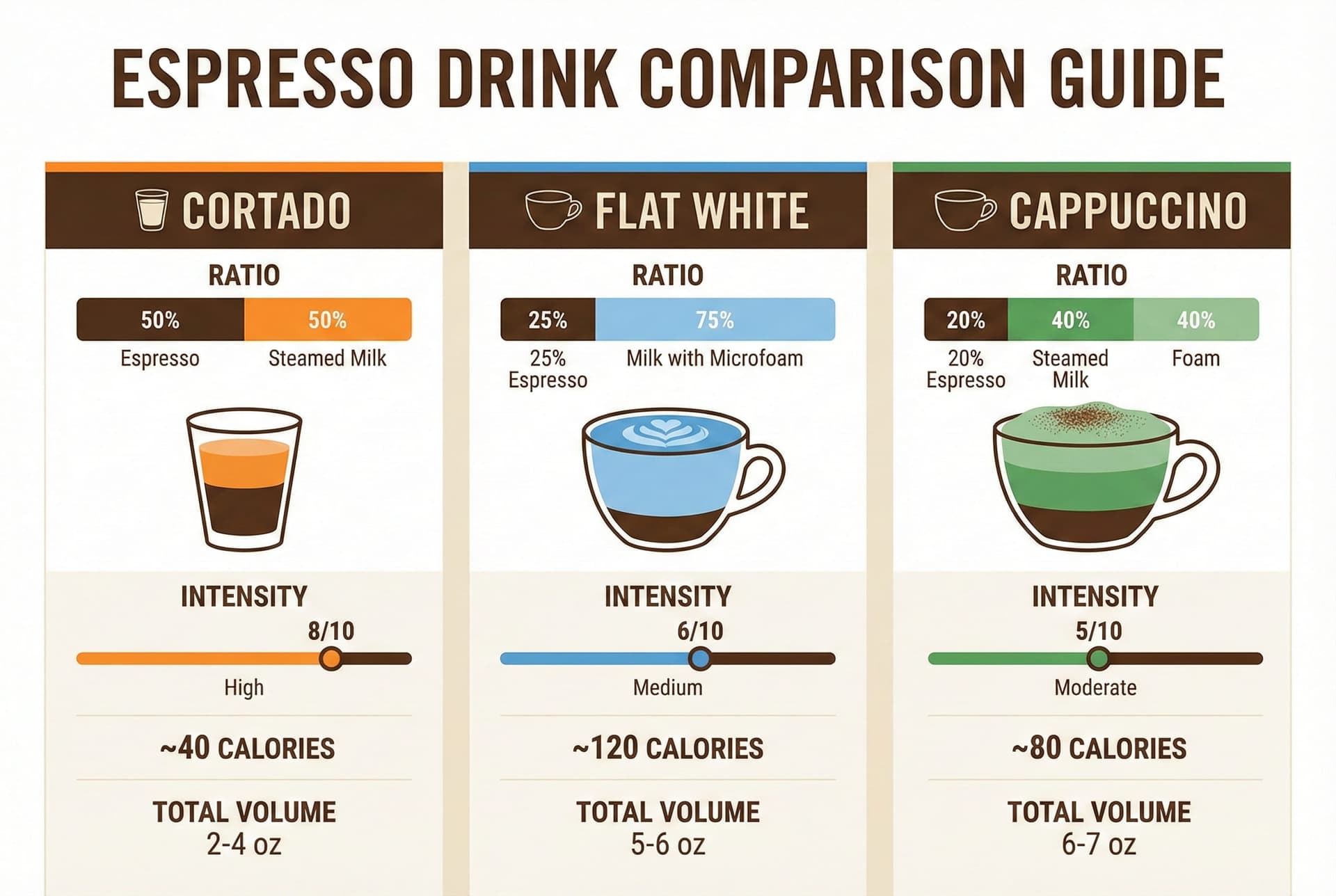
After fifteen years behind the espresso machine, questions about the difference between flat white and cappuccino—and how the cortado fits in—come up more than almost any other topic. The flat white vs cappuccino vs cortado comparison matters because each drink takes a fundamentally different approach to combining espresso with milk. Cortado vs cappuccino is the sharpest contrast: the cortado is a compact 1:1 espresso-milk balance, while cappuccino splits thirds equally between espresso, steamed milk, and foam. Which drink is stronger? The cortado leads on flavor intensity. Whether you're weighing flat white vs cappuccino calories, foam style, or serving size, these differences are real—rooted in ratio, technique, and tradition, not just marketing.
Flat White vs Cappuccino vs Cortado – Quick Summary
- Strongest flavor:Cortado
- Most milk-forward:Cappuccino
- Smoothest texture:Flat White
- Highest calories:Cappuccino
- Smallest size:Cortado
- Best for latte art:Flat White
Quick Comparison
| Drink | Size | Ratio | Foam | Intensity |
|---|---|---|---|---|
| Flat White | 6-7 oz | 30% espresso, 70% milk | Thin microfoam (0.25") | 6/10 |
| Cappuccino | 6 oz | 33% espresso, 33% milk, 33% foam | Thick foam cap (1"+) | 6/10 |
| Cortado | 4 oz | 50% espresso, 50% milk | Minimal foam | 7/10 |
Why Understanding These Drinks Matters
The confusion between flat white, cappuccino, and cortado isn't just coffee snobbery—it affects your daily coffee experience, your satisfaction, and whether you actually receive the drink you're craving. I've watched countless customers order a flat white expecting a cappuccino, or request a cortado hoping for something resembling a flat white.
These three drinks represent fundamentally different philosophies about combining espresso with milk. Understanding the distinctions helps you:
- Order confidently at any café worldwide
- Get exactly what you want rather than accepting whatever arrives
- Understand pricing differences ($4-6 range varies by complexity)
- Make better at-home preparation decisions about technique and equipment
- Appreciate specialty coffee culture and regional traditions
What Is a Flat White?
The flat white emerged from Australia and New Zealand in the 1980s, representing a reaction against the thick, dry foam of traditional cappuccinos that dominated cafés at the time. The drink was born from baristas seeking to create something with better integration between espresso and milk—silky microfoam throughout rather than a distinct foam cap sitting on top.
Both Australia and New Zealand claim to have invented the flat white, and the friendly rivalry continues. What's certain is that the drink represented innovative thinking about milk texture. Rather than accepting the cappuccino's three distinct layers (espresso, milk, foam), flat white pioneers asked: what if we integrated microfoam throughout the entire drink, creating uniform silky texture from first sip to last?
The flat white remained largely unknown outside Australia and New Zealand until the 2010s. When Starbucks added it to their menu in 2015, global awareness exploded—though their version often disappoints purists by using too much milk or wrong proportions, essentially serving small lattes. The authentic flat white experience requires proper microfoam technique and respect for the traditional 30/70 espresso-to-milk ratio. For a complete deep-dive into the flat white alone—recipe, microfoam technique, size breakdown, and step-by-step tasting notes—see our dedicated What Is a Flat White guide.
Flat White Composition
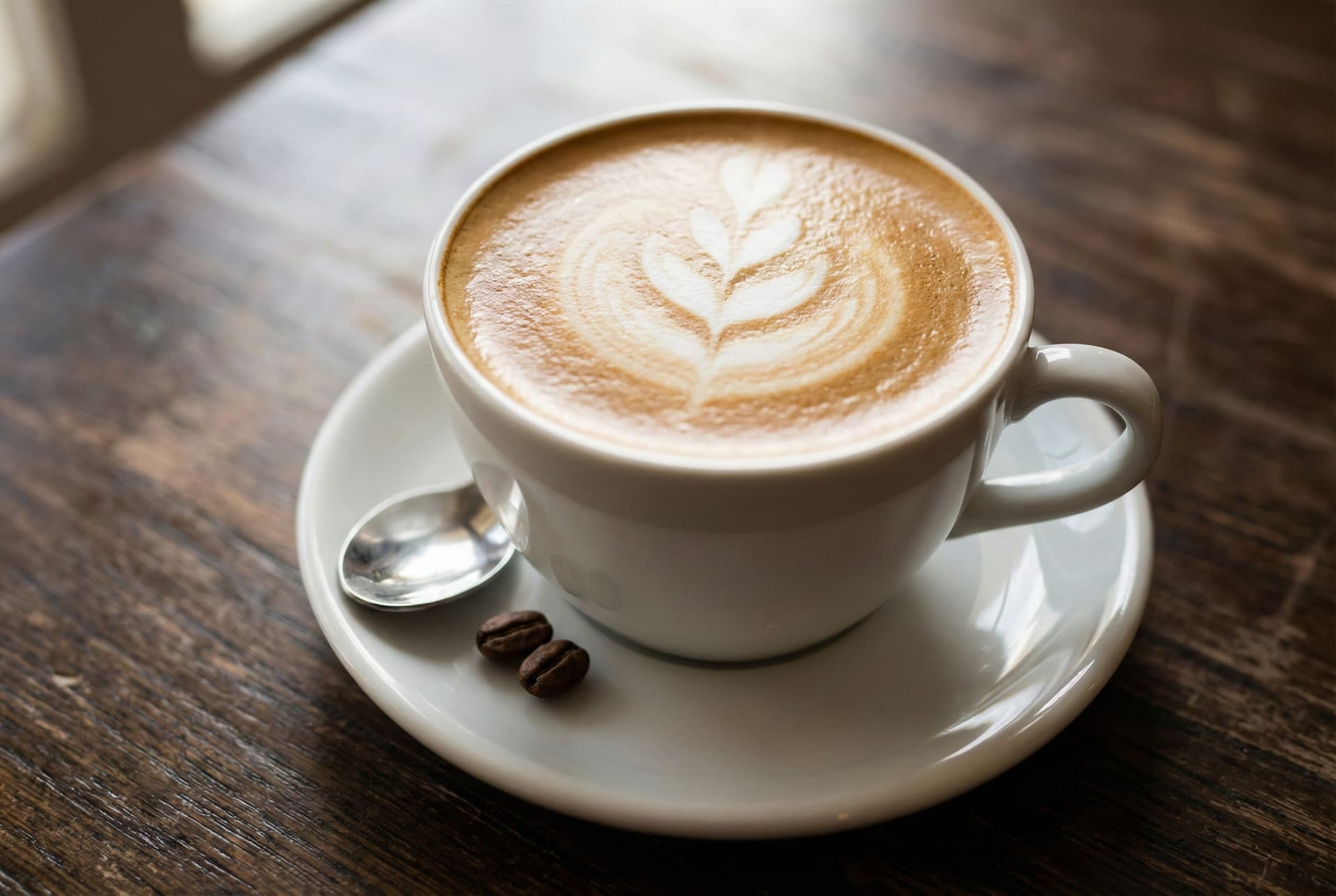
- 2 oz espresso (double shot, traditionally ristretto for sweetness)
- 4-5 oz steamed milk with velvety microfoam integrated throughout
- 0.2-0.25 inch microfoam layer on top—just enough for latte art
- Total volume: 6-7 oz in ceramic tulip cup
- Ratio: 30% espresso, 70% milk (stronger than latte's 15-20%)
- Temperature: 145-155°F—cooler than cappuccino for silky texture
- Intensity: 6/10—coffee-forward but not aggressive
- Calories: 110-130 with whole milk
The Ristretto Advantage
Traditional flat whites use ristretto shots—“restricted” extractions stopping at 1.5-1.75 oz instead of full 2 oz. Ristretto shots are sweeter, less bitter, and more concentrated because you're extracting only the most soluble, pleasant compounds before bitter elements emerge. This sweetness complements the flat white's milk beautifully, creating balanced flavor without needing added sugar.
Many modern cafés use standard double shots for flat whites—still delicious, but traditional preparation favors ristretto for its enhanced sweetness and reduced acidity. If you're making flat whites at home, experiment with both: grind slightly finer and stop extraction earlier for ristretto, or use standard extraction for bolder flavor.
Microfoam: The Defining Feature
What makes flat white special is microfoam texture throughout the drink—not just on top. This requires specific steaming technique: minimal air incorporation (3-4 seconds of aeration versus cappuccino's 5-8 seconds), creating thousands of tiny bubbles that integrate seamlessly with liquid milk. The result feels like drinking liquid velvet—creamy without being heavy, textured without being foamy.
Properly made flat white microfoam should have “wet paint” consistency when you swirl the pitcher—glossy, flowing, completely integrated. No large bubbles visible. When you pour, the microfoam mixes with espresso crema to create the tan color and silky mouthfeel that defines the drink. The thin layer on top (0.2-0.25 inches) exists primarily for latte art—contrast this with cappuccino's 1+ inch foam dome.
Taste Profile: Sip by Sip
First sip (immediate): Silky texture hits first—the microfoam coats your palate immediately. Coffee flavor is strong but not overwhelming, with milk's sweetness and fat content softening any harsh edges. You taste espresso's complexity (fruit notes, chocolate, caramel) without the intensity of straight espresso or cortado. Temperature is perfect for immediate drinking—no burning tongue.
Mid-drink (3-7 minutes): Consistency remains uniform throughout—no distinct phases like cappuccino. Each sip delivers the same balanced experience: strong coffee flavor, silky texture, subtle milk sweetness. The microfoam stays integrated rather than separating into layers. This consistency is why many coffee professionals prefer flat whites—predictable, balanced, showcasing quality espresso without hiding it in excessive milk.
Final sips (7-10 minutes): Coffee concentration increases slightly as you reach the bottom, but not dramatically—the drink maintains balance better than cappuccino. The silky texture persists to the last drop. Well-made flat white should taste as good at the end as it did at the beginning, just slightly cooler.
Finish (aftertaste): Clean espresso notes linger with gentle milk sweetness. The microfoam's fat content prevents bitter compounds from dominating your palate. Aftertaste should be pleasant and complex—you should detect the origin characteristics of quality beans. Lasts 3-5 minutes without turning harsh or sour.
Common Flat White Mistakes
- ✗Too much milk: Many cafés serve 8-12 oz “flat whites” that are actually small lattes. Authentic flat white is 6-7 oz maximum. If it comes in a large cup, you've been served incorrectly.
- ✗Cappuccino-style foam: Thick foam cap defeats the purpose. Flat white should have barely-there surface foam—the microfoam exists throughout, not on top.
- ✗Over-heating milk: Temperature above 160°F destroys microfoam's silky texture. Flat white requires cooler milk (145-155°F) than cappuccino to maintain velvet quality.
- ✗Large bubbles: Visible bubbles mean failed microfoam technique. Should look like wet paint—glossy, smooth, completely integrated.
- ✗Wrong cup: Flat white should come in 5-6 oz tulip-shaped ceramic cup. Glass cups or large mugs indicate the café doesn't understand the drink.
What Is a Cappuccino?
The cappuccino stands as perhaps the world's most iconic espresso drink, yet it remains among the most misunderstood and poorly executed. Named after Capuchin monks whose brown hooded robes resembled the drink's color when milk foam mixed with espresso, the cappuccino emerged in early 20th century Italy as the perfect breakfast coffee—rich enough to satisfy, textured enough to provide sensory interest, balanced enough to pair with morning pastries.
The genius of proper cappuccino lies in its three-part harmony: equal portions of espresso, steamed milk, and milk foam creating distinct yet integrated layers. This 1:1:1 ratio isn't arbitrary—it creates perfect balance where espresso provides intensity, liquid milk adds sweetness and body, and foam delivers luxurious texture. When executed properly, each sip delivers all three components in varying proportions, making the drinking experience dynamic rather than monotonous.
Unfortunately, most American coffee chains serve oversized, under-foamed versions bearing little resemblance to Italian cappuccinos. A traditional Italian cappuccino is 5-6 oz total; American versions often reach 12-20 oz—essentially large lattes with slightly more foam. This size inflation ruins the cappuccino's essential character: the precise espresso-to-milk-to-foam balance that makes it special.
Cappuccino Composition

- 2 oz espresso (double shot at 200-205°F) — foundation layer
- 2 oz steamed milk (at 150-160°F) — middle layer providing sweetness and body
- 2 oz milk foam (airy microfoam) — top layer creating signature domed texture
- Total volume: 6 oz in traditional Italian preparation (8-10 oz American adaptation)
- Ratio: 33% espresso, 33% milk, 33% foam (the sacred 1:1:1 balance)
- Final temperature: 150-160°F—warm and comforting without burning
- Cup style: Wide-mouth ceramic cup 6-8 oz capacity (allows foam dome)
- Intensity: 6/10—balanced between bold and gentle
- Calories: 80-120 (less than lattes despite similar size—foam is mostly air)
- Caffeine content: 128-150mg (standard double shot)
The Three-Layer Magic
What makes cappuccino unique is the intentional layering. Unlike flat white where microfoam integrates throughout, cappuccino maintains three distinct zones that reveal themselves sequentially:
- Top layer (foam): Light, airy, barely sweet. Releases trapped coffee aromatics as it melts on your tongue. Creates indulgent, dessert-like opening experience.
- Middle layer (liquid milk): Where cappuccino truly shines. Steamed milk has mixed with espresso, creating coffee-milk harmony. Temperature is perfect, sweetness balances bitterness.
- Bottom layer (espresso-concentrated): Final sips deliver boldest flavor as foam and most milk have been consumed. Espresso character intensifies, creating satisfying strong finish.
This sequential revelation is intentional—cappuccino takes you on a journey from gentle introduction to bold conclusion. It's coffee as theater, not just beverage.
Foam Technique: The Defining Challenge
Creating proper cappuccino foam requires more aggressive aeration than flat white but better technique than beginners typically use. The goal: substantial foam volume (roughly 50% increase from original milk volume) while maintaining microfoam texture—not bath-style large bubbles.
Start with cold milk (38-45°F) in cold pitcher. Position steam wand just below surface, tip slightly off-center. Turn on steam and introduce air for 5-8 seconds—you'll hear distinct hissing/tearing sound as air incorporates. As milk expands and temperature rises, gradually lower pitcher to submerge wand deeper, creating rolling vortex that breaks up large bubbles while continuing to incorporate tiny ones.
Stop steaming when pitcher feels too hot to touch comfortably (150-155°F). Tap pitcher firmly on counter 2-3 times to collapse any large bubbles, then swirl vigorously to integrate foam with liquid milk. Pour technique matters: start with slow pour to introduce liquid milk, then raise pitcher slightly to pour foam on top, creating that characteristic white dome rising above cup rim.
The Italian Breakfast Rule
In Italy, cappuccinos are strictly morning drinks—consumed only before 11:00 AM, typically with a breakfast pastry. Ordering cappuccino after lunch immediately marks you as a tourist. This rule exists because Italians consider milk-heavy drinks too filling for post-meal consumption, when digestion requires lighter options like macchiato or espresso.
While Americans needn't follow this rule religiously, understanding it provides valuable cultural context. The cappuccino's size and richness genuinely do make it better suited to morning consumption when you need substantial sustenance rather than just a coffee hit. Many people find milk-heavy drinks uncomfortable after full meals—the Italian tradition reflects practical wisdom, not arbitrary snobbery. For a dedicated deep-dive covering ratio, foam technique, dry vs wet styles, and first-hand tasting notes, see our complete cappuccino guide.
Taste Experience: The Three-Phase Journey
First sips (0-3 minutes): Initial contact delivers primarily foam—light, airy, barely sweet. The foam's delicate texture melts on your tongue instantly, releasing trapped coffee aromatics and creating surprising flavor intensity from something so ethereal. You're tasting mostly air infused with milk and coffee essence. This phase feels almost dessert-like: indulgent, luxurious, sensory-rich. The foam's temperature is perfect—warm enough to be comforting, not hot enough to scald or obscure flavors.
Middle sips (3-7 minutes): As you penetrate the foam layer, you reach steamed milk mixed with espresso—this is where cappuccino truly shines. Each sip now delivers varying proportions: sometimes more foam, sometimes more liquid, creating that dynamic experience impossible with flat white or cortado. The coffee flavor intensifies as you reach espresso concentrated at bottom. Milk's natural sweetness balances espresso's acidity and potential bitterness. Temperature remains pleasant—the thick foam layer acts as insulation, keeping drink warmer longer than you'd expect.
Final sips (7-12 minutes): The last portion is decidedly espresso-heavy—you've consumed most foam and milk, leaving concentrated coffee at bottom. These final sips deliver the boldest flavor, creating satisfying finish that reminds you this is serious coffee, not just milky beverage. Well-made cappuccino saves best for last: intense espresso tempered by residual milk coating on cup sides. The temperature has dropped to perfect drinking level—cool enough to detect subtle flavor notes like fruit, chocolate, or caramel that high heat can mask.
Finish (aftertaste): Clean, balanced aftertaste with mild milk sweetness and pronounced roasted coffee notes. The foam's fat content leaves pleasant coating that prevents bitter compounds from dominating. Aftertaste should linger pleasantly for 5-7 minutes without becoming harsh or sour—if it turns bitter quickly, either espresso was over-extracted or milk was over-heated.
Common Cappuccino Mistakes
- ✗Oversizing: 12-20 oz “cappuccinos” at chains are actually lattes. Authentic cappuccino is 5-8 oz maximum. Large size destroys the essential 1:1:1 ratio.
- ✗Under-foaming: Too little foam creates latte, not cappuccino. You need visible substantial dome of foam rising above cup rim—this is non-negotiable.
- ✗Large bubbles: Foam should still be microfoam (thousands of tiny bubbles), not bath-style foam (large visible bubbles). Poor technique creates unpleasant texture.
- ✗Over-heating milk: Temperature past 165°F destroys milk's natural sweetness, creates scalded taste, and makes foam less stable. Aim for 150-155°F.
- ✗Wrong cup: Tall narrow cups prevent proper foam dome and hide the beautiful layering. Cappuccino requires wide-mouth cup to showcase its structure.
- ✗Full integration: Foam should sit on top creating visible layers, not completely integrate. Complete integration makes it a flat white, not cappuccino.
What Is a Cortado?
The cortado comes from Spain, where “cortar” means “to cut.” It's espresso “cut” with an equal amount of warm milk—the perfect 1:1 ratio that creates complete balance between coffee intensity and milk smoothness. No other espresso drink achieves this mathematical precision of equilibrium.
Born in Madrid and Barcelona cafés in the 1960s, the cortado emerged as the practical solution for coffee lovers who found espresso too intense but lattes too weak. Spanish café culture values efficiency and precision—the cortado embodies both. It's small enough to drink quickly (4-5 minutes), strong enough to deliver serious coffee flavor, smooth enough to avoid harsh bitterness, yet maintains espresso's essential character better than any milk-heavy drink.
The cortado spread throughout Latin America where it's known by various names: “cortadito” in Cuba (often with sweetened condensed milk), “café cortado” in Argentina, or simply “cortado” across Spain and Mexico. In recent years, specialty coffee culture has embraced the cortado worldwide, valuing its ability to showcase quality espresso while remaining approachable. For a dedicated deep-dive covering ratio, glassware, step-by-step recipe, and first-hand tasting notes, see our What Is a Cortado guide.
Cortado Composition
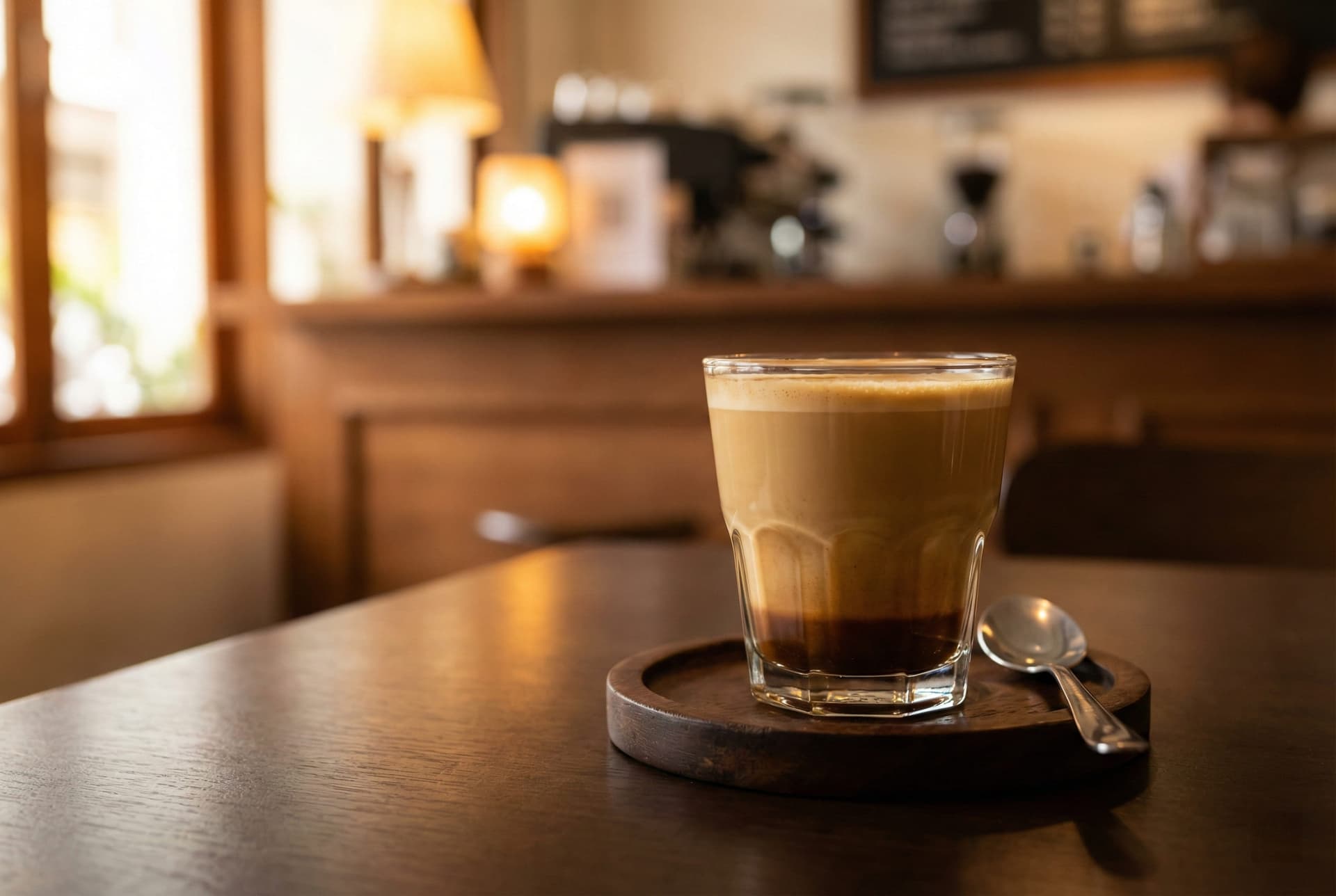
- 2 oz espresso (double shot at 200-205°F) — provides bold coffee base
- 2 oz steamed milk (at 145-150°F) — cuts acidity without overwhelming
- Minimal foam: Just 0.1-0.15 inches—barely present surface layer
- Total volume: 4 oz served in Gibraltar glass or small ceramic cup
- Ratio: Perfect 50% espresso, 50% milk (1:1—the defining characteristic)
- Final temperature: 155-165°F—immediately drinkable, no wait time
- Intensity: 7/10—decidedly coffee-forward while remaining smooth
- Calories: 35-40 with whole milk (minimal caloric impact)
- Caffeine content: 128-150mg (full double shot, same as all these drinks)
The Perfect 1:1 Balance
What makes cortado special isn't complexity—it's simplicity perfected. The 1:1 ratio creates unique equilibrium where neither component dominates. You taste espresso clearly—its origin characteristics, roast profile, extraction quality—but milk's fat and protein soften harsh edges without diluting flavor. It's like adjusting audio equalizer to perfect levels: not too much bass (bitterness), not too much treble (acidity), just balanced richness.
This balance makes cortado ideal for evaluating espresso quality. Poor extraction, stale beans, or incorrect technique show immediately—there's not enough milk to hide flaws. Conversely, exceptional beans shine in cortado preparation. Single-origin Ethiopian coffees with delicate fruit notes, Guatemalan beans with chocolate complexity, Brazilian coffees with nutty sweetness—all reveal their character beautifully in cortado's minimal-milk environment.
Minimal Foam Philosophy
Unlike flat white's integrated microfoam or cappuccino's thick foam cap, cortado requires minimal foam—just enough surface layer to create visual contrast but not enough to affect taste or texture significantly. When steaming milk for cortado, aerate for only 2-3 seconds (versus flat white's 3-4 seconds or cappuccino's 5-8 seconds).
The goal is liquid steamed milk, not foamed milk. You want enough tiny bubbles to create glossy finish but not enough to build foam volume. Many baristas describe perfect cortado milk as “barely touched”—the wand introduces minimum air while heating milk to proper temperature. This technique creates the smooth, liquid texture that defines cortado's mouthfeel.
The Gibraltar Glass Tradition
In the United States, cortado is often served in a Gibraltar glass—a 4.5 oz rocks-style glass that became synonymous with the drink through San Francisco specialty coffee culture in the 2000s. The glass itself is a Libbey Gibraltar tumbler (hence the name), chosen because its 4.5 oz capacity perfectly holds a double cortado.
The glass offers practical advantages: clear sides let you see the beautiful gradient where espresso meets milk, thick walls retain heat well, wide mouth allows for easy drinking, and compact size fits the drink's minimal volume. Many American specialty cafés simply list “Gibraltar” on their menu rather than “cortado”—they're the same drink, just named after the serving vessel.
Taste Experience: Pure Balance
First sip (immediate): Bold espresso hits first—you immediately taste coffee's full character. But instead of espresso's sharp intensity or potential bitterness, milk's smoothness follows within milliseconds, creating balanced integration. You detect espresso's complexity (fruit notes, chocolate, caramel, nuttiness depending on origin) without overwhelming intensity. Temperature is perfect—hot enough to release aromatics, cool enough to drink immediately without burning your tongue.
Mid-drink (2-4 minutes): Consistency remains remarkably uniform throughout. Unlike cappuccino's evolving phases, cortado delivers the same balanced experience from first to last sip. This consistency is intentional—the 1:1 ratio and minimal foam prevent layer separation. Each sip reinforces the drink's essential character: strong coffee flavor, smooth delivery, clean finish. As it cools slightly, you may detect subtle flavor notes that high heat initially masked—stone fruit in Ethiopian beans, cocoa in Brazilian, bright citrus in Kenyan.
Final sips (4-6 minutes): Even at the bottom, cortado maintains its balance. Because of the precise 1:1 ratio, you don't get cappuccino's espresso-heavy finish or latte's milk-heavy persistence. The last sip tastes remarkably similar to the first—just cooler. This consistency makes cortado perfect for those who want predictability: you know exactly what you're getting from start to finish.
Finish (aftertaste): Clean espresso finish with subtle milk sweetness. Because there's less milk than latte or flat white, espresso's aftertaste is more prominent—but not harsh. The milk's fat content has coated your palate just enough to prevent bitter compounds from dominating. Aftertaste should reveal the espresso's quality clearly: pleasant complexity that lingers 3-5 minutes without turning sour or bitter.
Cortado Variations Worth Knowing
- Cortadito (Cuban-style): Cortado made with sweetened condensed milk or sugar added to espresso before milk. Popular in Miami and Cuban communities. Much sweeter than traditional Spanish cortado but maintains 1:1 ratio concept.
- Cortado Condensada: Uses evaporated milk or condensed milk instead of steamed milk. Creates different texture and pronounced sweetness. Common in Spain and Portugal.
- Bombon: Technically different drink but related—espresso layered on top of sweetened condensed milk in clear glass. Visual appeal and sweet profile make it dessert-like.
- Gibraltar: American name for cortado served in Gibraltar glass. Functionally identical to Spanish cortado, just named after the glassware.
Common Cortado Mistakes
- ✗Wrong ratio: Some cafés serve 2 oz espresso with 3-4 oz milk, calling it cortado. Not accurate—authentic cortado is strict 1:1 ratio. More milk makes it a piccolo or small flat white.
- ✗Too much foam: Cortado should be liquid steamed milk, not foamy. Visible thick foam layer means wrong technique—defeats the drink's purpose.
- ✗Over-heating milk: Temperature above 155°F creates too much foam and scalded taste. Cortado requires gentler heating—145-150°F produces best results.
- ✗Poor espresso: Cortado's minimal milk means quality matters enormously. Stale beans, bad extraction, or dirty equipment show immediately. Always use fresh beans (roasted within 2-4 weeks).
- ✗Wrong vessel: Served in large cup, cortado looks tiny and sad. Proper 4-5 oz Gibraltar glass or small ceramic cup presents the drink appropriately for its size.
Key Differences Explained
Understanding the distinctions between these three drinks goes beyond memorizing ratios—it's about recognizing different philosophies for combining espresso with milk. Each drink achieves a specific goal through deliberate technique.
Size and Volume
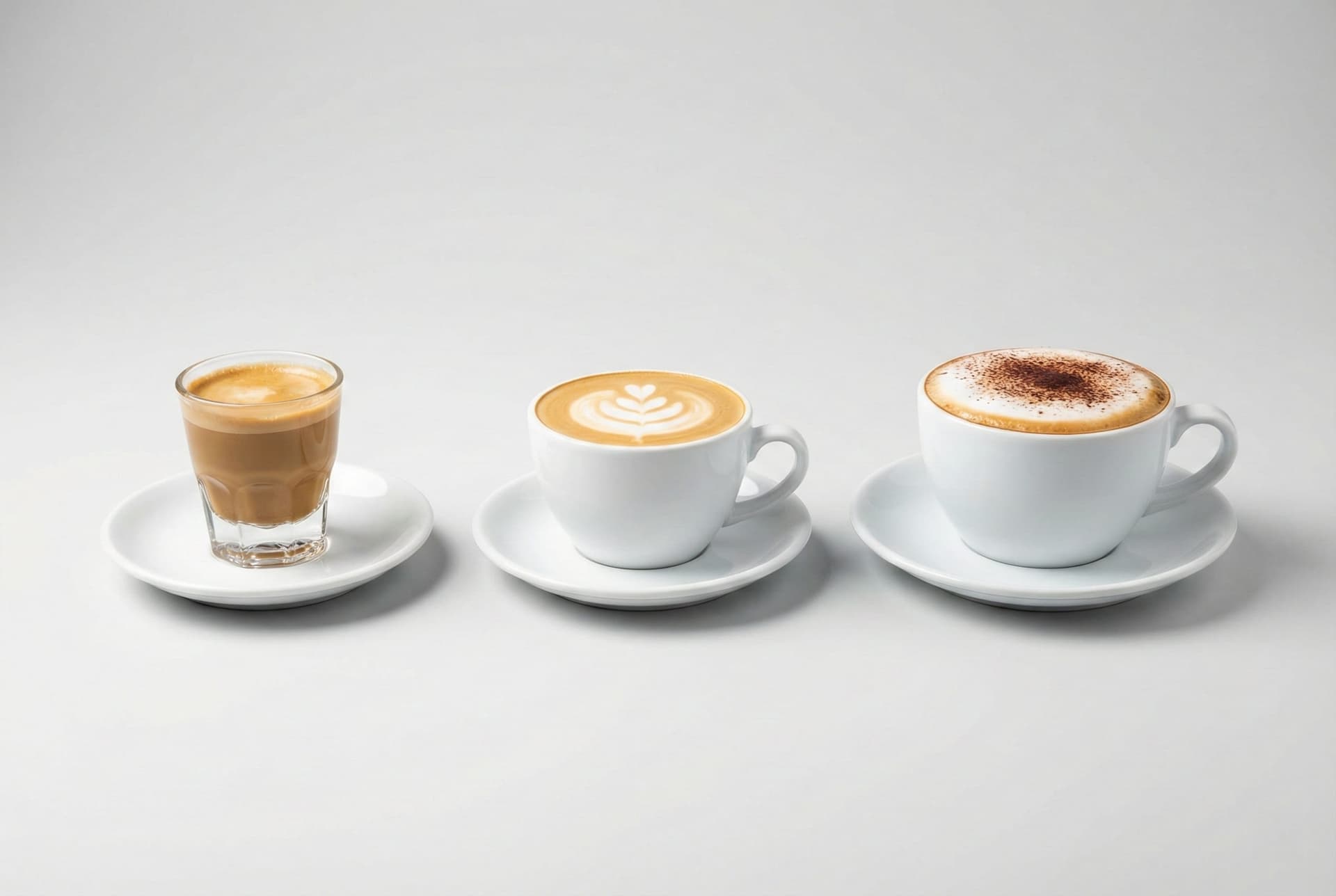
Cortado (4 oz) is smallest—quick coffee hit consumed in 4-6 minutes. Perfect for afternoon break or post-meal coffee when you don't want excessive milk volume.
Cappuccino (6 oz traditional, 8-10 oz American) is mid-size—leisurely morning drink consumed over 10-15 minutes. The foam acts as insulation, keeping it warm longer. Ideal when you want substantial coffee experience without latte's commitment.
Flat White (6-7 oz) falls between cappuccino and cortado in total volume, but the absence of thick foam makes it feel smaller than cappuccino despite similar liquid content. Consumed over 8-12 minutes.
Foam Texture and Philosophy
| Drink | Foam Character | Aeration Time | Result |
|---|---|---|---|
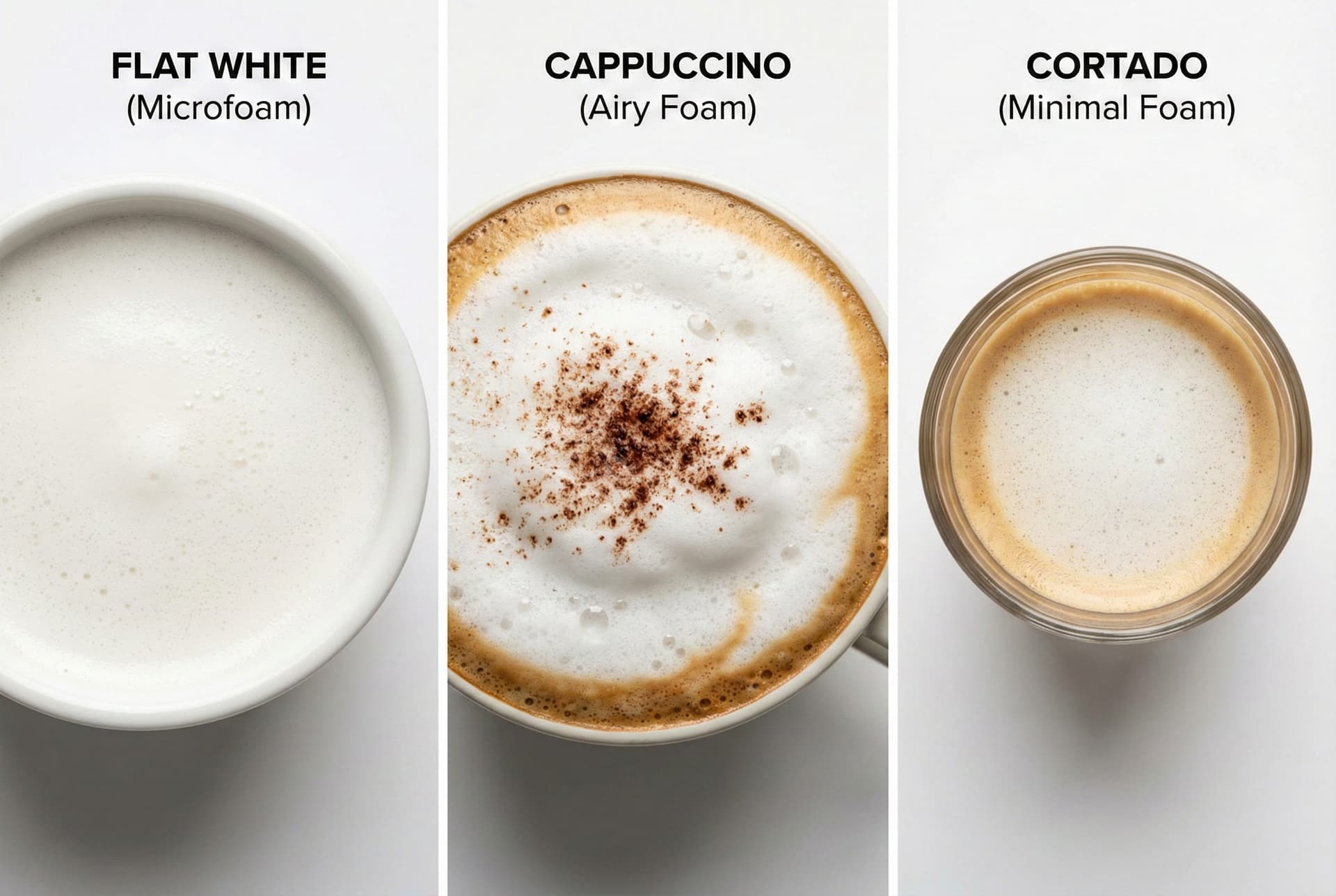
| Flat White | Integrated microfoam throughout, thin layer on top (0.2-0.25") | 3-4 seconds | Silky, velvety, uniform texture from first to last sip |
| Cappuccino | Distinct foam cap, airy and substantial (1"+ dome) | 5-8 seconds | Three-phase experience: foam → milk → espresso |
| Cortado | Minimal foam, mostly liquid milk (0.1-0.15" barely-there surface) | 2-3 seconds | Smooth liquid texture, espresso-forward balance |
Coffee Intensity and Ratio Analysis
Cortado delivers strongest coffee taste (7/10 intensity) due to its 50% espresso ratio. Every sip is half espresso, half milk—you taste coffee clearly throughout. Best for experienced coffee drinkers who want smooth delivery of bold flavor.
Flat White and Cappuccino tie (6/10 intensity) despite different textures. Flat white's 30% espresso ratio and cappuccino's 33% ratio deliver similar coffee strength. The difference is texture, not intensity—flat white feels smoother due to integrated microfoam, while cappuccino provides varied experience through its layers.
Latte (for comparison) ranks 4/10 intensity with only 15-20% espresso ratio. The generous milk makes it gentle and approachable but masks origin characteristics and subtle flavor notes that shine in cortado or flat white. For a dedicated side-by-side, see our Latte vs Cortado guide.
Temperature Differences Matter
Cortado: 155-165°F—immediately drinkable. The liquid milk heats quickly and cools slightly during pouring, arriving at perfect temperature for instant consumption.
Flat White: 145-155°F—cooler milk is essential for silky microfoam texture. Higher temperatures destroy microfoam's velvety quality. Also immediately drinkable.
Cappuccino: 150-160°F—slightly hotter milk with thick foam insulation keeps drink warm longer. Often needs 30-60 seconds to cool to comfortable drinking temperature, especially if barista pushed milk to 160°F+.
Cultural Context and Tradition
Cappuccino
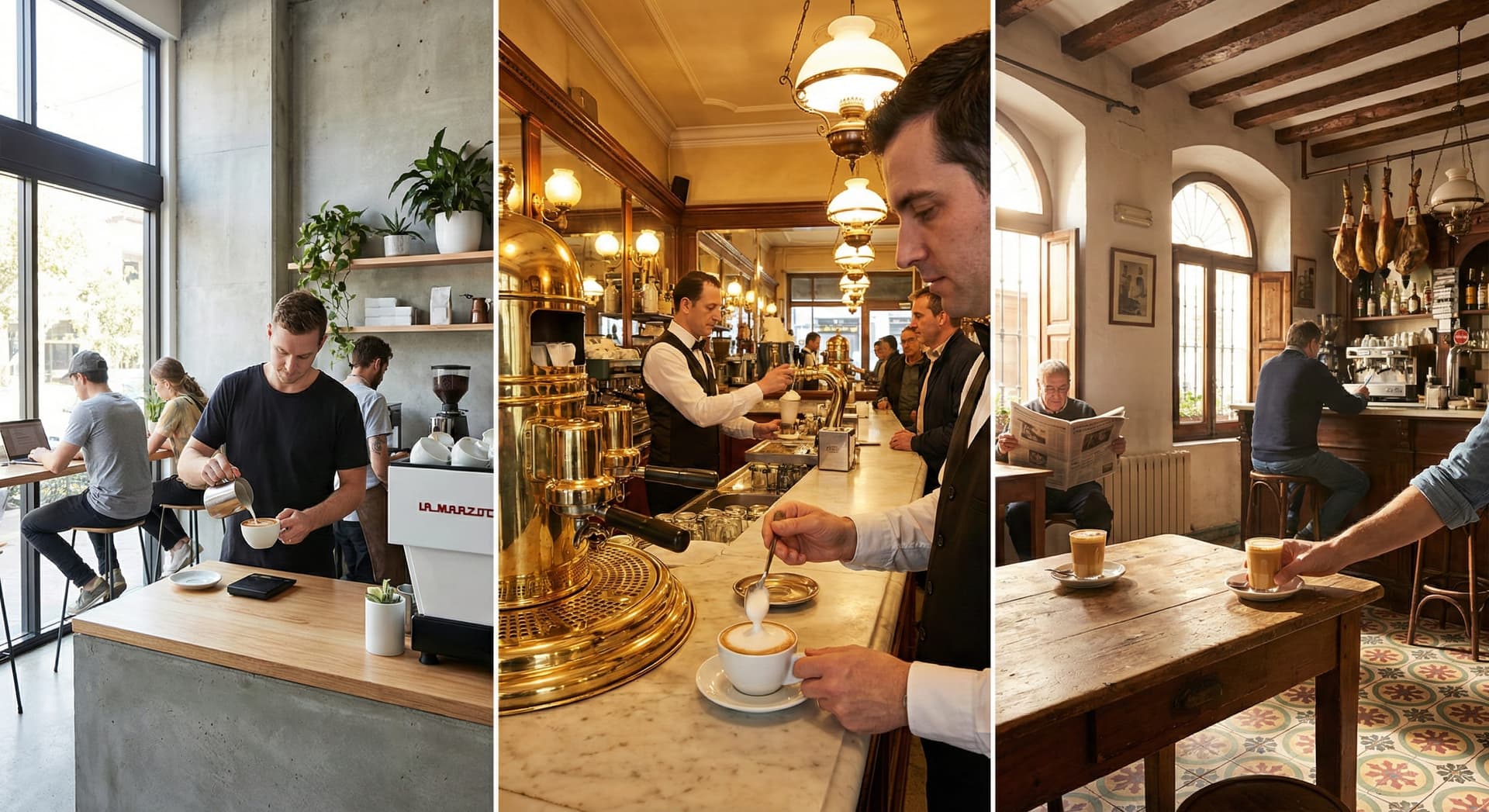
- Origin: 1930s Italy
- Traditional time: Morning only (before 11 AM)
- Cultural role: Breakfast ritual with pastry
- Consumption: Sitting at table, 10-15 minutes
- Modern status: Global standard, universally recognized
Flat White
- Origin: 1980s Australia/New Zealand
- Traditional time: Any time of day
- Cultural role: Modern café culture symbol
- Consumption: Casual setting, 8-12 minutes
- Modern status: Specialty coffee favorite, gaining worldwide recognition
Cortado
- Origin: 1960s Spain
- Traditional time: Mid-afternoon (3-5 PM)
- Cultural role: Quick coffee break, social moment
- Consumption: Often standing at bar, 4-6 minutes
- Modern status: Specialty café staple, Latin America favorite
Calorie and Nutritional Comparison
| Drink | Calories | Protein | Calcium | Sugar |
|---|---|---|---|---|
| Cortado (4 oz) | 35-40 cal | 2g | 60-80mg | 2g |
| Cappuccino (6 oz) | 80-120 cal | 6g | 120-180mg | 8g |
| Flat White (6-7 oz) | 110-130 cal | 7-8g | 180-220mg | 10g |
*Values based on whole milk. Cappuccino has fewer calories than flat white despite similar size because foam is mostly air. Sugar values are naturally occurring milk sugars (lactose), not added sugar.
Preparation Techniques Mastered
Making these drinks properly requires understanding both espresso extraction and milk steaming technique. Let's break down each drink's preparation step-by-step based on fifteen years of barista training experience. For a deeper primer on the espresso foundation these drinks share, see our What Is Espresso guide.
Flat White Step-by-Step
- Pull ristretto shots (traditional) or standard double: Use 18-20g ground coffee, extract 1.5-2 oz espresso in 25-30 seconds. Target rich golden crema layer—indicates proper extraction.
- Steam milk with minimal aeration: Use 6-7 oz cold whole milk in 12-20 oz pitcher. Aerate for 3-4 seconds only—brief, gentle introduction of air. Create rolling vortex motion that breaks up bubbles while heating.
- Stop at 145-155°F: Lower temperature preserves microfoam's silky texture. Pitcher should feel hot but still touchable.
- Tap and swirl: Tap pitcher 1-2 times to collapse any large bubbles, swirl vigorously for 10-15 seconds to integrate foam with liquid milk. Should look like glossy wet paint.
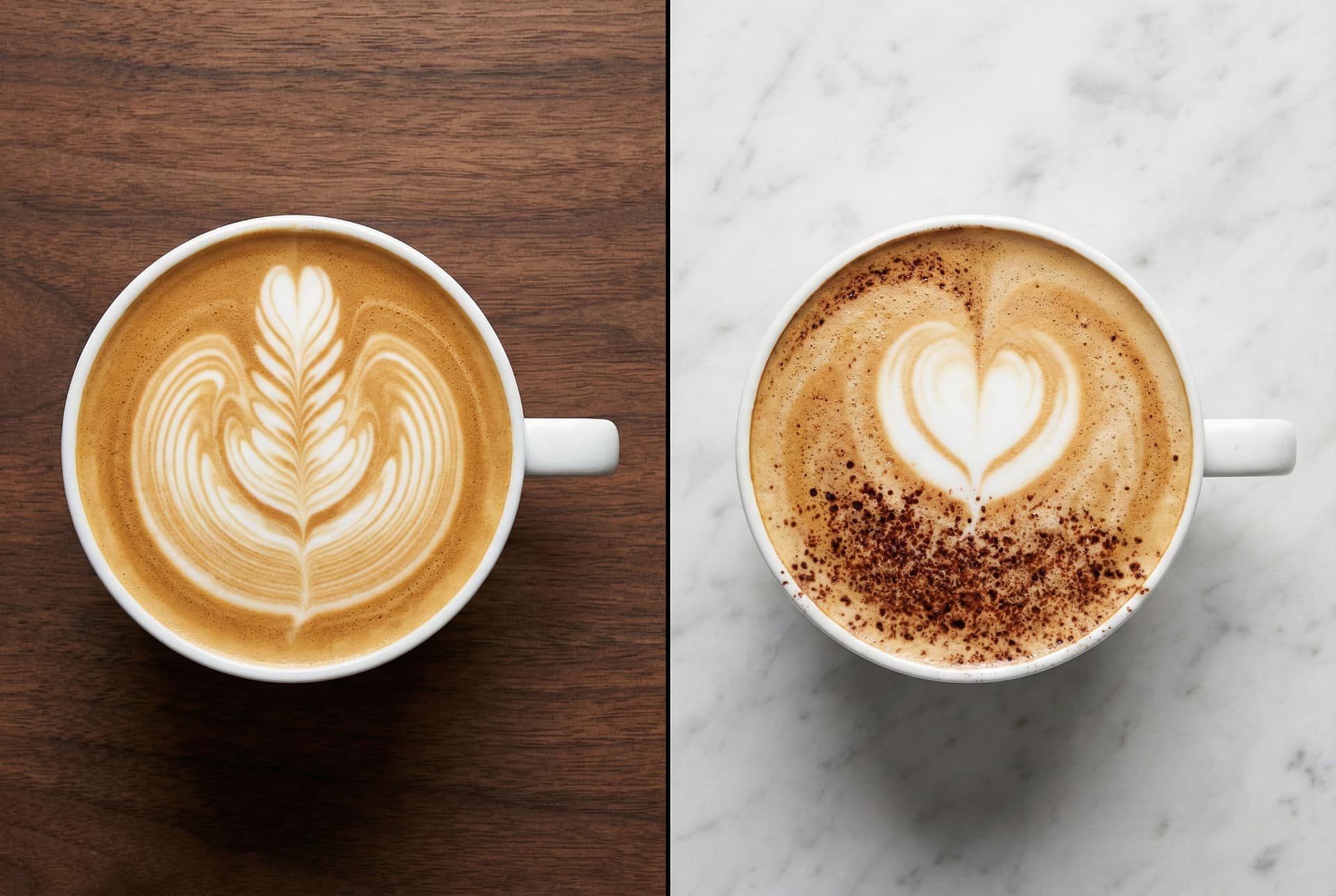
- Pour with intention: Pour from 2-3 inches height, starting in center of espresso. As cup fills, lower pitcher closer and increase flow rate to create latte art. Aim for 0.2-0.25 inch microfoam layer on surface.
- Serve immediately: Present in preheated 5-6 oz tulip cup. Drink should be immediately consumable without waiting.
Cappuccino Step-by-Step
- Pull double espresso: Use 18-20g ground coffee, extract 2 oz in 25-30 seconds. Pour immediately into preheated 6-8 oz wide-mouth cappuccino cup.
- Steam milk with aggressive aeration: Use 6-8 oz cold milk in 12-20 oz pitcher. Introduce air for 5-8 seconds—longer than flat white, creating substantial foam volume. Listen for that distinctive "ripping paper" sound indicating proper aeration.
- Create 50% volume increase: Milk volume should visibly expand as foam develops. Pitcher should feel noticeably lighter and fuller halfway through steaming.
- Heat to 150-155°F: Stop before milk gets too hot. As you submerge wand deeper, create rolling vortex that integrates foam while preventing large bubble formation.
- Tap and swirl briefly: 2-3 firm taps to remove largest bubbles, quick swirl to integrate—but don't over-integrate. Cappuccino needs more foam separation than flat white.
- Pour in two phases: Start with slow pour to introduce liquid milk. After cup is ~60% full, raise pitcher slightly to pour foam on top. This creates distinct foam dome characteristic of proper cappuccino.
- Create the dome: Final pour should build visible white foam cap rising above cup rim—the cappuccino's signature look.
Cortado Step-by-Step
- Pull double espresso: Extract 2 oz using 18-20g ground coffee in 25-30 seconds. Pour into preheated 4-5 oz Gibraltar glass or ceramic cup.
- Steam milk with minimal aeration: Use just 3-4 oz cold milk in 12 oz pitcher (small volume works best). Introduce air for only 2-3 seconds—barely audible hissing. Goal is heated liquid milk, not foam.
- Heat to 145-150°F only: Cortado uses cooler milk than cappuccino. As soon as pitcher feels warm (not hot), you're done. Over-heating creates unwanted foam.
- Skip tapping, light swirl: Cortado milk should be liquid enough that tapping isn't necessary. Quick swirl to ensure temperature consistency.
- Pour gently: Pour from 1-2 inches height directly into center of espresso. The goal is integration, not latte art or layering. Pour should be smooth and controlled.
- Serve immediately in proper glass: Traditional Gibraltar glass or small cup shows the beautiful gradient where espresso meets milk. Drink should be ready to consume instantly.
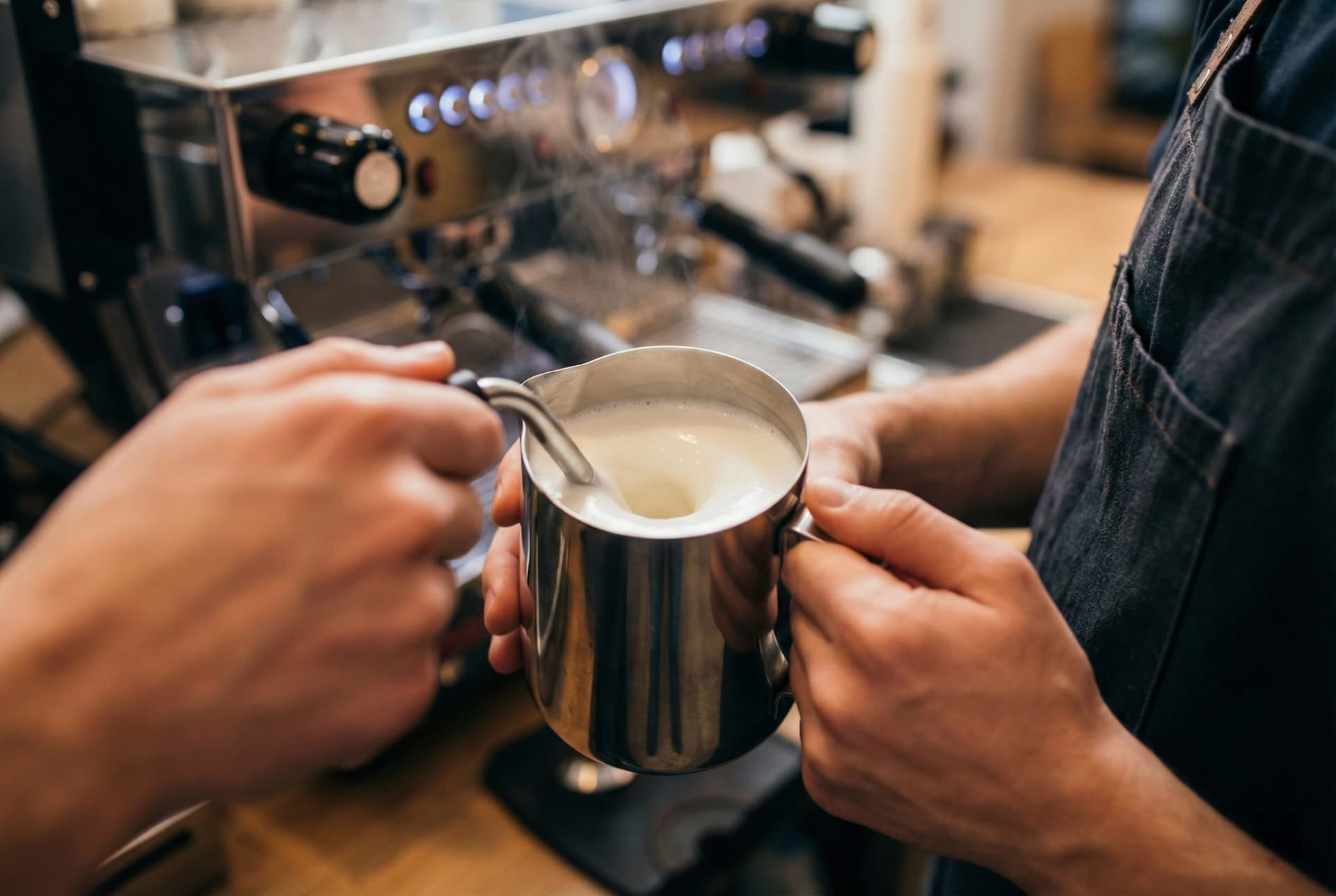
Milk Steaming Mastery
Milk texture differentiates these three drinks more than any other factor. Understanding milk steaming technique is essential for authentic preparation. Here's what fifteen years of teaching baristas has taught me about creating perfect texture for each drink.
The Science of Milk Foam
Milk foam forms when steam introduces air bubbles into milk while heat denatures milk proteins. These proteins unfold and create scaffolding that traps air bubbles, forming foam. The size of those bubbles and how they're distributed determines texture:
- Microfoam (tiny bubbles): Creates silky, velvety texture—ideal for flat white and quality cappuccinos
- Large bubbles: Creates dry, bath-style foam—poor technique, unpleasant mouthfeel
- No bubbles: Just heated milk—appropriate for cortado's minimal-foam philosophy
Temperature Guidelines Are Critical

- 145-150°F (Cortado): Barely warm to touch, milk proteins just beginning to denature. Creates liquid texture with minimal foam. Too cool for cappuccino, perfect for cortado.
- 150-155°F (Flat White): Hot but still touchable, optimal for silky microfoam. Proteins fully denatured for foam stability, not so hot that foam becomes dry or milk tastes scalded.
- 155-160°F (Cappuccino): Very hot, can barely touch pitcher. Maximum safe temperature before milk begins to scald. Creates stable foam with good volume retention.
- 165°F+ (Too Hot): Scalded milk—tastes burned, loses natural sweetness, foam becomes unstable and dry. Avoid completely—common beginner mistake that ruins drinks.
Milk Type Matters
Different milks foam differently due to varying protein and fat content:
- Whole milk (3.5% fat): Gold standard. Perfect balance of fat for flavor/mouthfeel and protein for foam stability. Produces best microfoam for all three drinks. Creates sweetest taste.
- 2% milk: Acceptable compromise. Slightly less creamy but foams nearly as well. Good choice if managing calories without sacrificing much quality.
- Skim milk: Creates foam easily but lacks body and sweetness. Cappuccinos become dry and thin. Not recommended for flat white—can't achieve proper velvety texture. Acceptable for cortado since foam isn't critical.
- Oat milk (barista blend): Best non-dairy option. Modern barista blends foam remarkably well—sometimes better than skim dairy milk. Works for all three drinks. Look for brands like Oatly Barista or Minor Figures.
- Soy milk: Foams well but can curdle with espresso's acidity if poor quality or over-heated. Use fresh, barista-specific brands. Works better for cappuccino/flat white than cortado due to texture.
- Almond milk: Challenging to foam unless barista blend. Standard almond milk separates and won't create stable microfoam. Only use barista-specific brands for cappuccino/flat white.
- Coconut milk: Generally poor for foaming. Acceptable for cortado (minimal foam needed) but avoid for cappuccino and flat white—can't achieve proper texture.
The Perfect Pitcher Position
Proper steam wand positioning is the single most important technique factor:
- Start position: Wand tip just below milk surface, positioned slightly off-center toward pitcher spout. Pitcher should tilt slightly so milk depth is uneven.
- Aeration phase: Keep wand near surface while introducing air. Should hear "hissing" or "tearing paper" sound—not gurgling (too deep) or screaming (too high).
- Texturing phase: Once desired foam volume is created, lower pitcher to submerge wand 1/2 inch below surface. Creates rolling vortex that breaks up large bubbles.
- Final position: Wand remains submerged until target temperature reached. Vortex should continue rolling—if it stops, adjust pitcher angle slightly.
Common Mistakes and How to Avoid Them
After training over 200 baristas and testing preparations at 75+ cafés, I've identified the most common mistakes that prevent these drinks from reaching their potential. Here's how to avoid them.
Universal Mistakes (All Three Drinks)
- ✗Using stale beans: Coffee beans lose flavor dramatically after 2-4 weeks from roast date. Espresso makes this obvious—stale shots taste flat, bitter, or sour. Always check roast date, never buy pre-ground, and store beans in airtight container away from light/heat.
- ✗Wrong grind size: Most common extraction problem. Too fine = over-extraction = bitterness. Too coarse = under-extraction = sour/weak. Adjust grinder in tiny increments (single number or one "click") and test. Target 25-30 second extraction for double shot.
- ✗Dirty equipment: Coffee oils turn rancid within days, imparting bitter taste. Backflush espresso machine daily, clean steam wand after every use, replace portafilter screens monthly, deep clean grinder weekly. This isn't optional.
- ✗Not preheating cups: Cold cups drop drink temperature 10-15°F instantly, affecting taste and texture. Warm cups with hot water or store on machine warming tray. Essential for flat white and cappuccino especially.
- ✗Inconsistent dosing: Using different amounts of coffee each time creates wildly variable results. Invest in scale ($15-30), weigh every dose to 0.1g precision. Consistency is professionalism.
Flat White-Specific Mistakes
- Too much milk: 8+ oz is latte territory. Flat white must be 6-7 oz maximum or you've destroyed the ratio.
- Cappuccino-style foam: Thick foam cap means wrong technique. Microfoam should integrate throughout.
- Using regular espresso instead of ristretto: Less traditional but acceptable—however, ristretto's sweetness is part of authentic flat white character.
- Over-aerating milk: More than 4 seconds aeration creates too much surface foam. Keep it minimal for silky texture.
Cappuccino-Specific Mistakes
- Oversizing: 12+ oz cappuccino is contradiction in terms. Authentic is 6 oz (max 8 oz American-style).
- Insufficient foam: Foam dome should rise visibly above cup rim. No dome = latte, not cappuccino.
- Large bubbles: "Bath foam" texture instead of microfoam ruins mouthfeel. Tap pitcher firmly to collapse large bubbles.
- Pouring flat white technique: Cappuccino requires two-phase pour—liquid first, then foam on top. Single continuous pour creates flat white texture.
Cortado-Specific Mistakes
- Wrong ratio: Anything other than 1:1 (equal espresso and milk) isn't cortado. 2 oz espresso needs exactly 2 oz milk.
- Too much foam: Visible thick foam layer defeats the purpose. Should be liquid steamed milk with barely-there surface.
- Using poor espresso: Cortado's minimal milk means quality matters enormously—use freshest beans possible.
- Over-heating milk: Higher temperature creates unwanted foam. Keep it 145-150°F maximum.
When to Choose Each Drink
Choose Flat White If:
- You find lattes too large/milky
- You appreciate silky microfoam texture
- You want strong coffee without intensity
- You enjoy latte art
Choose Cappuccino If:
- You love thick, creamy foam
- You want morning coffee tradition
- You prefer 6 oz size
- You like sequential drinking experience
Choose Cortado If:
- You want perfect espresso-milk balance
- You prefer minimal foam
- You want smallest size (4 oz)
- You need afternoon coffee
Equipment Recommendations for Home Preparation
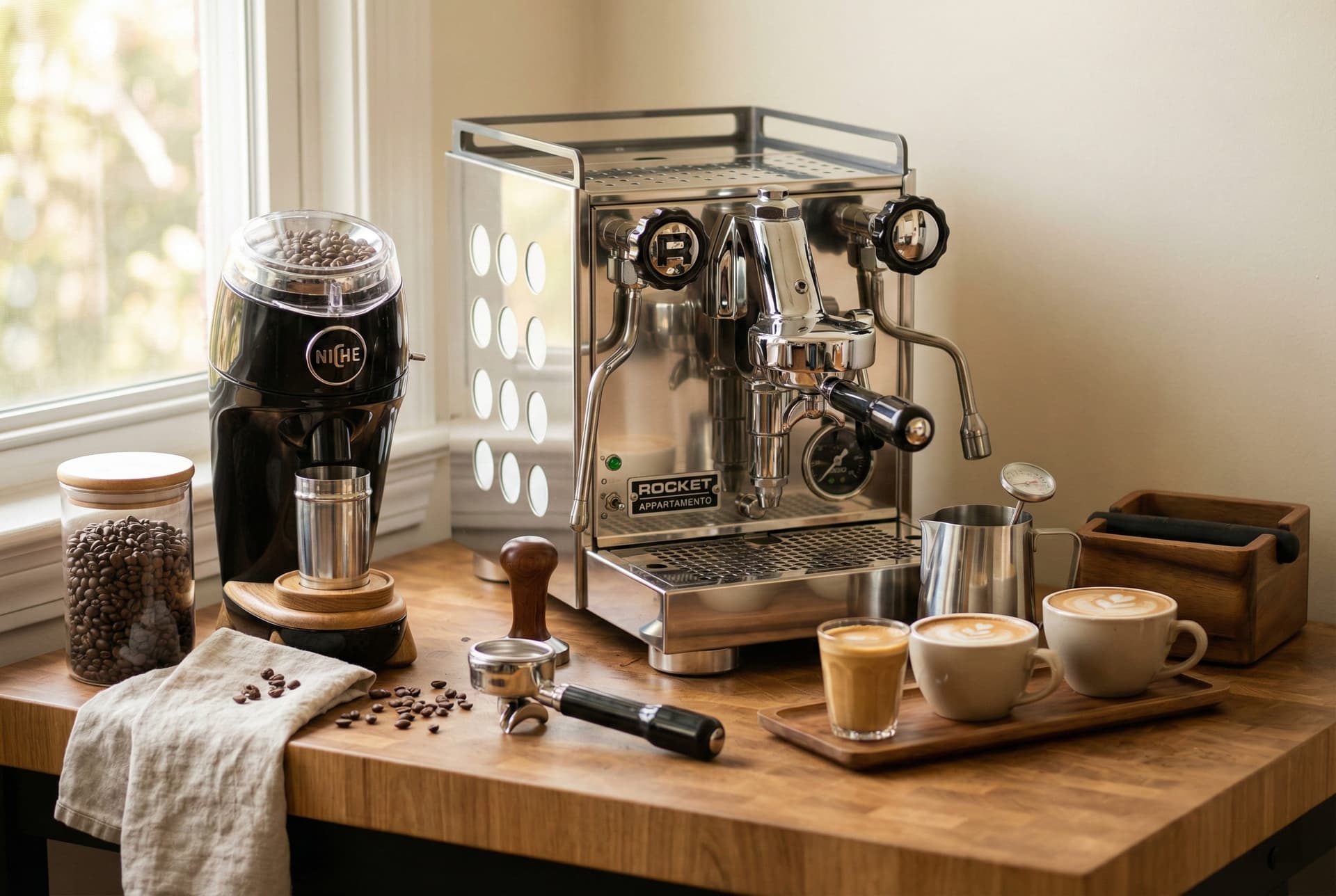
Making these drinks at home requires proper equipment. The sections below outline what each piece does and what to look for at different budgets. For an overview of the machine categories available, see our espresso machine types guide.
Essential Equipment Checklist
- ✓Espresso machine with steam wand: Minimum 9 bars pressure for proper extraction, powerful steam wand (1000W+ boiler preferred) for good milk texture. Budget: $300-2000+
- ✓Quality burr grinder: Stepless or micro-step adjustment essential for espresso. Blade grinders produce inconsistent particle size = bad extraction. Budget: $200-800
- ✓Milk pitcher (12-20 oz): Stainless steel with spout for pouring. 12 oz works for cortado, 20 oz better for cappuccino/flat white. Budget: $15-40
- ✓Thermometer (optional but recommended initially): Clip-on or instant-read for milk. Once you develop feel, you won't need it. Budget: $10-25
- ✓Scale with 0.1g precision: For weighing coffee dose and tracking extraction ratios. Consistency depends on accurate dosing. Budget: $15-50
- ✓Proper cups/glasses: 5-6 oz tulip cups for flat white, 6-8 oz wide-mouth cups for cappuccino, 4-5 oz Gibraltar glasses or small cups for cortado. Budget: $5-15 each
- ✓Tamper: 58mm for most machines, calibrated spring-loaded preferred for consistency. Budget: $15-60
- ✓Distribution tool (WDT or leveler): Ensures even coffee bed for balanced extraction. Budget: $20-50
Espresso Machine Recommendations by Budget
Budget-Friendly ($300-500)
Breville Bambino Plus ($350-400): A capable entry-level machine with fast heat-up (3 seconds), automatic milk frothing, and a compact footprint. The steam wand has adequate power for learning all three drinks. Limitations: smaller water tank, less temperature stability than higher-end machines.
Best for: Those wanting to learn home espresso without a large upfront investment. Can produce quality cortados and decent flat whites and cappuccinos with practice.
Mid-Range ($500-1000)
Breville Barista Express ($600-700): An all-in-one machine with built-in grinder, PID temperature control, and a powerful steam wand. Produces reliable results for all three drinks. Limitations: the integrated grinder is less flexible if you want to upgrade components separately later.
Gaggia Classic Pro ($449-$499): Commercial-style 58mm portafilter, straightforward mechanics, and a large modding community. Excellent steam power. Produces café-quality drinks with practice. Limitations: requires manual control, no PID out of the box (can be added).
Best for: Enthusiasts ready to develop technique. These machines reward skill with consistent results.
Enthusiast ($1000-2000)
Rancilio Silvia Pro ($1700-1900): Dual boiler system, PID control, commercial build quality. Steam and brew simultaneously—huge workflow advantage. Produces professional-level flat whites, cappuccinos, and cortados. Limitations: large footprint, premium price.
Lelit Elizabeth ($1400-1600): Dual boiler, PID, excellent steam power, flow profiling. Outstanding value at this price point. Makes drinks indistinguishable from café quality. Limitations: smaller brand, harder to find locally.
Best for: Serious home baristas who want to remove equipment as a limiting variable. Results at this level depend primarily on technique and bean quality.
Professional ($2000+)
Decent Espresso DE1+ ($2999+): Ultimate control with app-based profiling, precise temperature management, commercial-grade components. Makes perfect versions of all three drinks. Ideal for obsessive tweakers.
Rocket Appartamento ($1800-2100): Heat exchanger design, commercial build quality, beautiful Italian styling. Exceptional steam power for perfect milk texture. E61 group head provides excellent temperature stability.
Best for: Those treating home espresso as a serious long-term pursuit. Built to last.
Grinder Recommendations
Don't cheap out on grinders. A $200 grinder with $400 machine produces better espresso than $800 machine with $50 grinder. Grind quality matters more than most people realize.
- Budget: Baratza Encore ESP ($200): Newly designed for espresso. Stepless adjustment, acceptable consistency. Entry point for serious espresso. Can produce good shots with patience.
- Mid-range: Baratza Sette 270 ($400): Specifically designed for espresso, micro-step adjustment, fast grinding. Excellent particle consistency. Makes grind adjustments easy—crucial when dialing in.
- Premium: Niche Zero ($600-700): Single-dose workflow, excellent particle uniformity, quiet operation, beautiful design. Produces professional-level grind quality. Can easily switch between espresso and filter grind.
- Professional: Mazzer Mini ($600-800) or Eureka Mignon Specialita ($500-700): Commercial build quality, exceptional consistency, stepless adjustment. These are café-level grinders for home use.
Frequently Asked Questions
All three drinks use the same double espresso shot, delivering 128–150mg caffeine each.
Milk volume has zero effect on caffeine content.
Whether you choose a flat white, cappuccino, or cortado, you get the same energy boost—only the milk-to-espresso ratio and overall drinking experience differ.
Final Thoughts
These three drinks represent three distinct approaches to combining espresso with milk:
- Flat White: Modern innovation prioritizing silky texture and coffee-forward balance
- Cappuccino: Italian classic celebrating foam's textural magic
- Cortado: Spanish pragmatist achieving perfect 1:1 harmony
There's no “best” drink—only drinks better suited to specific moments and preferences. For more espresso drink comparisons, see our Macchiato vs Latte guide and, if you're curious about the most concentrated option in this family, our What Is a Macchiato guide covers both espresso and latte macchiato in full detail.
Get Coffee Tips
Join our newsletter for expert reviews and brewing guides.