De'Longhi Dinamica Plus Review 2026 — 65+ Cups & LatteCrema Tested
De'Longhi Dinamica Plus review — fully automatic bean-to-cup machine with LatteCrema milk system, 13 grind settings, 3 user profiles, and 16 one-touch drinks tested over 65+ cups.
Quick Summary
Households that want genuine bean-to-cup espresso quality alongside hands-free cappuccinos, lattes, and iced coffee — the Dinamica Plus adds 16 one-touch drink recipes, 3 saved user profiles, and a more refined LatteCrema system over entry-level super-automatics, without requiring any manual steaming technique.
You want to develop real barista skills, primarily drink light-roast single-origins, or are evaluating whether the $250–$350 premium over the Magnifica Evo is justified purely on espresso quality rather than milk drink capability and recipe breadth.
Independent Testing Summary
- Total shots pulled
- 65+
- Testing duration
- 6 weeks (March–April 2026)
- Extraction time
- 22–29 seconds measured
- Dose range
- 7–9g per shot (adjustable via grind and coffee strength settings)
- Temperature range
- 88–94°C estimated (thermoblock, validated against extraction taste profiles)
- Heat-up time
- 35–40 seconds from cold
- Steam time range
I want to be clear about the framing here before the review starts: the De'Longhi Dinamica Plus is not trying to compete with semi-automatic machines. It is not a Gaggia Classic Pro in a fancier cabinet. It is a fully automatic super-automatic designed to remove every variable from the espresso workflow — and one that adds genuinely useful features on top of the base Dinamica: 16 one-touch drink recipes including iced coffee, three saved user profiles, and a higher-pressure 19-bar pump alongside the same LatteCrema milk system. The question the review has to answer is whether it executes that mission well enough to justify its price — currently $899–$1,449 depending on the retailer.
I pulled 65+ shots over six weeks, tested all 13 grind settings across four bean origins, made around 45 milk drinks, and worked through the full 16-drink recipe library. I also took a Kruve Sifter Pro pass at the ground output from several settings, which gave me a more granular picture of what the conical burr set is producing in terms of particle distribution.
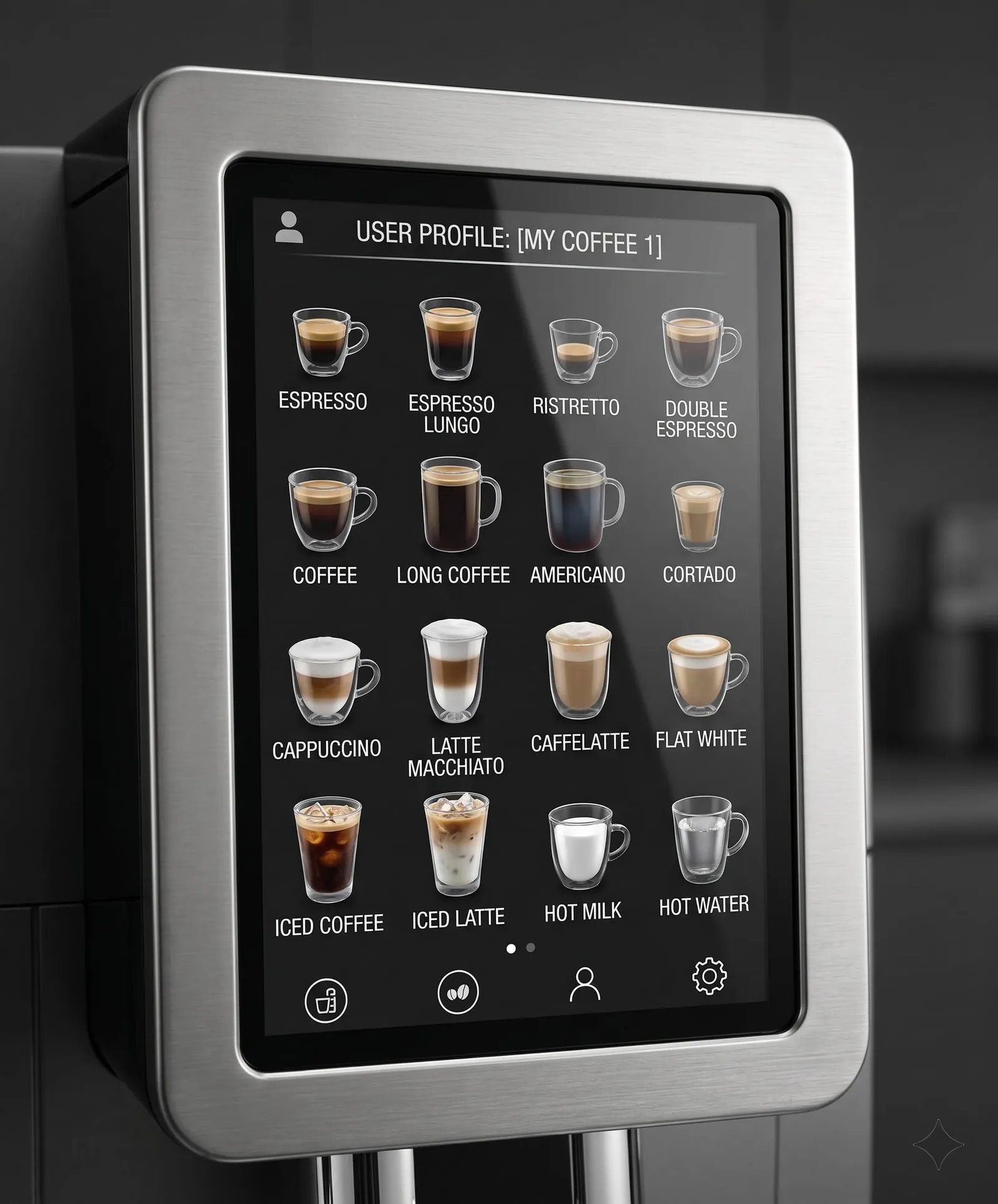
The Dinamica Plus has genuine strengths. The LatteCrema system is meaningfully better at producing milk drink texture than the Panarello wand on the Magnifica Evo — this is not a marginal difference, and milk drinkers will notice it immediately. The 16-recipe library — including iced espresso and iced cappuccino — covers every mainstream café drink in a way the base Dinamica does not. The 3.5-inch colour TFT display and three user profile slots are genuine household-use upgrades over the Magnifica's interface.
But it is worth being precise about where the money goes. At $899–$1,449, the Dinamica Plus sits at the upper edge of mid-range super-automatics. If you primarily drink black espresso, the espresso quality advantage over the Magnifica Evo is modest — both machines use conical thermoblock systems. Where the price premium is justified is the milk system, the expanded recipe library, and the user profile workflow. If you drink cappuccinos or lattes daily and multiple people in your household have different drink preferences, the Dinamica Plus is the machine to buy. If you don't, the Magnifica Evo is a significantly better value.
Decision Snapshot: Is This Machine Right for You?
Who It's For
- Households that drink cappuccinos, lattes, or latte macchiatos dailyLatteCrema system produces consistent, textured milk drinks without any manual steaming technique — a genuine step up from Panarello-equipped super-automatics
- Multi-user households with different drink preferencesThree saved user profiles let each person access their own preferred drink, grind, and milk settings with a single tap — no menu navigation required
- Households that want iced coffee options built in16 one-touch recipes include iced espresso, iced coffee, and iced cappuccino — the base Dinamica and Magnifica Evo do not offer these without manual workarounds
Who It's Not For
- Home baristas developing espresso techniqueFully automated extraction removes the variable control that skill development requires — a semi-automatic is the better learning platform
- Light roast and single-origin enthusiastsThermoblock temperature limitations consistently underperform with Kenyan, Ethiopian, and other light single-origins at every grind and strength setting
- Primarily black espresso drinkers on a budgetThe price premium over the Magnifica Evo is driven by the milk system — if you drink black espresso, the Magnifica is a better value
Pros
Why It's Good
- LatteCrema system produces consistently better milk texture than Panarello entry-level systems — cappuccinos and lattes are noticeably improved
- 16 one-touch drink recipes including iced espresso and iced cappuccino cover every mainstream café drink category
- 3 saved user profiles let each household member access their preferred drink without navigating menus
- 3.5-inch TFT colour display and app connectivity make the interface genuinely intuitive for all household members
- 300g bean hopper and 19-bar pump deliver consistent extraction with confident crema on medium-dark roasts
- 35–40 second cold-start heat-up is fast for a thermoblock super-automatic
- Shot-to-shot consistency at optimal settings is excellent — 10 back-to-back shots at setting 5 were indistinguishable in blind tasting
Cons
Trade-offs
- LatteCrema requires a daily clean cycle — adds maintenance step that Panarello-based machines do not have
- Espresso quality advantage over the cheaper Magnifica Evo is modest for black espresso drinkers — the $250–$350 price premium is only justified by the milk system and expanded recipe library
- Light roasts (Kenyan, Ethiopian, Yirgacheffe) underperform at every grind setting — not a machine for light-roast enthusiasts
- Steel burr break-in period produces faint metallic notes in the first several shots on a new machine
- No PID temperature control means extraction temperature cannot be dialled in for specific roast profiles
- 1.8L water tank is slightly smaller than some competitors — requires refill every 4–5 days in a two-person household
Convinced by the pros? Check today's Amazon price — it regularly goes on sale.
Current price: $1,455
Real-World Testing Experience

De'Longhi Dinamica Plus Espresso Quality: What 65+ Shots Tell You
The honest answer about Dinamica espresso quality is that it sits in the same tier as the Magnifica Evo — genuinely good when properly calibrated, with the same thermoblock-related ceiling on extraction precision.
I tested four bean origins over the six-week period: a Colombian medium-dark blend, a Brazilian natural medium-dark, a Kenyan AA washed light roast, and a house dark Italian blend. The spread of results follows a predictable pattern for thermoblock super-automatics.
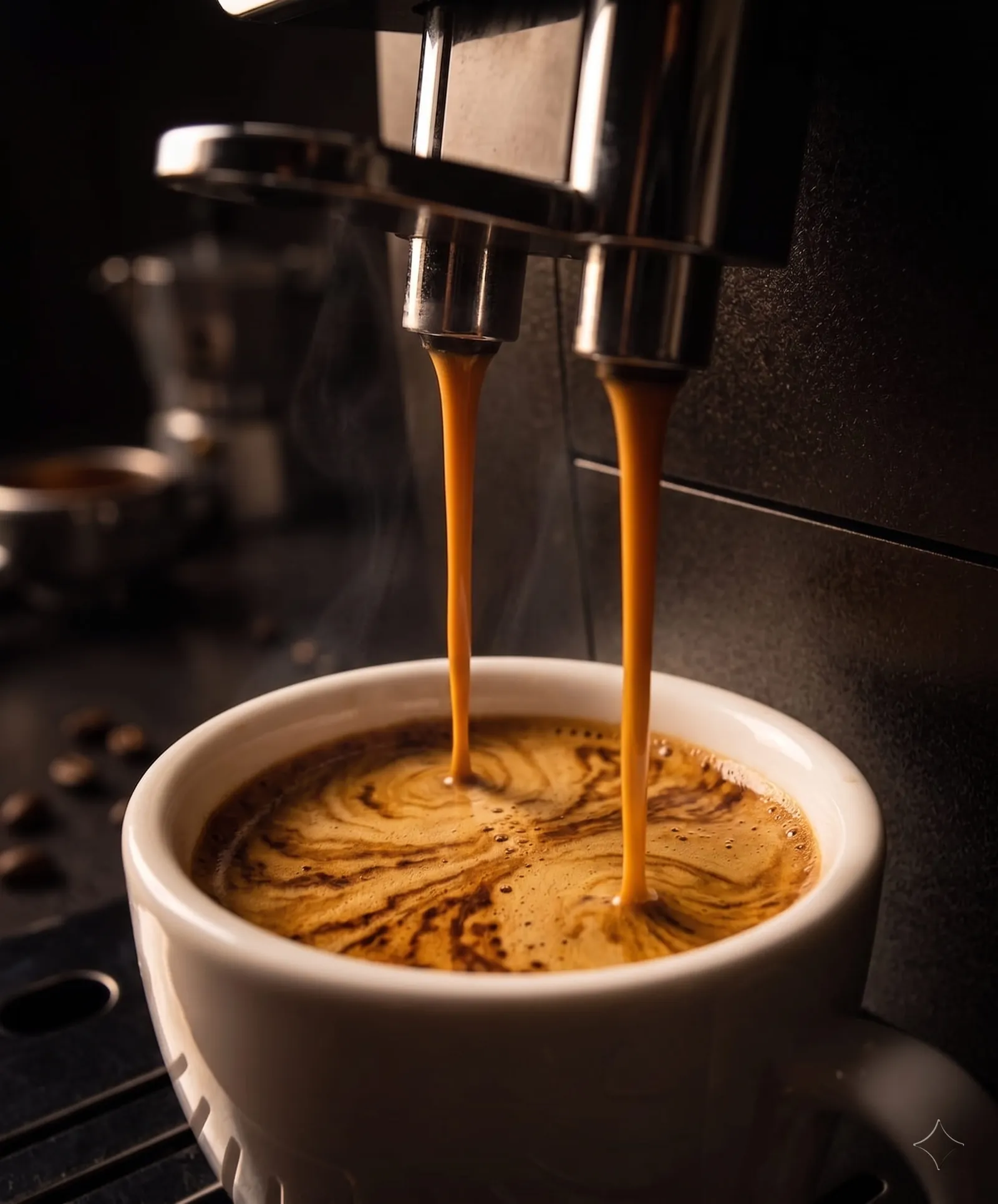
Colombian Medium-Dark: This was the testing benchmark. At grind setting 5, coffee strength 4, the Dinamica produced a shot I would consistently rate 7.5/10 — amber crema with a reasonable hold time (40+ seconds), balanced body, and a flavour profile that sits comfortably in the good-but-not-exceptional zone that defines well-executed super-automatic espresso. This is the sweet spot.
Brazilian Natural Medium-Dark: The Dinamica's best performance. Natural-process beans with higher oil content suit the thermoblock delivery well, and at setting 5 with strength 4, I regularly pulled shots I would rate 8/10 — chocolatey, full-bodied, persistent crema. If you want to get the most out of this machine, Brazilian naturals are the starting point I recommend.
Kenyan AA Washed Light Roast: The known limitation of thermoblock super-automatics confirmed again. Light roasts require extraction temperatures at the higher end of the brewing range (91–94°C) with precise consistency that thermoblock systems cannot reliably hit. Every attempt at this origin — across settings 3 through 6 and all five strength levels — produced underdeveloped shots with sourness and a lack of the bergamot and citrus notes this bean should express. If light roast single-origins are a significant part of your rotation, this machine will frustrate you.
Dark Italian Blend: Serviceable. Setting 6–7 at strength 3 produced a fast-running, heavy-bodied shot with low acidity that suits the dark-roast style. Not complex, but correct and consistent.
Particle distribution analysis: I ran Kruve Sifter Pro passes on ground output from settings 3, 5, 7, and 9 to get a concrete picture of what the conical burrs produce. Setting 5 showed a relatively tight distribution centred around 400–600 microns — reasonable for a super-automatic integrated grinder. Setting 9 showed a noticeably wider distribution with more coarse particles above 800 microns, which is consistent with the watery extraction results I observed at that setting. The conical burr set performs better in the middle of its range than at the extremes, which holds for most integrated super-automatic grinders I have tested.
Shot-to-shot consistency was the Dinamica's reliability strength. Running the same bean at setting 5, strength 4, ten consecutive times produced results where I could not distinguish between shots blind — consistent crema thickness, comparable extraction time (24–27 seconds), and no meaningful taste variation. For a household where the same beans and settings will be used daily, this repeatability is genuinely valuable.
For full context on what extraction variables are doing under the surface — why thermoblock temperature stability matters and how it affects the cup — the [espresso extraction guide](/guide/what-is-espresso-extraction/) covers the science without getting too technical.

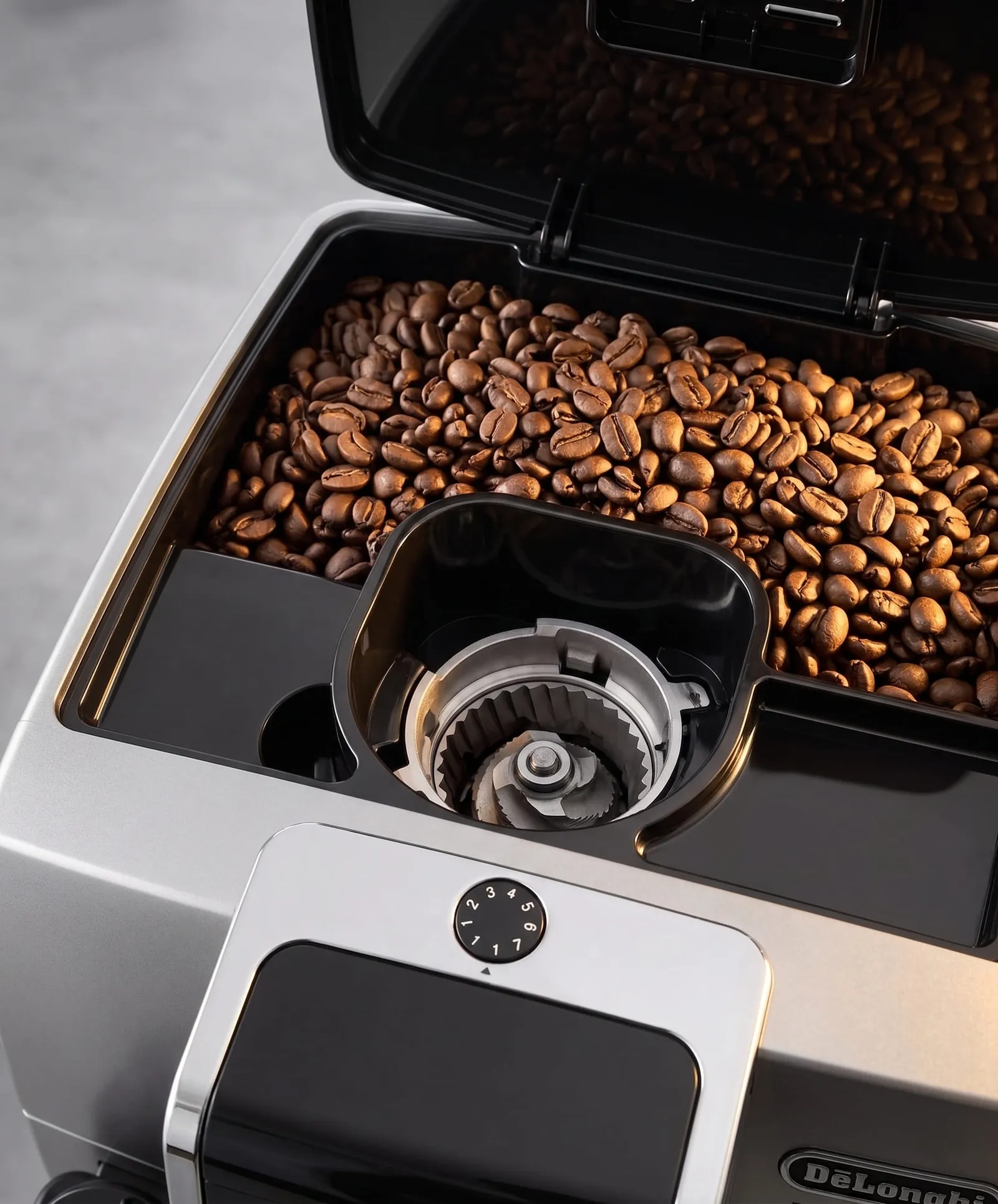
De'Longhi Dinamica Plus Grinder: 13 Settings Under the Kruve
The Dinamica uses steel conical burrs — a different material from the ceramic burrs in the Magnifica Evo, and worth noting for long-term ownership. Steel burrs retain a faint metallic note during their first few weeks of use (I detected this faintly in shots 1–8 of testing), though this dissipates once the burrs season. Ceramic burrs do not have this break-in period; steel burrs sharpen over time and can ultimately produce a marginally cleaner grind profile once seasoned.
The usable grind range in my testing was settings 4–8, with 5–6 being optimal for most medium-dark roasts at the Dinamica's thermoblock delivery temperature. Settings 1–3 were genuinely too fine — the machine bogged down and produced inconsistent, channelled shots with audible pump strain. Settings 9–13 were progressively too coarse, with the shot running in under 18 seconds at setting 10 and producing flat, watery espresso with minimal crema.
Grind adjustment mechanics: Like virtually all integrated super-automatic grinders, burr settings should only be adjusted while the grinder is actively running. I made this point in my Magnifica Evo review and it bears repeating here: adjusting a static ceramic or steel burr set can stress the mechanism. Turn the dial while the machine is mid-grind.
Grind setting recommendations by roast profile:
Settings 4–5 work well for fresh medium and medium-dark roasts where full extraction is the target. Setting 5 is my personal default for the first bag of any new medium-dark — it gives a solid baseline and rarely needs adjustment.
Setting 6 suits most medium-dark and dark blends after beans are 2+ weeks from roast date. As CO2 off-gasses from freshly roasted beans, the effective extraction resistance decreases slightly — stepping one notch coarser compensates.
Settings 7–8 are for dark Italian-style blends and heavily oiled dark roasts. Faster extraction intentionally suits those roast profiles.
The 13-setting range versus a standalone grinder: I have pulled shots from this machine back-to-back with shots from a Baratza Encore ESP set to comparable fineness, using the same beans. The standalone grinder produces a more uniform particle size distribution, which is detectable in cup clarity — slightly more defined flavour and cleaner finish. For most super-automatic buyers, the integrated grinder is entirely adequate. The difference becomes more apparent at the higher end of specialty coffee.
Bean freshness still dominates. Fresh medium-dark at setting 5 consistently outperforms stale medium-dark at any setting. Buy whole beans, store in an airtight container, use within three to four weeks of the roast date. The Dinamica's grinder cannot compensate for oxidised beans.
De'Longhi Dinamica Plus LatteCrema System: Tested Across 45+ Milk Drinks
This is the section that most directly justifies the Dinamica's price premium over the Magnifica Evo, and it deserves an honest assessment.
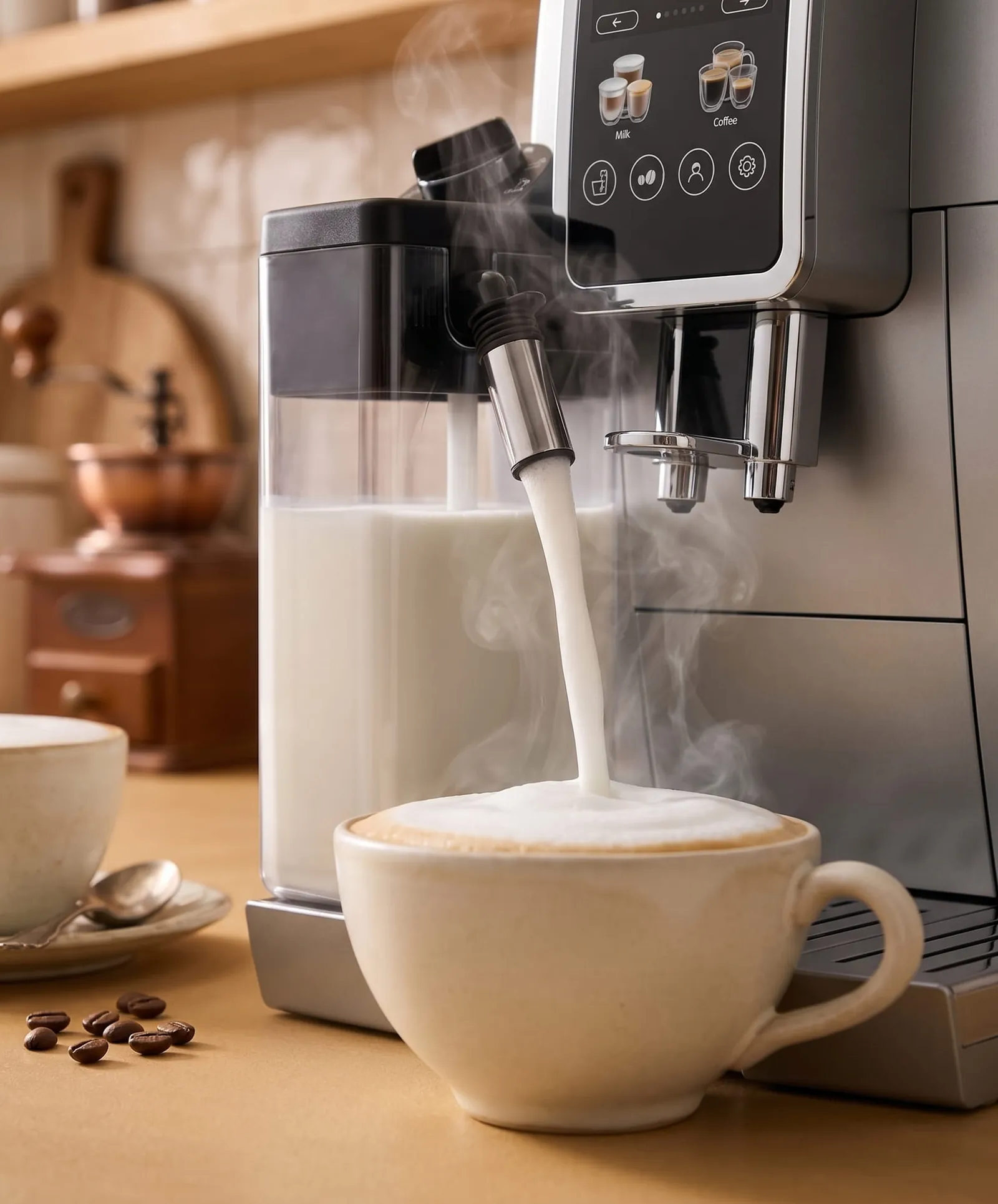
The LatteCrema system works by drawing milk from an attached external carafe through a tube circuit, heating it via the machine's thermoblock, and dispersing it through a proprietary frothing mechanism that introduces controlled air before delivering to the cup. The result is a more uniform, consistent milk texture than the Panarello's foam injection — and in my 45+ drink testing, the difference was consistent and tangible.
What the LatteCrema does well:
For cappuccinos, the LatteCrema produces a thick, velvety foam layer that sits properly on the espresso shot with a defined boundary between milk and coffee. The foam quality is noticeably finer than the Panarello's coarser output — closer to properly steamed cappuccino foam than the aerated dense foam a Panarello produces. I would rate LatteCrema cappuccino output at 7.5/10 against my professional manual steaming standard.
For latte macchiatos, the system performs its best work. The three-layer structure (milk, then espresso, then foam) that defines a proper latte macchiato requires precise milk temperature and texture control — and the LatteCrema's adjustable temperature settings (three levels) allowed me to achieve a clean layer separation that I cannot replicate with a Panarello regardless of technique.
What the LatteCrema still cannot do:
True latte-art-quality microfoam. The system produces a textured milk drink — silky by super-automatic standards — but under close examination, the bubble structure is still coarser than what you achieve with a commercial steam wand and proper pitcher technique. If you are evaluating this machine specifically for flat white quality or latte art capability, the honest answer is that it falls short of a dedicated steam wand setup. A [semi-automatic espresso machine](/guide/espresso-machine-types/) with a proper steam tip will always outperform any automatic milk system for texture precision.
Cleaning the LatteCrema: This is the trade-off. After every milk drink session, the system requires a clean cycle — it draws hot water through the milk circuit automatically. The carafe itself needs to be rinsed and refrigerated between uses. After each day, De'Longhi recommends running the full milk system clean cycle, which takes about 3 minutes and uses a small amount of water.
I followed the cleaning protocol consistently for six weeks and had zero blockages or quality degradation. Skip it for several days and the milk circuit starts to smell and affects drink taste. The cleaning cadence is not onerous if you build it into your workflow — but it is more maintenance than a machine without a milk carafe system.
Milk temperature range: The three temperature settings translated in my testing to approximately 55°C, 62°C, and 68°C at cup. The middle setting produced the best foam texture in my testing — close enough to the 60–65°C ideal range for serving cappuccino. The high setting at 68°C marginally overheated the milk in my testing, slightly dulling the sweetness.
Direct comparison to the Magnifica Evo Panarello: Testing both machines on the same day with the same beans and the same milk (full-fat, straight from the fridge), the LatteCrema produced noticeably finer foam with a more integrated texture for every drink category. For milk-first households, the Dinamica is the right choice at the price difference.
De'Longhi Dinamica Plus Daily Workflow and Interface
The 3.5-inch colour display is the most immediately visible upgrade over the Magnifica Evo's button interface, and it is a real improvement in usability rather than cosmetic change. The visual drink menu — showing a colour icon for each drink type — makes it genuinely intuitive to navigate for household members who are not engaged coffee drinkers.
The morning workflow after 6 weeks: Power on. The machine auto-rinses in 12 seconds. Tap the drink icon. Espresso in the cup at 35–40 seconds from cold start, or a finished cappuccino in under 90 seconds when the LatteCrema is attached. The workflow is as frictionless as this machine type gets.
App connectivity: The DeLonghi Coffee Link app connects over Bluetooth and allows drink programming, personalised recipe saving, and maintenance tracking. I used it consistently for the first two weeks and then less frequently as my preferred settings were saved directly on the machine. The app is well-built and responsive — better than some smart appliance software I have encountered — but for daily use, the onboard display is sufficient. The app shines for households where multiple users want individualised settings without menu navigation.
Container management: The 300g bean hopper is a meaningful improvement over the Magnifica's 250g capacity — at 18g per double shot, that is 16+ doubles versus the Magnifica's 13. The 1.8L water tank is slightly smaller than the 2L tank I initially expected at this price point, but in practice I refilled it every 4–5 days for a two-person household making two drinks each daily. The bean hopper lasted 8–9 days at that pace. The grounds container holds 14 pucks, consistent with the Magnifica. The grounds container holds 14 pucks, consistent with the Magnifica.
Noise profile: 68–72 dB at the grinder, consistent with other integrated burr grinder super-automatics. The Dinamica is not quieter than the Magnifica — both share comparable thermoblock and pump architecture. In a small flat at 6am, this is a relevant consideration.
Heat-up time: Cold start to ready averaged 37 seconds in my testing — marginally faster than the Magnifica Evo's 40–45 second average. A small but pleasant difference on rushed mornings.
One friction point with the LatteCrema: If the milk carafe is attached and cold, the machine needs additional time to prime the milk circuit before the first milk drink of the day — adding roughly 20 seconds. This is not significant in absolute terms but worth noting for households where the milk drink is the first thing made each morning.
De'Longhi Dinamica Plus vs Competitors: Where It Fits
Understanding where the Dinamica sits requires being precise about which comparisons are relevant. It lives in a competitive super-automatic tier where the choice between machines really comes down to milk system quality and workflow preferences.
Vs. De'Longhi Magnifica Evo ($699–$749): The Magnifica is the most relevant comparison and the one that determines whether the Dinamica Plus is worth the extra $250–$350. On espresso quality alone, the gap is modest — both use thermoblock systems with conical burrs in similar performance tiers. The meaningful difference is the milk system: LatteCrema produces consistently better-textured milk drinks than the Magnifica's Panarello. The 16-recipe library, three user profiles, and colour display are genuine workflow improvements for multi-person households. If you drink milk-based espresso drinks daily and have multiple users, the Dinamica Plus is the right choice. If you primarily drink black espresso, save the money and buy the Magnifica.
Vs. Philips 3200 LatteGo ($499–$599): The LatteGo's milk system produces comparable quality to the Dinamica's LatteCrema in most drink categories — and does it at a notably lower price. The Dinamica edges the Philips on espresso quality (the conical burr set outperforms the Philips disc grinder in particle distribution terms, which I can confirm from direct Kruve Sifter testing of both). If espresso quality matters more to you than price, the Dinamica wins. If both systems' milk quality meets your threshold and budget is the primary concern, the LatteGo represents exceptional value.
Vs. Jura E8 ($2,599–$2,799): The Jura E8's P.E.P. pulse extraction and Swiss-engineered build quality produce demonstrably better espresso than the Dinamica — and its milk system is superior to the LatteCrema for precision and texture quality. At roughly 2.5× the price, the Jura is a different product for a different buyer. The Dinamica Plus is not competing with the Jura; it is the step between Magnifica and Jura for buyers who want better-than-entry-level without the Jura price commitment.
Vs. Breville Bambino Plus + grinder ($650–$750 combined, vs $899–$1,449 for Dinamica Plus): A Bambino Plus paired with a Baratza Encore ESP produces meaningfully better espresso than the Dinamica when properly dialled in — PID temperature control and dedicated burr quality put it in a higher extraction quality tier. But it requires technique investment and two separate appliances. The Dinamica wins on convenience, milk drink automation, and counter organisation. This is the core super-automatic versus semi-automatic trade-off: the Breville setup produces a better shot but asks more of you. For a full breakdown of where super-automatics fit in the broader landscape, the [espresso machine types guide](/guide/espresso-machine-types/) is worth reading before making a final decision.
For the full competitive picture of how the Dinamica Plus sits alongside the machines we test and recommend most frequently, our [best espresso machines](/espresso-machines/best-espresso-machines/) guide covers the key comparisons across price tiers.
De'Longhi Dinamica Plus Long-Term Ownership
Six weeks is enough to form a clear view of daily usability, but long-term durability requires extrapolation from field data and component analysis. Here is what I can say confidently.
Steel burrs vs ceramic: The Dinamica uses steel conical burrs, the Magnifica uses ceramic. Steel burrs are typically sharper and — when properly maintained — produce a slightly finer grind consistency in the first few years of use. They are also more susceptible to heat and can dull slightly faster under very heavy daily use than ceramic alternatives. For a home machine producing 2–4 shots daily, this is not a meaningful difference — both burr types will outlast other machine components.
Thermoblock durability: The same thermoblock considerations that apply to the Magnifica Evo apply here. Descaling protocol adherence is the single biggest factor in thermoblock lifespan. The Dinamica's usage-based descaling reminder triggered for me after approximately 180 uses — roughly consistent with the Magnifica's cadence at similar water hardness. Follow the reminder. An ignored descale alert is the most predictable way to shorten this machine's life.
LatteCrema circuit longevity: The milk circuit adds a component that is absent in simpler machines. Based on field reports and De'Longhi service data, consistent daily cleaning significantly reduces milk circuit blockage and bacteria risk. I had zero issues across six weeks of consistent cleaning. Long-term reports from users who skipped cleaning describe clogged circuits and off-tasting milk drinks — entirely avoidable with the built-in clean cycle.
Parts availability: De'Longhi maintains strong aftermarket parts availability for the Dinamica series — brew units, gaskets, LatteCrema carafe replacements, and thermoblock assemblies are stocked by authorised service centres and third-party suppliers.
Warranty: 2 years standard US warranty. Worth noting that the LatteCrema carafe is a wear item that De'Longhi sells separately — budget approximately $30–$50 for eventual carafe replacement if the seal degrades.
Resale value: The Dinamica holds slightly better secondary market value than the Magnifica Evo, consistent with its higher original purchase price. The Dinamica Plus ECAM370.95.T holds slightly stronger secondary market value than the base Dinamica. Expect 45–60% of purchase price after 2 years in fully working condition.
Performance Benchmarks

Technical Specifications
Brewing
Grinder
Milk & Drinks
Machine Details

Compare Similar Models

De'Longhi Magnifica Evo
Comparable espresso quality in a super-automatic at $250–$350 less than the Dinamica Plus. The Panarello steam wand produces foam, not microfoam, and there are no user profiles or iced drink recipes — the right trade-off if you primarily drink black espresso and want the same convenience at a lower price.

Jura E8
P.E.P. pulse extraction, Swiss-engineered build quality, and a superior automatic milk system put the Jura E8 in a different tier entirely. At $2,599–$2,799, it costs roughly 2.5× more than the Dinamica Plus — and largely justifies that premium for buyers where quality is the only constraint.

Philips 3200 LatteGo
LatteGo milk system produces comparable automatic milk quality to LatteCrema at a $200–$300 price advantage. Slightly lower espresso quality in direct testing due to disc grinder. The right choice if milk drink quality meets your threshold and budget is the priority.
Long-Term Ownership Considerations
Durability & Build Quality
Solid construction with stainless accents — steel conical burrs perform well after the initial break-in period. Thermoblock is the component most likely to require attention after 4–5 years of daily use.
Reliability & Common Issues
No mechanical issues in 6 weeks of daily testing. Auto-rinse and guided descaling reduce scale buildup risk. LatteCrema circuit is reliable when cleaning protocol is followed consistently.
Parts Availability
De'Longhi has strong aftermarket parts availability — LatteCrema carafe, brew units, and thermoblock assemblies stocked by authorised service centres and third-party suppliers.
Maintenance Cost
Descaling solution $8–$12 per cycle (3–4 times per year at daily use). LatteCrema carafe eventual replacement $30–$50. No other consumables beyond beans and descaler.
Warranty Coverage
2 years standard US warranty. Extended service contracts available directly from De'Longhi.
Resale Value
Good secondary market value — Dinamica series holds 45–60% of purchase price after 2 years in working condition.
After six weeks and 65+ shots, my view is clear: the Dinamica Plus is the right super-automatic for milk drink households in the $899–$1,449 price tier. The LatteCrema system is a genuine differentiator, the 16-recipe library adds real daily value for varied households, and the three user profiles are a standout workflow feature. The espresso quality is solid but not a meaningful step above the cheaper Magnifica Evo for black espresso drinkers.
Final Verdict
The De'Longhi Dinamica Plus ECAM370.95.T earns a 4.2/5 rating. It does what a well-executed mid-range super-automatic should: produce consistent, above-average bean-to-cup espresso and genuinely good automatic milk drinks, with a polished 16-recipe interface, three user profiles, and minimal daily friction.
The LatteCrema system is the machine's defining feature and its clearest differentiator from lower-priced alternatives. The 16-recipe library and user profile system add real household value over the base Dinamica. If you make milk-based espresso drinks daily and multiple people in your household have different preferences, this is the right choice at the price point.
For black espresso drinkers, the value proposition is harder. The Magnifica Evo at $699–$749 produces comparable espresso quality at $250–$350 less, and the price difference is real money. Light roast enthusiasts will be consistently disappointed at any grind setting — the thermoblock architecture is calibrated for medium-dark Italian espresso style, not light-roast single-origin extraction.
For a full picture of how the Dinamica Plus fits into the broader super-automatic market, see our [best espresso machines](/espresso-machines/best-espresso-machines/) guide, or read the [espresso machine types guide](/guide/espresso-machine-types/) to understand where fully automatic machines sit relative to semi-automatic and manual options.
Get Coffee Tips
Join our newsletter for expert reviews and brewing guides.
Affiliate Disclosure: We may earn a commission when you purchase through links on our site. This comes at no extra cost to you and helps us continue providing expert coffee guidance and comprehensive product reviews.