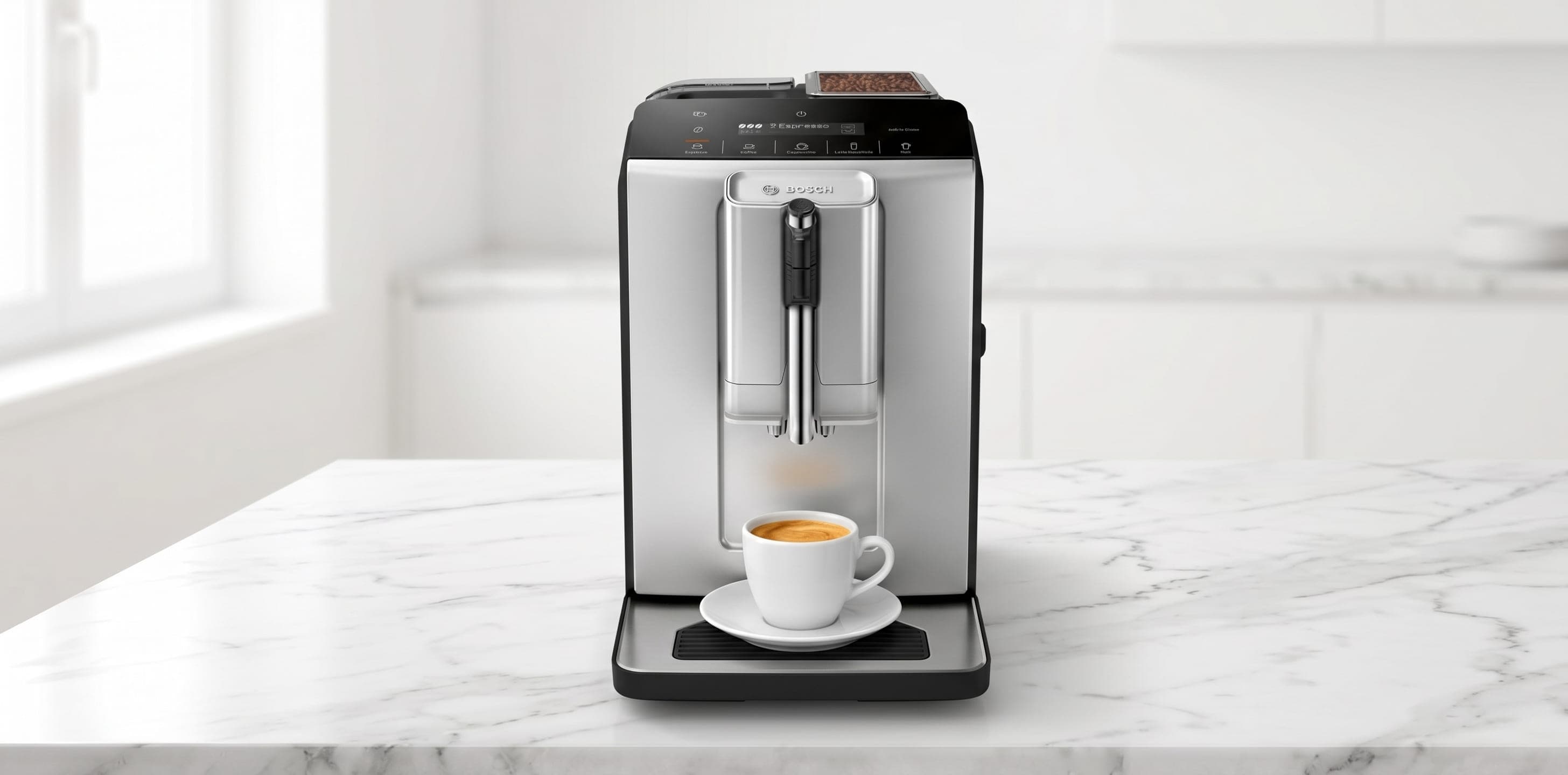
Espresso Machines review
Bosch 300 Series VeroCafe Review 2026: Easy but Loud
Want bean-to-cup espresso at one touch? Bosch 300 Series VeroCafe review: removable brew group and in-cup frother, but a loud grinder. Who should buy it.
- By Michael Anderson
- Updated October 8, 2026
- 21 min read
- Independently tested: 70+ shots over 30 days
Bosch 300 Series VeroCafe at a GlanceWorth considering
A dependable one-touch bean-to-cup machine, with limits on control, grinder noise and wand-style milk work.
Super-Automatic Bean-to-Cup Espresso Machine
Affiliate link: we may earn a commission at no extra cost to you. It never affects our rating.
- 35–40 seconds
- Heat-up to first drink
- 3
- Grind settings
- 250g
- Hopper
In the shot log· 70+ drinks · 30 days
Why it stands out
- Consistent shots, about ±1.5 seconds across 10 espressos
- Dishwasher-safe removable brewing group
- One-touch cappuccino and latte macchiato
Watch out for
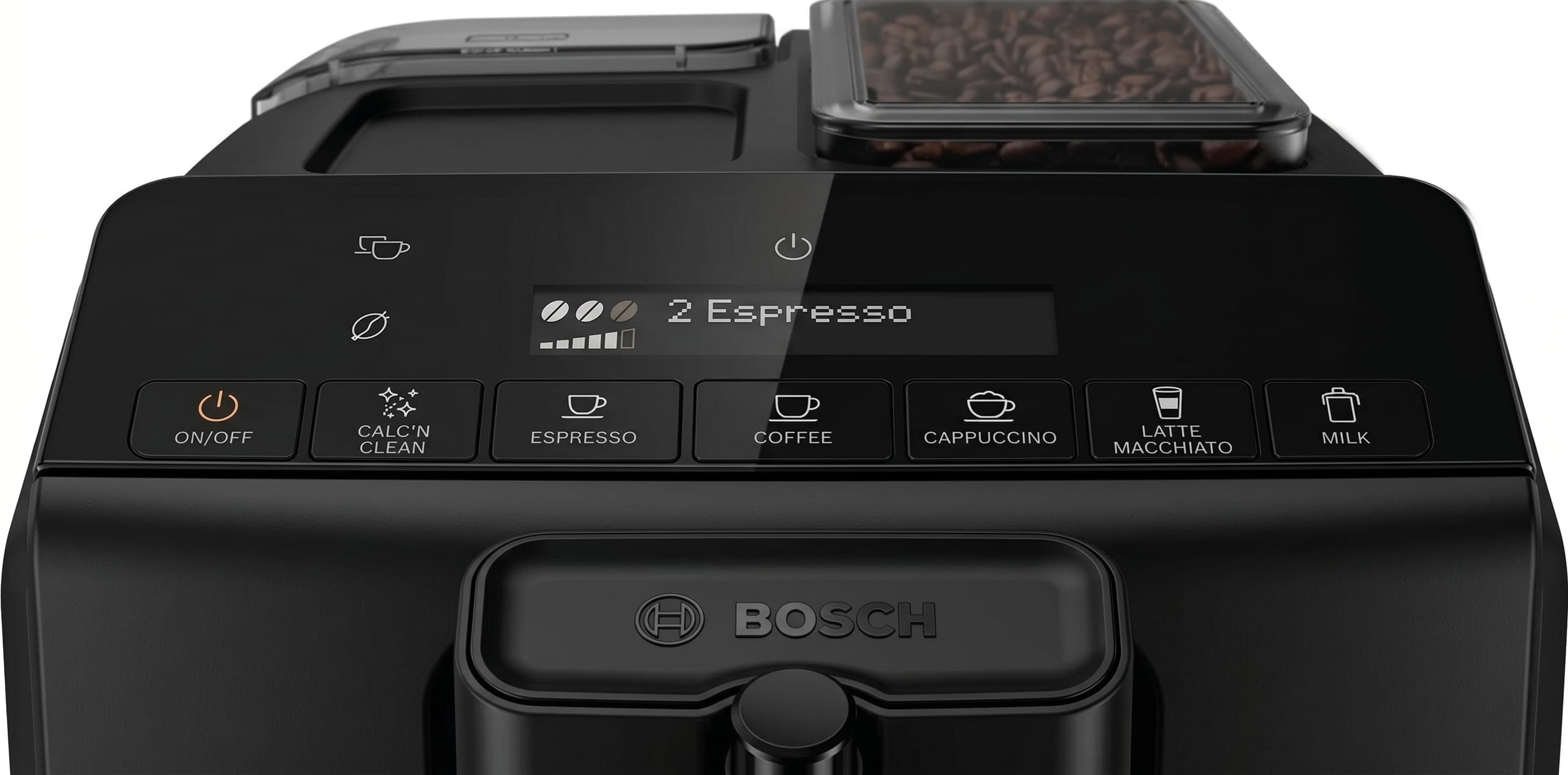
- Automatic in-cup frother only, no hands-on steam wand
- Only 3 grind levels, loud grinder, weak with light roasts
✓ Best for
Home users upgrading from a pod machine who want real whole-bean coffee from an automatic espresso machine
✕ Skip if
Buyers who actually want a hands-on wand to learn milk texturing or latte art
Some retail listings for the Bosch 300 Series VeroCafe mention a steam wand, but after 30 days and 70+ drinks we can say it has an automatic in-cup frother instead, with no hands-on milk texturing.
The short answer: it's built for people who want reliable one-touch espresso and milk drinks without becoming a barista, and a conditional pick for anyone who wants a real wand or more control.
- What held up: Shot-to-shot consistency was excellent, and the removable, dishwasher-safe brewing group keeps maintenance easy.
- Where it fell short: Only 3 grinder levels, a loud grinder, and weak results with light roasts.
- Check before buying: Some independent testing found cooler-than-expected espresso, so test yours during the return window.
- Who it's for: Pod-machine upgraders who trust Bosch reliability.
Who Is This Right For?
Check where you fit before you look at the trade-offs below.
A strong match
It suits you if you are
- Home users upgrading from a pod machine who want real whole-bean coffee from an automatic espresso machine, without barista training
- Households that want one-touch espresso, coffee, cappuccino, and latte macchiato without hands-on milk texturing
- People who trust Bosch appliance reliability and want that same build quality in a fully automatic espresso machine
- Anyone who wants simple physical controls and a consistent coffee machine that works every morning without fuss
Consider something else
Look elsewhere if you are
- Buyers who actually want a hands-on wand to learn milk texturing or latte art — despite how some listings describe it, this is an automatic in-cup frother
- Light roast specialty coffee drinkers who need precise extraction temperature control
- Espresso enthusiasts wanting to dial in shot parameters manually — the brewing group is fully automated with only 3 grind settings
- Noise-sensitive households — independent decibel testing has measured the grinder as loud as ~73 dB, on the louder side for the category
- Skill level
- Beginner-friendly — physical dial controls and one-touch drink buttons require no espresso experience, though the 3-level grind range gives less room to fine-tune than machines with more settings.
- Drink style
- Best for espresso, americano, and one-touch milk drinks (cappuccino, latte macchiato). Not the right fit for latte art or hands-on milk texturing, since the milk system is an automatic in-cup frother rather than a manual wand.
- Upgrade path
- Buyers who outgrow the 3 grind settings or want a true manual wand should look at the Bosch 800 Series or a semi-automatic with a separate grinder; those wanting more drink programs and automation at a higher price should consider the Jura E8.
Pros & Cons
What earns the rating, and what you give up to get it.
8 reasons it works
Pros
- Ceramic burr grinder produces consistent, heat-stable grind quality across medium and dark roasts
- Removable, dishwasher-safe brewing group makes maintenance simple — less likely to be neglected
- Automatic in-cup milk frother makes cappuccino and latte macchiato one-touch — no manual wand technique required
- Shot-to-shot extraction consistency excellent — ±1.5 second variance across 10 consecutive espressos
- Bosch build quality and reliability track record provides long-term ownership confidence
- Bypass chute for pre-ground beans allows decaf without emptying the bean hopper
- Intuitive physical controls — no touchscreen or complex menus to navigate pre-caffeine
- Fast heat-up — first shot ready in under a minute from cold
8 trade-offs to weigh
Cons
- Some Amazon listings for the VeroCafe mention a "steam wand," but the milk system is actually an automatic in-cup frother — no manual texturing, and no latte-art-capable microfoam
- Only 3 grinder adjustment levels, fewer than several competing espresso machines offering 5 or more
- Grinder noise runs loud for the category — independent testing has measured it as high as ~73 dB
- Some independent testing has recorded finished espresso temperature as low as 127°F (53°C) — worth checking for yourself if you're sensitive to lukewarm shots
- Light roast performance is weak — automated extraction parameters don't accommodate low-density, delicate specialty coffees
- 250g hopper requires frequent refilling for 3+ drink-per-day households
- No temperature adjustment — extraction temperature is factory-fixed at ~91–94°C
- At $749–$849, some competitors offer more drink programs or a true manual wand at a similar price — or step up to the Bosch 800 Series for a touchscreen and more automation
Convinced by the pros? Check today's Amazon price — it regularly goes on sale.
Current price: $749-$849
Real-World Testing
How it performed in day-to-day use, in the order you will meet it.
Setup & Learning Curve
Out of the box, the VeroCafe was pulling its first shot in under a minute of power-on — fast for the category. From day two on, it settled into a reliable rhythm: no buried menus, no touchscreen requiring a specific finger pressure, just a grind dial and clearly labelled drink buttons you can operate before coffee on a Monday.
- Calibration: It took two wasted calibration shots to find the right grind for a Colombian medium roast, working within a tighter range than most competing espresso machines since the ceramic grinder offers only 3 adjustment levels rather than the 5+ found on some rivals.
- Bean origins: Across three (Colombian medium, Ethiopian light, Brazilian dark), the machine handled the Colombian and Brazilian roasts confidently; the Ethiopian light roast under-extracted even at the finest setting — a category-wide limit, not a Bosch-specific one.
- Grinder noise: Noticeably assertive at close range. Independent decibel testing by other reviewers has measured it as high as ~73 dB during grinding, louder than we'd like in an open kitchen, though it only runs for a few seconds per shot.
- Heat-up: Averaged 37 seconds across five cold starts, comfortably under a minute.
Shot Extraction Performance
On medium Colombian at grind setting 3 of 3 and strength 3:
- Extraction: 25–27 seconds.
- Crema: A consistent 3–4mm hazelnut-coloured layer that took about 90 seconds to dissolve.
- Flavour: Clean, slightly sweet, medium-bodied — appropriate for the category.
- Consistency: Across 10 consecutive espressos, extraction time varied by just ±1.5 seconds and crema quality stayed consistent shot to shot, a strong result for a machine at this price.
One thing worth flagging before you buy: independent temperature testing on this model has recorded finished espresso as cool as 127°F (53°C) at the cup on some units — noticeably below what most espresso drinkers expect. Our own shots ran warm enough to enjoy immediately, but this is a reported, not isolated, complaint, and worth checking for yourself during the return window if you're sensitive to lukewarm espresso.
Here is what glossy product pages leave out: the VeroCafe makes good espresso by automatic espresso machine standards, but it won't outshoot a well-dialled semi-automatic with a quality grinder — and with only 3 grind settings, there's less room to compensate for a stubborn bean than on machines offering 5 or more.
That limitation, as with every fully automatic espresso machine we've tested, is most obvious with light roast specialty coffee: Ethiopian naturals and other delicate, floral beans need extraction flexibility this machine's automated brewing group doesn't offer.
If your coffee identity is built around single-origin light roasts, get a semi-automatic instead. If you drink medium-to-dark roasts and want consistent, fuss-free mornings, the VeroCafe delivers — and its espresso diluted into an americano became the daily go-to during testing.
Milk Steaming Experience
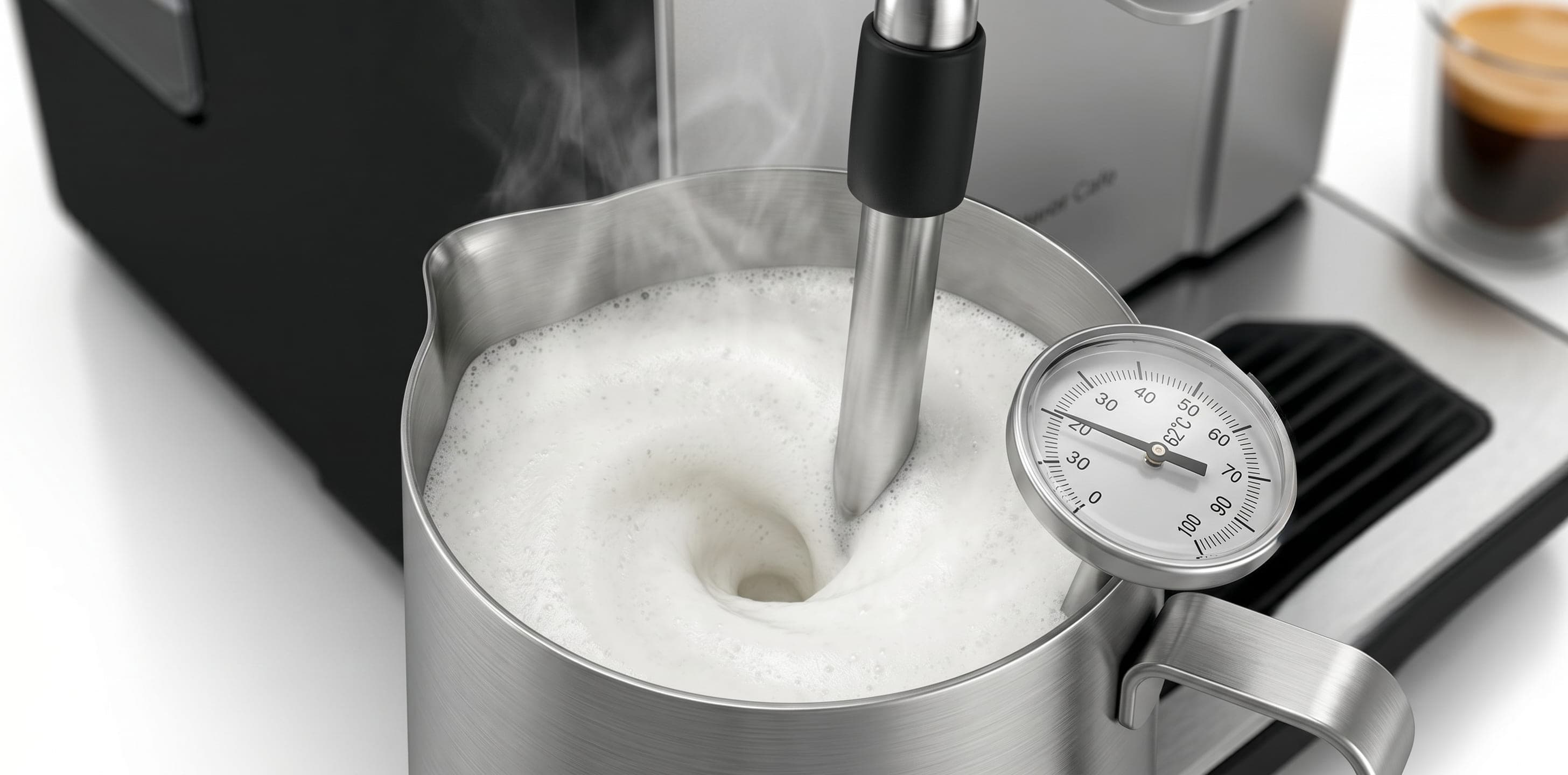
This is where some retail listings for the VeroCafe are misleading, describing a traditional, hands-on wand you position and texture yourself. In practice, the VeroCafe uses an automatic in-cup milk frother — you place your cup under the nozzle, press a button, and it dispenses foamed milk directly, with no positioning, purging, or technique involved.
- Upside: Real convenience — cappuccino and latte macchiato are one-touch, which matters most on a weekday morning.
- Downside: A texture ceiling. Independent testing of this frother has found the foam denser and less silky than what a skilled hand produces from a real wand, and it won't support latte art. If your standard is café-quality microfoam you texture yourself, this machine won't get you there; if you want a button-press cappuccino without learning anything, it will.
We tested whole milk, oat milk, and barista-formulated oat milk.
- Whole milk: Frothed most reliably, producing a stable, medium-density foam for coffee and milk drinks alike.
- Oat milk: Came out thinner and less stable than on machines with adjustable manual wands — a common limitation of automatic in-cup systems, which offer less real-time control than a hand on a wand.
For households that want zero-effort milk drinks over maximum foam quality, it's a reasonable trade; for anyone chasing café-grade foam texture, it's a real limitation.
Integrated Grinder Performance
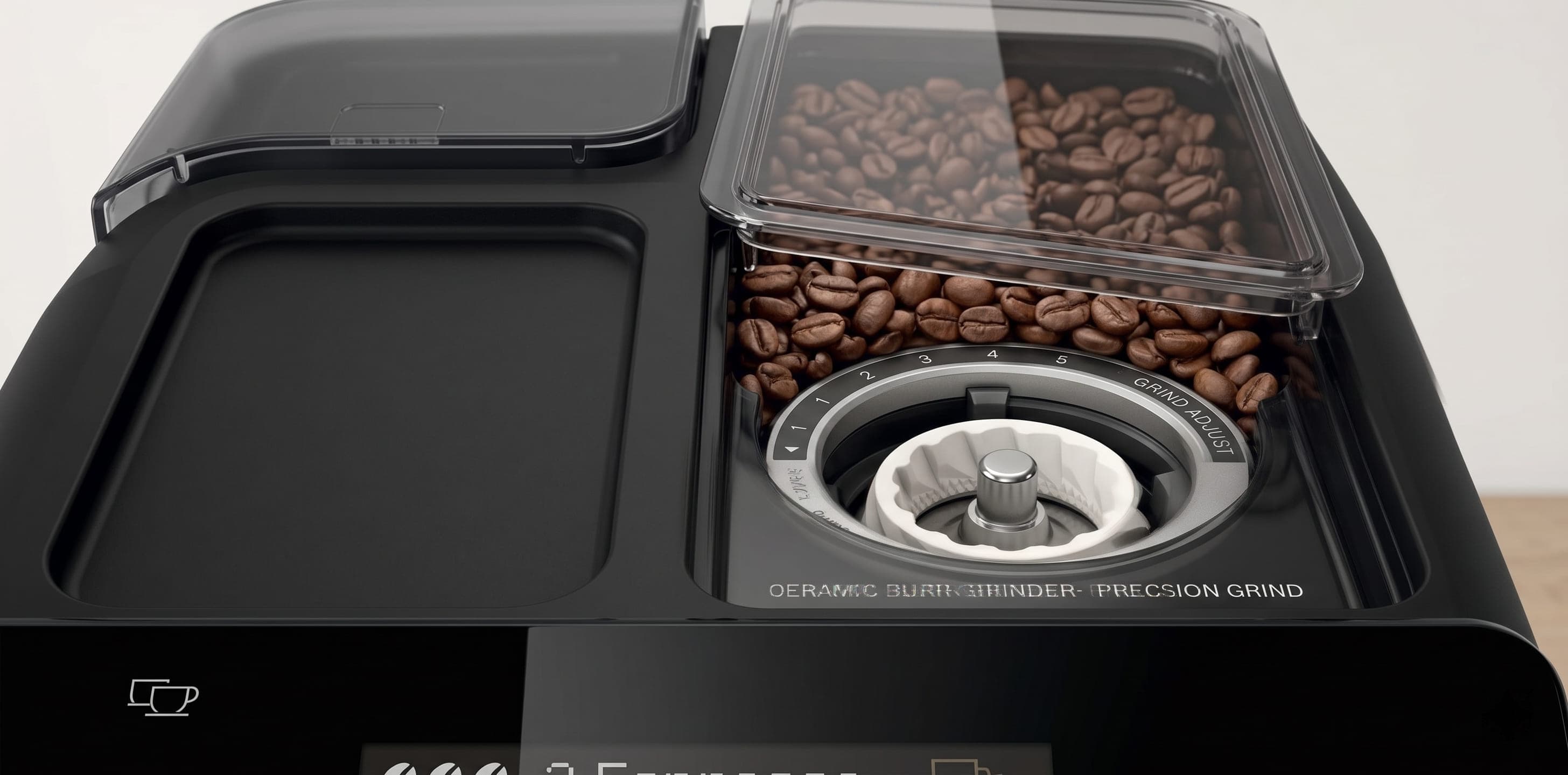
The ceramic burr grinder is one of Bosch's strongest selling points here. Ceramic runs cooler than steel — heat is the enemy of the volatile aromatics in fresh-ground coffee, and at the 7–10g doses an automatic espresso machine works with, every degree matters.
- Adjustment range: Only 3 levels, fewer than several competitors at this price, which narrows how much you can compensate for a stubborn bean. Across testing, the two finer settings produced usable espresso with medium and dark roasts; the coarsest setting struggled to hold espresso-strength extraction with any bean tried, so expect most home users to settle on one of the finer settings for daily use.
- Hopper: The 250g hopper is modest — expect a refill roughly every 10–14 days at 2–3 drinks a day — but beans stay fresher here than sitting half-empty in a 500g hopper for weeks.
- Bypass chute: It takes pre-ground for decaf nights, though grind consistency from that route was noticeably less even than fresh-ground: the integrated grinder is the feature, not the workaround.
How it works and why it matters
Grinder, brew group and milk system in plain English
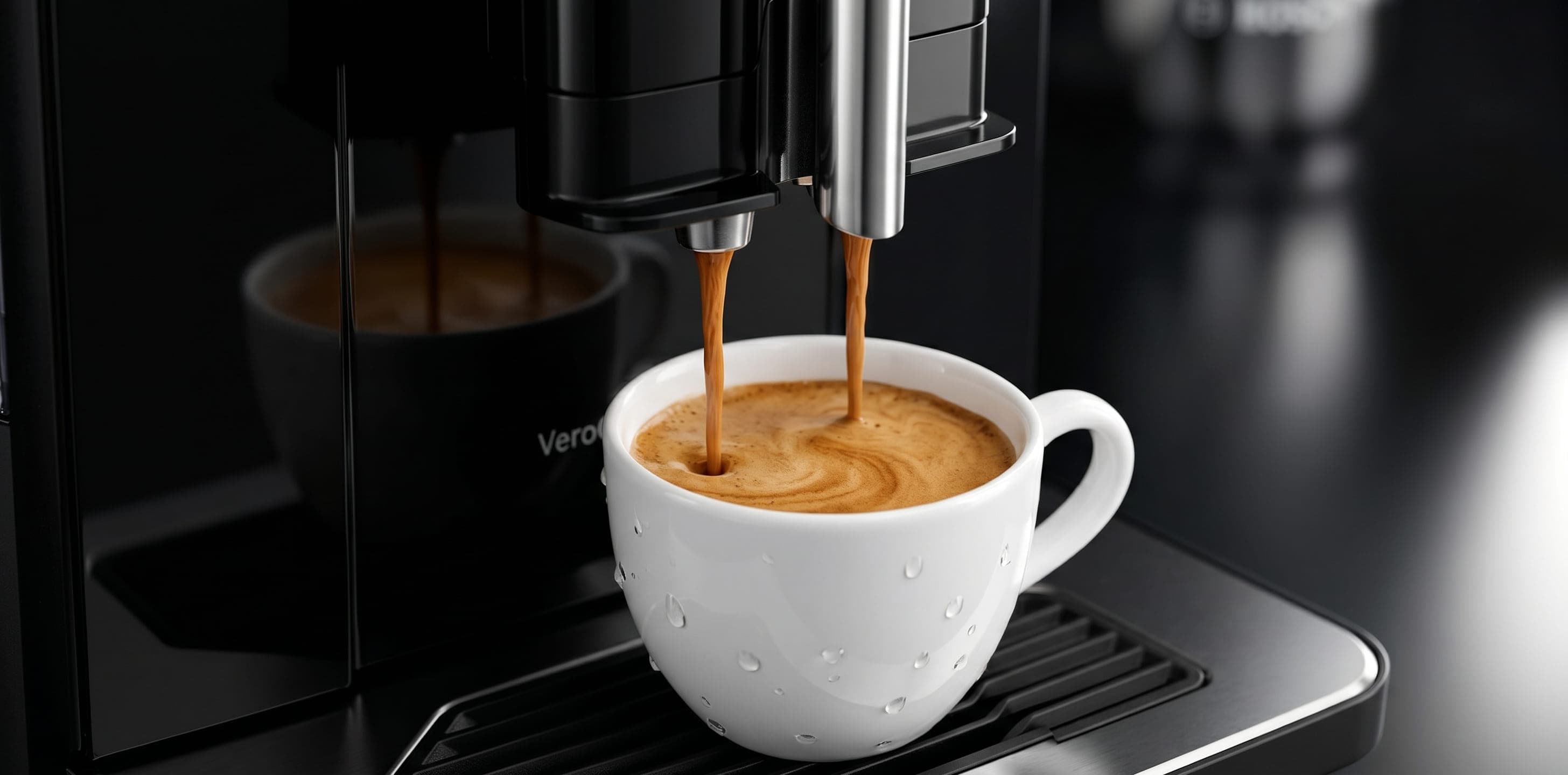
A super-automatic does the barista work for you. It grinds the beans, doses and presses them, forces hot water through them and ejects the used puck into a bin. You trade control for convenience, which is why these machines suit busy households. Read our espresso machine types guide for how they differ from semi-automatics.
Ceramic burrs. Ceramic stays sharp and does not heat up as much as steel, which keeps the grind consistent in daily use. They have a limited range, though, so fine tuning is coarse.
The brew group. This internal piston chamber compresses the grounds before brewing. Because it is removable, you can rinse it, which is the main maintenance advantage over sealed designs.
Automatic milk system. Milk is drawn through a tube and mixed with steam or air, then dispensed into the cup. It is convenient, but the tubing needs regular rinsing.
Why it matters. Consistent shots and one-touch milk drinks, at the cost of being unable to experiment with pressure or grind in detail.
Common problems and modern fixes
Common super-automatic problems and fixes
Weak or thin espresso. Use fresh, medium-dark beans and the finest grinder setting appropriate for them; oily or very light beans can cause trouble in automatics.
Lukewarm coffee. Preheat the cup with hot water and run a rinse cycle first.
Milk residue. Rinse the milk system after each use and run the cleaning cycle regularly, or bacteria and sour smells build up.
Scale. Use filtered water and descale on schedule; the descaling guide covers the principles.
Clogging. Avoid very oily beans and keep the brew group clean. The cleaning guide and maintenance guide help.
Noise. Grinder noise is normal; place the machine on a soft mat to dampen vibration.
Alternatives. If you want more control over the shot, see our Breville Barista Express review.
Before you decide
What You're Actually Buying at This Price
At the $749–$849 price point, an automatic espresso machine needs to nail three things:
- Grinder: One that produces consistent particle distribution for drinkable espresso. The VeroCafe's ceramic burr grinder, even with just 3 adjustment levels, supports clean extraction in the 24–28 second window.
- Brewing group: One that extracts without channelling. The VeroCafe's is removable and dishwasher-safe, and rinses in about two minutes, which matters more than most buyers realise.
- Milk system: One that's actually easy to use daily.
On milk, the VeroCafe uses an automatic in-cup frother rather than a true hands-on wand, despite what some listings suggest. That means one-touch cappuccino, latte macchiato, and coffee with no positioning or timing skill required — a real convenience advantage over espresso machines that expect you to learn wand technique.
The trade-off is a texture ceiling: it won't produce the dense, latte-art-capable microfoam a skilled hand can pull from a real wand, and independent testing has found the dispensed foam and shot temperature can run cooler than expected. Know which trade-off matters more to you before buying.
Long-Term Ownership
Durability, upkeep and running costs once the novelty wears off.
- Durability
Heavy-duty ABS and stainless-steel casing with a commercial-grade brewing group.
More detail
Bosch fully automatic espresso machines typically reach 7–10 years with proper care — longer than most competitors at this price — and the ceramic burr grinder showed no meaningful wear after daily testing.
- Reliability
Bosch super-automatics report lower early-failure rates than less-established brands in this category.
More detail
The leading cause of long-term performance loss is limescale buildup in the brew circuit — following the descaling prompts consistently is the single most important habit for keeping this machine running well.
- Parts
Bosch maintains parts for its appliance lines for 7+ years post-discontinuation.
More detail
Brewing group seals, water tank connectors, and drip trays ship through Bosch's BSH service network and Amazon, typically within 3–5 business days in the continental US.
- Upkeep
Lighter day-to-day upkeep than machines with complex integrated milk carafe systems — a quick frother nozzle rinse, a weekly two-minute rinse of the removable brewing group, and a descale cycle every 6–8 weeks cover it.
More detail
See the FAQs below for the full schedule.
- Warranty
2-year manufacturer's limited warranty covering defects in materials and workmanship — excludes wear items and descaling-related damage if maintenance was neglected.
More detail
Extended coverage is available through select retailers ($60–$90/year), and Bosch service centres are available in major US metros.
Final Verdict
Our rating, who it fits, and what it costs.
Bosch 300 Series VeroCafeWorth considering
3.9 / 5 — Is it worth buying?
Testing shows the Bosch 300 Series VeroCafe's real strength is engineering quality and extraction consistency — not feature count or milk system sophistication.
✓ Best for
- Home users upgrading from pod machines who want one-touch espresso, cappuccino, and latte macchiato
- Buyers who want zero-effort milk drinks and don't mind giving up hands-on wand control
✕ Skip if
- Anyone who wants a real manual wand to learn milk texturing or latte art
- Specialty coffee drinkers focused on light roast single-origin extractions
Score breakdown
Shots tested
70+
Testing period
30 days
Ready to decide?
$749-$849typical street price
Our verdict: 3.9/5, worth considering. Independently tested; commissions never change a rating.
Tools That Pair With This Review
Put it into practice with a free calculator built for what you just read.
- Espresso Dial-In CalculatorEnter your actual shot results to see whether you're on target — and what to adjust.
- Espresso Yield CalculatorEnter your dose and shot style (ristretto, normale, lungo) to get your target shot weight.
- Coffee Grind Size CalculatorPick your brew method and get the right grind size, texture, and grinder setting.