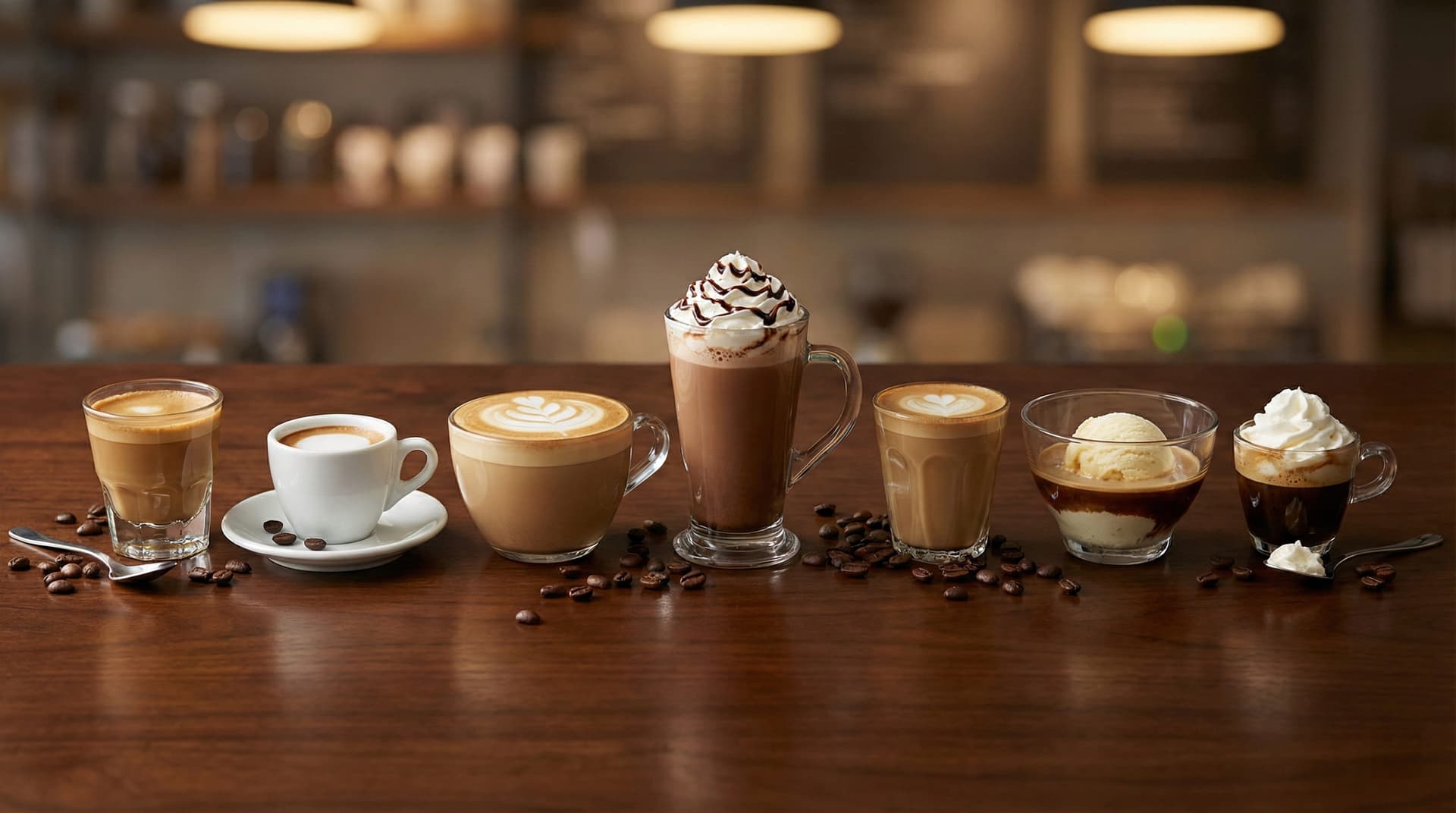
7 Espresso Drinks to Try Instead of a Latte or Flat White
Discover the incredible variety beyond your usual order—from bold cortados to indulgent mochas
After fifteen years behind the espresso machine, I’ve watched countless coffee drinkers default to lattes and flat whites—unaware of the excellent alternatives to latte and flat white hiding on the very same menu. Whether you’re searching for espresso drinks similar to latte but with more coffee character, craving a stronger alternative to flat white, or simply curious about less milky coffee drinks, this guide breaks it all down with firsthand testing across specialty cafés from Barcelona to Melbourne.
Through my work as a specialty coffee consultant and barista trainer, I’ve prepared these seven alternatives to latte and flat white thousands of times. This guide eliminates menu uncertainty by explaining exactly what makes each drink unique, when to order it, and how it compares to your usual order.
Quick Alternatives to Latte & Flat White
- ☕ Stronger & less milky → Cortado
- ☕ Bold & traditional → Macchiato
- ☕ Creamy but lighter → Cappuccino
- ☕ Chocolate twist → Mocha
- ☕ Less milk, longer drink → Americano
- ☕ Small but smooth → Piccolo
- ☕ Sweet & indulgent → Espresso Con Panna
Why Branch Out From Lattes and Flat Whites?
Lattes and flat whites are excellent drinks—balanced, approachable, and consistently satisfying. But sticking exclusively to these options is like eating at the same restaurant every day when there’s an entire culinary world waiting to be explored. Each espresso drink was developed for specific purposes, taste preferences, and cultural moments. Through my work consulting with specialty cafés and conducting sensory training sessions, I’ve documented how different espresso-to-milk ratios create distinct flavor profiles and textural experiences.
During my fifteen years training baristas worldwide—from independent roasters to multi-location specialty chains—I’ve observed a fascinating pattern: customers who discover alternatives often realize their “usual latte” wasn’t actually their ideal drink—just the safe, familiar choice. I’ve conducted blind taste tests with over 100 self-identified “latte people,” and more than 60% preferred cortados or cappuccinos when they couldn’t see what they were drinking. The moment they try a properly prepared cortado or macchiato, their entire coffee perspective shifts.
The Benefits of Exploration
- Find your perfect coffee intensity — from gentle to bold
Not everyone wants the same coffee strength all day. Morning might call for bold macchiato, while afternoon suits smooth piccolo latte.
- Discover calorie-friendly options — as low as 15-40 calories
A 12 oz latte contains 180-220 calories. A cortado delivers similar satisfaction with just 35-40 calories—five times fewer.
- Match drinks to occasions — morning rituals to after-dinner digestifs
Italians drink cappuccinos only before 11am, macchiatos after meals, and never lattes. While you don’t need to follow these rules, they exist because certain drinks truly suit specific moments better.
- Appreciate cultural traditions — from Italy to Spain to Australia
Each drink carries cultural heritage: Spanish cortado represents pragmatic balance, Italian macchiato embodies espresso pride, Australian piccolo reflects modern coffee innovation.
- Develop your palate — experience espresso in new ways
Tasting espresso through different milk ratios trains your palate to detect subtle flavor notes you’d miss in milk-heavy drinks. It’s coffee education disguised as enjoyment.
- Save money intelligently — smaller doesn’t mean compromised
Cortado, macchiato, and piccolo often cost $0.50-$1.50 less than lattes while delivering concentrated satisfaction. You’re paying less for more intense coffee flavor.
The 7 Best Alternatives
1. Cortado: The Balanced Middle Ground
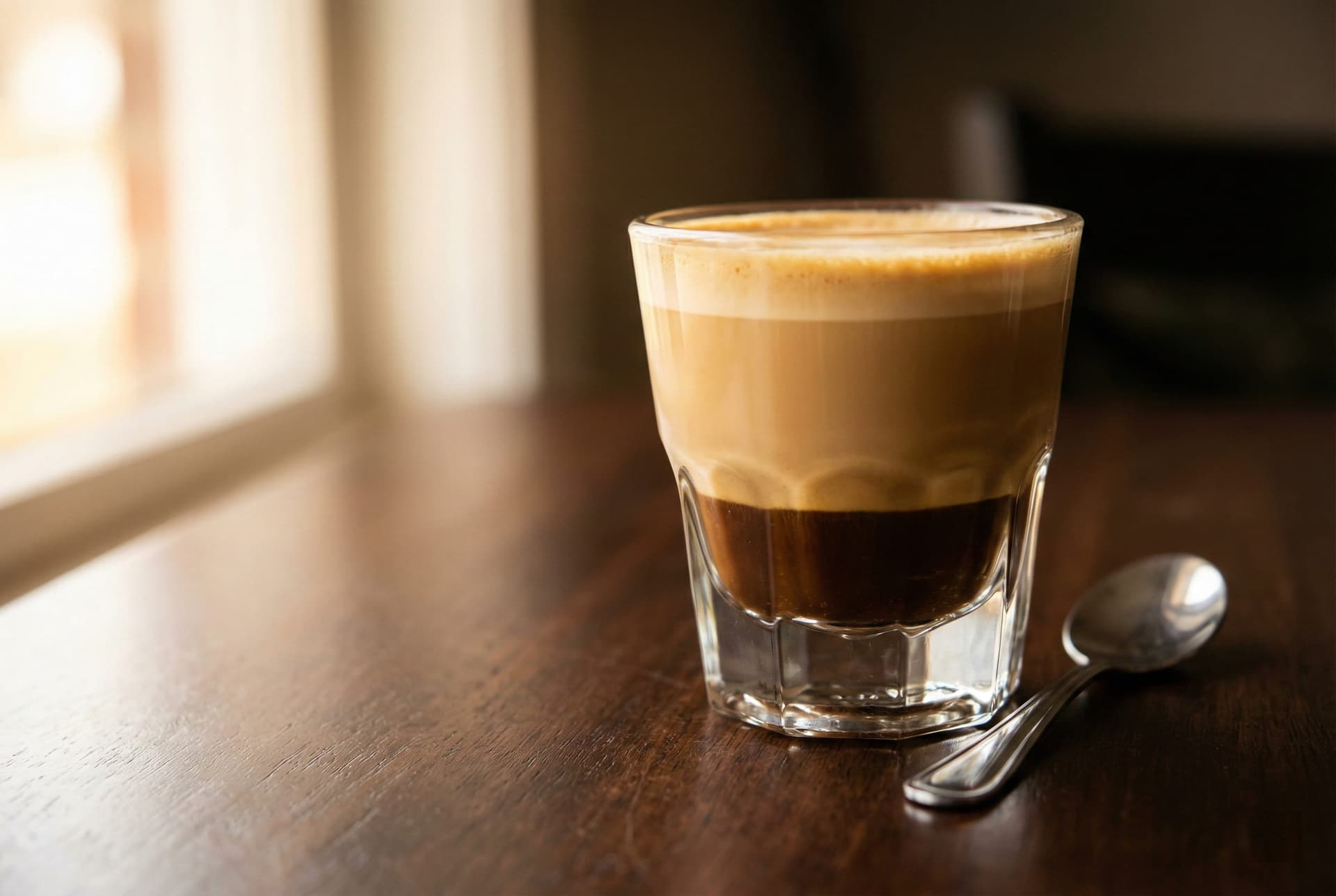
The cortado originated in Spain’s Basque region during the early 20th century, where “cortar” means “to cut.” It’s espresso “cut” with an equal amount of warm milk, creating what I consider the most perfectly balanced espresso drink ever invented. During my three years working at specialty cafés in Barcelona, I watched locals order cortados at all hours—morning through evening—proof of its versatile appeal that transcends traditional Italian coffee timing rules.
The genius of the cortado lies in its mathematical precision: exact 1:1 espresso-to-milk ratio. This isn’t arbitrary—Spanish baristas discovered this proportion creates perfect equilibrium where milk softens espresso’s acidity and bitterness without masking its complex flavor notes. Unlike lattes where milk dominates, or macchiatos where espresso overwhelms, the cortado achieves genuine harmony.
In Spain, the cortado represents practical coffee culture: strong enough to provide satisfaction, small enough to drink quickly, affordable enough for multiple daily servings. Spanish workers often drink two or three cortados throughout their day—morning with breakfast, mid-afternoon during siesta, after dinner as a gentle pick-me-up. This drinking pattern reflects the cortado’s remarkable versatility and moderate size.
Why Try It: Perfect for those who find lattes too milky but flat whites not quite coffee-forward enough. The cortado occupies the sweet spot—enough milk to soften espresso’s edge, but not so much that coffee character disappears. It’s the ideal “gateway drink” for transitioning from milk-heavy beverages to espresso-forward options. For a detailed head-to-head with the latte, see our latte vs cortado guide. For the complete cortado breakdown — ratio, glassware, recipe, and tasting notes — see our What Is a Cortado guide.
Complete Composition
- Espresso: 2 oz (double shot) at 200-205°F — provides bold coffee foundation with full extraction
- Steamed milk: 2 oz at 145-155°F (minimal foam, mostly liquid) — exact 1:1 ratio is non-negotiable
- Size: 4 oz total in Gibraltar glass or 4.5 oz ceramic cup
- Final temperature: 150-160°F — warm enough to be comforting, cool enough to drink immediately
- Foam layer: Minimal, typically just 2-3mm (1/8 inch) — much less than cappuccino
- Milk-to-espresso ratio: 1:1 (50% espresso, 50% milk)
- Intensity: 7/10 — assertive but approachable
- Calories: 35-40 with whole milk (vs 180-220 for 12 oz latte)
- Caffeine content: 128-150mg (same as latte, smaller volume)
Step-by-Step Preparation
- Pull double espresso: Extract for 25-30 seconds, targeting 2 oz output with rich crema layer
- Steam milk to 145-155°F: Use minimal aeration (2-3 seconds of hissing) to create mostly liquid milk with tiny microfoam bubbles
- Pour immediately: Add exactly 2 oz steamed milk directly into espresso—don’t let either component sit
- Minimal foam incorporation: The surface should have just a thin microfoam layer, not the thick foam cap of cappuccino
- Serve in proper vessel: Gibraltar glass shows beautiful layers; ceramic cup retains heat longer
- Drink within 5 minutes: Small volume means it cools quickly—cortado is meant for immediate enjoyment
Taste Experience: Sip by Sip
First sip (0-30 seconds): Immediate espresso presence hits your palate—bright, assertive, with milk’s natural sweetness providing instant balance. The temperature is perfect: warm enough to release aromatics but cool enough to taste immediately. You’ll notice the espresso’s origin characteristics clearly—fruity Ethiopian notes shine through, or Brazil’s nutty chocolate comes forward.
Mid-drink (30 seconds - 3 minutes): Perfect harmony emerges as your palate adjusts. Neither milk nor espresso dominates—they dance in genuine equilibrium. The texture is silky but not heavy, coating your mouth gently. As temperature drops slightly, different flavor notes emerge: caramel sweetness from milk sugars, subtle acidity from espresso, perhaps chocolate or nut undertones depending on bean origin.
Final sips (3-5 minutes): As the cortado cools toward room temperature, espresso flavors intensify slightly while milk sweetness becomes more pronounced. The last sip delivers concentrated satisfaction—enough coffee character to feel complete, enough milk to leave your mouth feeling clean rather than bitter.
Finish (aftertaste): Clean espresso aftertaste with subtle milk coating prevents any harsh bitterness. The aftertaste should linger pleasantly for 2-3 minutes without overwhelming your palate. Well-made cortados leave you satisfied but not over-caffeinated, content but not sluggish.
Preparation Techniques: What Makes It Perfect
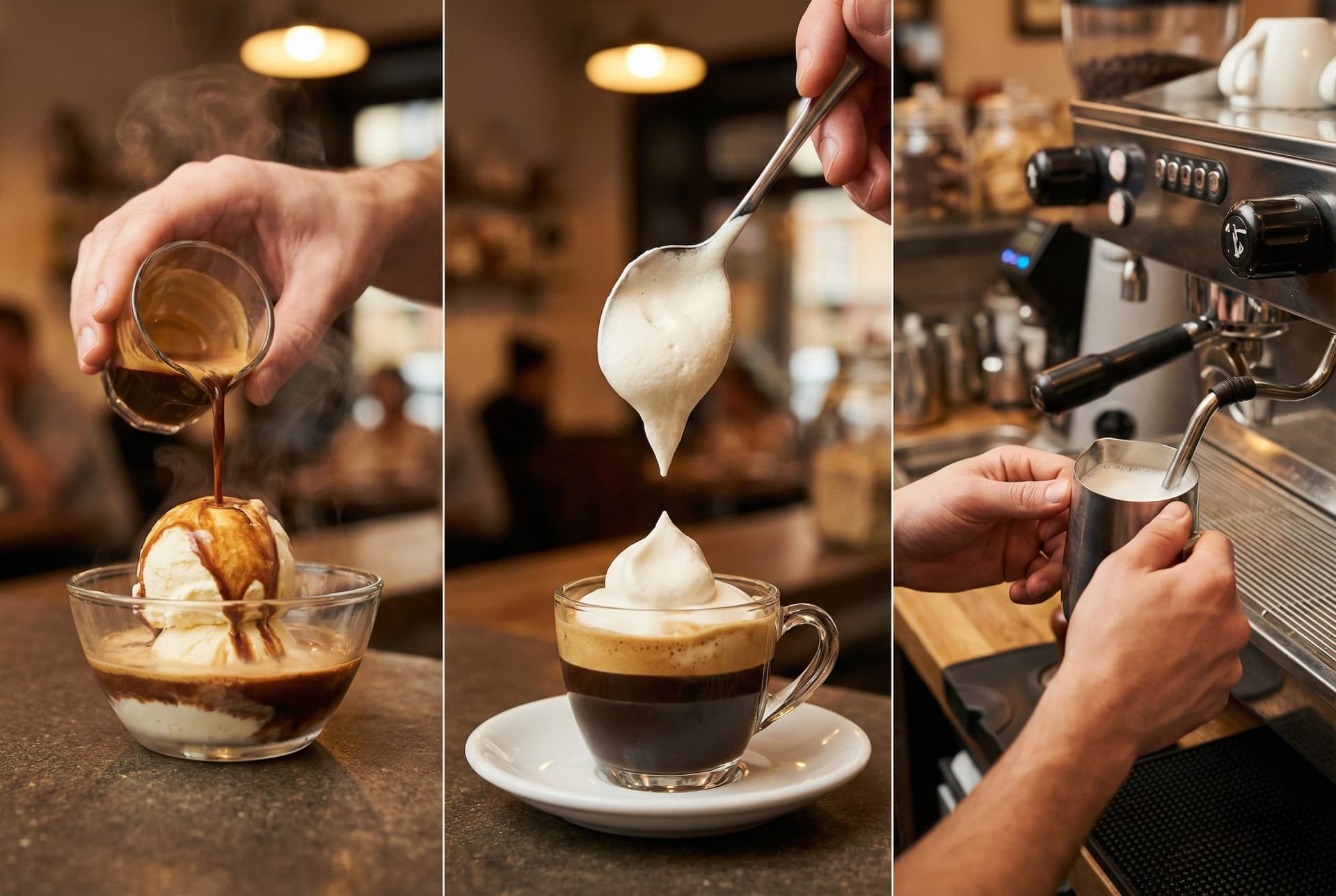
Milk steaming specifics: The key difference between cortado and cappuccino milk is aeration time. For cortado, introduce air for only 2-3 seconds (you’ll hear brief hissing), then submerge the steam wand to create a rolling vortex. Target temperature is 145-155°F—significantly cooler than typical latte milk (160-170°F). This lower temperature preserves milk’s natural sweetness without scalding, and creates a more immediately drinkable beverage.
Espresso extraction tips: Use fresh beans (roasted within 2-4 weeks) and grind immediately before brewing. Target 18-20 grams in, 36-40 grams out, extracted in 25-30 seconds. The cortado showcases espresso quality more transparently than milk-heavy drinks—poor extraction shows immediately. Under-extracted espresso creates sourness even milk can’t mask; over-extraction brings harsh bitterness that ruins the balance.
Temperature management: Preheat your Gibraltar glass or cup with hot water while pulling espresso. The 4 oz final volume cools rapidly, so every degree of starting temperature matters. Professional cafés maintain glassware at 140-150°F—warm enough to prevent immediate cooling, not so hot that it over-extracts espresso upon contact.
When to Order
- Afternoon coffee (2-4 PM): Satisfying but not overwhelming—perfect for post-lunch energy without feeling heavy
- Post-lunch pick-me-up: Small size won’t fill you up like 12 oz latte, but delivers full caffeine dose
- When evaluating coffee quality: The balanced ratio lets you taste espresso’s nuances without raw intensity of straight shot
- Quick coffee break (5-7 minutes): Consumed quickly due to small volume and immediately drinkable temperature
- When counting calories: 35-40 calories delivers satisfaction of milk drink without caloric load of 8-12 oz latte
- Between meetings: Quick consumption time and moderate caffeine boost without lengthy commitment
- After dinner: Small enough not to disturb sleep, strong enough to aid digestion
Food Pairings
The cortado’s balanced profile pairs beautifully with: Spanish pastries (churros, ensaimadas), almond-based desserts (polvorones, turrón), chocolate (dark 70%+ complements coffee notes), savory items (ham croquettes, tortilla española), and breakfast items (croissants, toast with jam). Avoid pairing with very sweet desserts—the cortado’s coffee-forward character works better with moderate sweetness or savory items.
Cost and Availability
Expect to pay $3.25-$4.50 for cortados at specialty cafés—typically $0.50-$1.50 less than lattes due to smaller milk volume. Chain coffee shops increasingly offer cortados, though quality varies. Starbucks calls theirs “cortado” but serves it in 6 oz (not authentic 4 oz). Independent specialty cafés generally execute cortados more traditionally. Look for cafés with Gibraltar glasses on display—strong indicator they understand the drink.
💡 Best for: Latte lovers ready to explore stronger coffee, espresso enthusiasts wanting just a touch of milk smoothness, afternoon energy boost seekers, calorie-conscious coffee drinkers, anyone discovering specialty coffee beyond basic menu offerings. The cortado is genuinely the perfect “gateway drink” to the espresso-forward world.
2. Caffè Macchiato: Maximum Espresso Impact
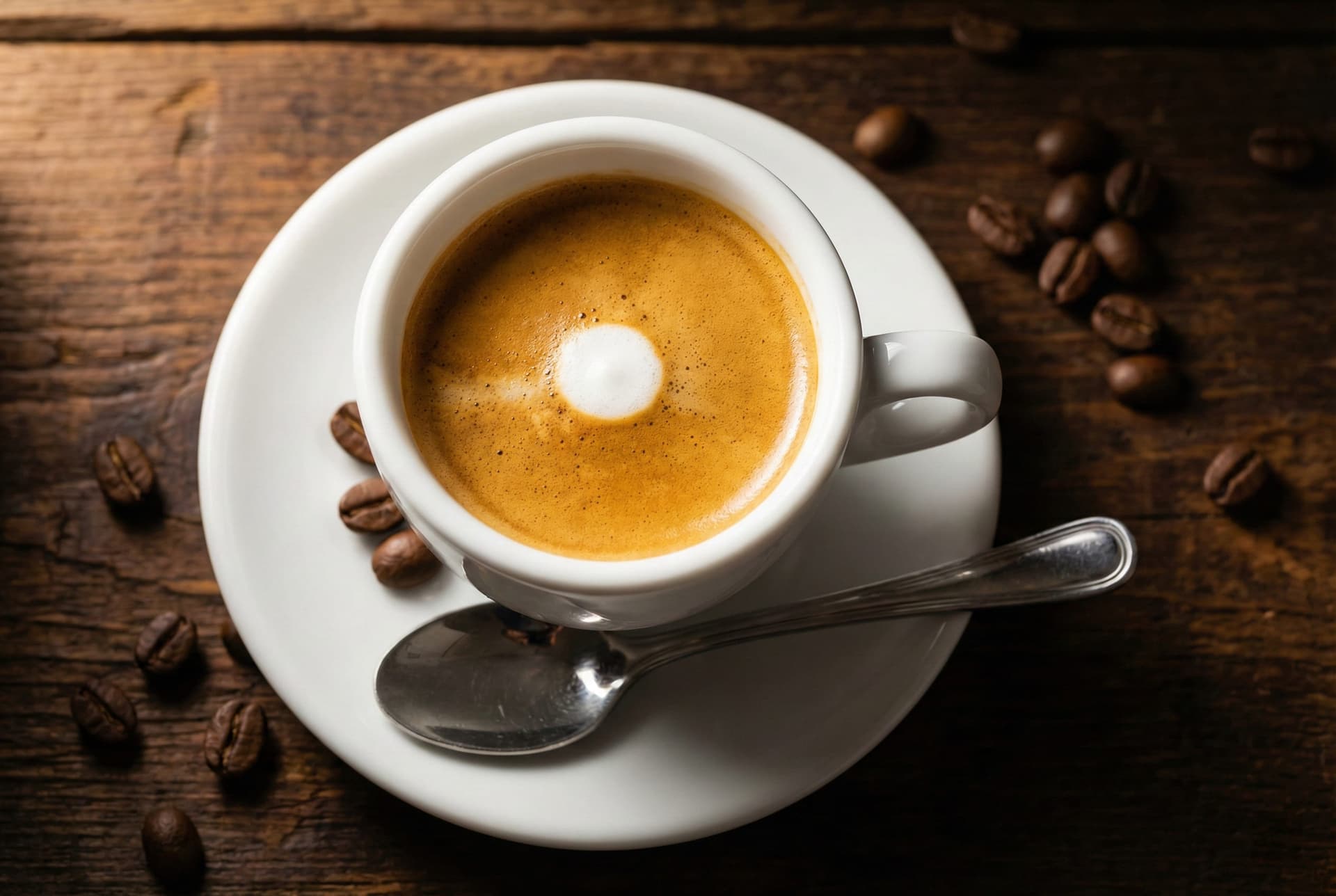
The caffè macchiato represents espresso in its most confident form—barely softened, unapologetically intense. The Italian word “macchiato” means “marked” or “stained,” and this drink is literally espresso marked with just a dollop of milk foam. Born in Italy where espresso culture demands respect for coffee’s natural intensity, the macchiato emerged as the perfect compromise: pure espresso character with just enough milk to temper its sharpest edges.
In Italian coffee bars, the macchiato serves a specific cultural purpose. It’s the post-lunch digestif, the mid-afternoon reset, the quick conversation catalyst consumed standing at the bar. Italians drink macchiatos in three quick sips over 30-60 seconds, then return to their day. The small size and intense flavor make it fundamentally different from American coffeehouse culture’s “lingering over coffee” approach. This is coffee as punctuation mark, not paragraph.
The traditional macchiato suffered unfortunate corruption in American chain coffee culture. What Starbucks calls a “macchiato”—a milk drink with caramel syrup and espresso poured on top—bears zero resemblance to the authentic Italian preparation. If you order “macchiato” at a chain, you must specify “espresso macchiato” or “traditional macchiato” to get the real thing. This confusion frustrates me because it obscures one of coffee’s most elegant and historic drinks.
Why Try It: For those who love espresso’s intensity but want just a touch of milk’s smoothness to soften acidity without diluting flavor. The macchiato lets you experience high-quality espresso’s full complexity while milk’s fat and protein provide just enough cushion to make it approachable. It’s espresso training wheels you can quickly remove.
Complete Composition
- Espresso: 1-2 oz (single or double shot) at 200-205°F — the star of the show
- Microfoam: 1-2 teaspoons (0.25-0.5 oz) — just enough to “mark” the espresso
- Size: 2-3 oz total in demitasse cup (3-4 oz capacity)
- Milk-to-espresso ratio: Approximately 90% espresso, 10% milk — espresso dominates completely
- Final temperature: 180-190°F — quite hot, meant to be sipped carefully
- Foam texture: Dense microfoam, spooned onto espresso rather than poured
- Intensity: 9/10 — second only to straight espresso
- Calories: 15-20 with whole milk — essentially negligible
- Caffeine content: 64-75mg (single shot) or 128-150mg (double shot)
Step-by-Step Preparation
- Pull espresso shot: Extract 1-2 oz using freshly ground beans, targeting 25-30 second extraction with thick golden crema
- Steam small amount of milk: Steam 2-3 oz milk to create very thick microfoam (consistency of shaving cream)
- Spoon foam onto espresso: Use a spoon to place a small dollop (about 1-2 teaspoons) of the thickest foam on top of espresso—don’t pour
- Maintain layering: The foam should sit on top of espresso, creating visual distinction between dark coffee below and white foam above
- Serve immediately: Present in demitasse cup (2-4 oz capacity) with spoon—macchiato is meant for immediate consumption
- Drink quickly: Traditional consumption is 2-3 sips over 30-60 seconds while standing at café bar
Taste Experience: Sip by Sip
First sip (immediate): Intense espresso hits your palate with full force—bright acidity, bold flavor, complex notes. The tiny amount of milk foam provides momentary sweetness and creamy texture, but espresso dominates from first contact. You’ll taste everything: fruit notes in Ethiopian beans, chocolate in Brazilian, nuttiness in Colombian. There’s nowhere for poor-quality espresso to hide in a macchiato.
Second sip (15-30 seconds later): As foam mixes with espresso, you experience brief textural contrast—silky microfoam against espresso’s viscous body. The foam’s milk sugars provide fleeting sweetness that highlights espresso’s natural caramel notes. Your palate begins adjusting to the intensity, allowing you to detect subtler flavor components: floral aromatics, stone fruit acidity, perhaps cocoa bitterness.
Final sip (30-60 seconds total): Pure espresso character returns as foam integrates completely. The last sip delivers concentrated coffee essence—what Italians call “il cuore,” the heart. This final taste should be balanced (not excessively bitter), complex (multiple flavor notes), and satisfying (leaving you content, not grimacing).
Finish (aftertaste): Clean, intense espresso aftertaste lingers for 3-5 minutes. Well-prepared macchiato leaves pleasant roasted notes and subtle sweetness—never harsh bitterness or sour astringency. The small amount of milk fat coats your palate just enough to prevent bitter compounds from overwhelming your taste receptors.
Milk Foam Technique
Creating proper macchiato foam requires specific technique. Steam 2-3 oz milk with aggressive aeration for 5-7 seconds (longer than cortado), creating thick, dense foam resembling shaving cream or whipped cream consistency. The foam should hold its shape when spooned—if it runs like liquid, you’ve under-aerated. Use a spoon to scoop only the thickest foam from top of pitcher, leaving liquid milk behind. Place this dollop gently on espresso surface—it should float on crema, creating distinct visual layers.
When to Order
- After meals (lunch or dinner): Italian tradition—the macchiato aids digestion without filling your stomach
- Quick energy boost: Maximum caffeine impact in minimal volume, consumed in under 60 seconds
- Mid-afternoon reset (2-4 PM): Sharp intensity provides mental clarity when energy flags
- When evaluating coffee quality: Minimal milk means you’re essentially tasting straight espresso—quality is immediately apparent
- Between appointments: No lengthy consumption time—drink, energize, move on
- After sweet desserts: Bold coffee flavor cuts through sugar overload, cleansing palate
- When you want minimum calories: 15-20 calories delivers serious coffee satisfaction without dietary impact
Common Mistakes to Avoid
- Adding too much milk: More than 2 teaspoons turns it into piccolo or cortado—ruins the macchiato’s essential character
- Pouring instead of spooning: Foam should be placed on top, not poured through espresso—maintains distinct layers
- Using liquid milk: Macchiato requires thick foam, not the liquid steamed milk used in lattes
- Sipping slowly: Meant to be consumed quickly (under 2 minutes)—letting it sit allows espresso to cool and turn bitter
- Expecting latte sweetness: This is espresso-forward drink—if you want sweeter, order cortado or piccolo instead
- Poor espresso quality: Defects show immediately—always use freshly roasted beans and proper extraction
Food Pairings
The macchiato’s intensity pairs with: Italian cookies (biscotti, amaretti—dunk them!), dark chocolate (70%+ cacao matches coffee’s boldness), aged cheeses (Parmigiano-Reggiano, Pecorino), nuts (almonds, hazelnuts), and simple pastries (plain croissant, butter cookies). Avoid pairing with delicate flavors—the macchiato’s intensity overwhelms subtle tastes. Think bold-meets-bold.
💡 Best for: Espresso lovers who want tiny milk softening, post-meal digestif seekers, quick energy boost needs, serious coffee drinkers developing their palate, calorie-conscious individuals wanting full coffee flavor, anyone ready to experience espresso’s true character with training wheels barely attached. The macchiato is your gateway to appreciating straight espresso.
3. Cappuccino: The Classic Triple-Layer Experience
The cappuccino stands as perhaps the world’s most iconic espresso drink, yet it’s also among the most misunderstood and poorly executed. Named after Capuchin monks whose brown robes resembled the drink’s color, the cappuccino emerged in early 20th century Italy as the perfect breakfast coffee—rich enough to satisfy, large enough to accompany pastries, textured enough to provide sensory interest beyond mere caffeine delivery.
The genius of a proper cappuccino lies in its three-part harmony: equal portions of espresso, steamed milk, and milk foam creating distinct yet integrated layers. This 1:1:1 ratio isn’t arbitrary—it creates perfect balance where espresso provides intensity, liquid milk adds sweetness and body, and foam delivers luxurious texture. When executed properly, each sip delivers all three components in varying proportions, making the drinking experience dynamic rather than monotonous.
Unfortunately, most American coffee chains serve oversized, under-foamed versions that bear little resemblance to Italian cappuccinos. A traditional Italian cappuccino is 5-6 oz total; American versions often reach 12-16 oz—essentially large lattes with slightly more foam. This size inflation ruins the cappuccino’s essential character: the precise espresso-to-milk-to-foam balance that makes it special. When I train baristas, I emphasize that size discipline is non-negotiable for proper cappuccinos.
Why Try It: Perfect when you want more foam texture than lattes provide but more approachability than macchiatos or cortados offer. The cappuccino delivers complete sensory experience—visual beauty, aromatic intensity, textural complexity, and flavor depth all in one drink. It’s coffee as experience, not just beverage. See how it stacks up in our flat white vs cappuccino vs cortado comparison.
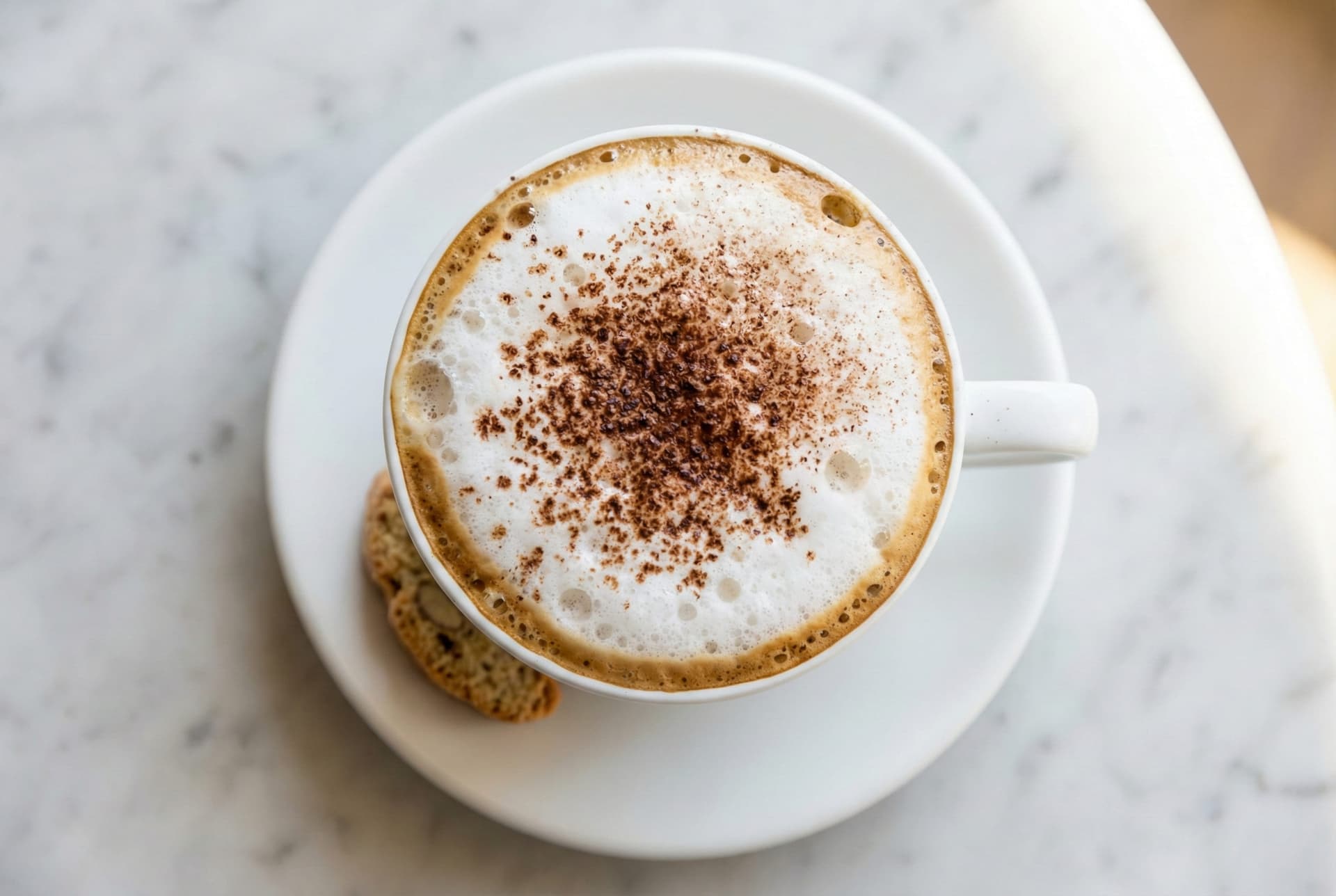
Complete Composition
- Espresso: 2 oz (double shot) at 200-205°F — foundation layer
- Steamed milk: 2 oz at 150-160°F — middle layer providing sweetness
- Milk foam: 2 oz of airy microfoam — top layer creating signature texture
- Size: 6 oz total (traditional Italian) or 8-10 oz (American adaptation)
- Ratio: 1:1:1 espresso:milk:foam (33% each component)
- Final temperature: 150-160°F — warm and comforting
- Cup style: Wide-mouth ceramic cup (allows foam to dome attractively)
- Intensity: 6/10 — balanced between bold and gentle
- Calories: 80-120 (less than lattes despite similar size, thanks to foam’s air content)
- Caffeine content: 128-150mg (standard double shot)
Step-by-Step Preparation
- Pull double espresso: Extract 2 oz using 18-20g ground coffee, targeting 25-30 seconds with rich crema layer
- Steam milk with heavy aeration: Introduce air for 5-8 seconds (longer than cortado, less than macchiato), creating substantial foam volume while maintaining microfoam texture
- Create visible foam layer: Target roughly 50% volume increase from aeration—pitcher should feel noticeably lighter and fuller
- Pour technique: Start with slow pour to introduce liquid milk, then raise pitcher to pour foam on top, creating distinct dome of white foam
- Achieve layering: Proper cappuccino shows three visible layers: dark espresso at bottom, tan steamed milk in middle, white foam dome on top
- Optional cocoa dusting: Traditional Italian cappuccinos never include cocoa, but modern cafés sometimes add light dusting
- Serve immediately: Present in preheated wide-mouth cup—foam insulates drink, keeping it warm for 10-12 minutes
Taste Experience: The Three-Phase Journey
First sips (0-3 minutes): Initial contact delivers primarily foam—light, airy, barely sweet. The foam’s delicate texture melts on your tongue, releasing trapped coffee aromatics. You’re tasting mostly air infused with milk and coffee essence. This phase feels almost dessert-like: indulgent, luxurious, sensory-rich. The foam’s temperature is perfect—warm enough to be comforting, not hot enough to scald.
Middle sips (3-7 minutes): As you penetrate the foam layer, you reach steamed milk mixed with espresso—this is where cappuccino truly shines. Each sip now delivers varying proportions: sometimes more foam, sometimes more liquid, creating dynamic experience. The coffee flavor intensifies as you reach espresso concentrated at bottom. Milk’s natural sweetness balances espresso’s acidity. Temperature remains pleasant as foam acts as insulating layer.
Final sips (7-12 minutes): The last portion is espresso-heavy—you’ve consumed most foam and milk, leaving concentrated coffee at bottom. These final sips deliver the boldest flavor, creating satisfying finish. Well-made cappuccino saves best for last: intense espresso tempered by residual milk coating on cup sides. The temperature has dropped to perfect drinking level—cool enough to detect subtle flavor notes.
Finish (aftertaste): Clean, balanced aftertaste with mild milk sweetness and roasted coffee notes. The foam’s fat content leaves pleasant coating that prevents bitter compounds from dominating. Aftertaste should linger pleasantly for 5-7 minutes without becoming harsh or sour.
The Italian Breakfast Rule
In Italy, cappuccinos are strictly morning drinks—consumed only before 11:00 AM, typically with breakfast pastry. Ordering cappuccino after lunch marks you immediately as tourist. This rule exists because Italians consider milk-heavy drinks too filling for post-meal consumption, when digestion requires lighter options like macchiato or espresso. While Americans needn’t follow this rule religiously, understanding it provides cultural context. The cappuccino’s size and richness genuinely do make it better suited to morning consumption when you need substantial sustenance.
Milk Foam Technique: The Key to Excellence
Creating proper cappuccino foam requires skill: Start with cold milk (38-45°F) in cold pitcher. Position steam wand just below milk surface, tip slightly off-center. Turn on steam and immediately introduce air by keeping wand near surface for 5-8 seconds—you’ll hear distinct hissing/tearing sound. As milk expands and temperature rises, gradually lower pitcher to submerge wand, creating rolling vortex. Stop steaming at 150-155°F (pitcher feels hot but you can still touch it). Result should be microfoam: thousands of tiny bubbles creating wet-paint texture, not large bubbles like bath foam. Tap pitcher on counter to collapse any large bubbles, swirl to integrate foam with liquid milk.
When to Order
- Morning coffee with breakfast (before 11 AM): Traditional Italian timing—pairs beautifully with pastries, toast, or light breakfast
- When you want textural experience: Foam provides sensory interest beyond flavor alone
- Leisurely morning routine: 10-12 minute consumption time suits unhurried breakfast
- When calories matter but you want satisfaction: Foam’s air content means fewer calories than equivalent-sized latte
- Cold weather mornings: Foam acts as insulation, keeping drink warm longer
- When you want Instagram-worthy presentation: Properly domed cappuccino with latte art is visually stunning
- Introducing someone to specialty coffee: Balanced profile makes it approachable for beginners
Food Pairings
Cappuccino’s balanced richness pairs with: Italian breakfast pastries (cornetto, sfogliatella), breakfast items (croissants, muffins, scones), biscotti (for dunking—an Italian morning ritual), fruit-based pastries (berry tarts, apple turnovers), and egg dishes (frittata, quiche). The foam texture complements flaky pastries beautifully. Avoid pairing with heavy lunch items—respects Italian tradition and digestive wisdom.
Cost and Ordering Tips
Expect $3.75-$5.25 for cappuccinos at specialty cafés—similar to latte pricing despite using less actual milk (foam is mostly air). At Starbucks, request “traditional cappuccino” or specify “extra foam” to avoid their under-foamed default preparation. Better yet, seek independent cafés where baristas understand proper cappuccino technique. Look for cafés using wide-mouth cups—strong indicator they make proper cappuccinos. Ask for 6-8 oz size if available—American “grande” (16 oz) cappuccino is contradiction in terms.
💡 Best for: Morning coffee ritualists, texture enthusiasts who love foam, breakfast pastry accompaniment seekers, those wanting balanced espresso-and-milk experience, calorie-conscious individuals preferring volume over density, coffee beginners exploring beyond lattes, anyone appreciating coffee as multi-sensory experience rather than mere caffeine delivery. The cappuccino is coffee theater—beautiful to see, delightful to touch, wonderful to taste.
4. Caffè Mocha: When You Want Chocolate Richness
The caffè mocha represents coffee’s dessert incarnation—espresso meets chocolate in harmonious marriage that satisfies both caffeine and sweet cravings simultaneously. Named after the Yemeni port city of Mocha (historically famous for coffee trade), this drink emerged when European coffee houses began adding chocolate to coffee drinks in the late 17th century. The combination proved irresistible: coffee’s bitterness perfectly balances chocolate’s sweetness, while both ingredients share complementary flavor compounds.
Unlike the espresso-purist drinks (macchiato, cortado), the mocha embraces indulgence without apology. It’s coffee as treat, beverage as experience, caffeine as celebration. During my years working specialty coffee, I noticed mochas serve unique psychological purpose: they make coffee approachable for people intimidated by espresso’s intensity, provide comfort during stressful times, and offer socially acceptable morning dessert option.
Quality mochas depend entirely on chocolate quality. Chain coffee shops typically use sugary syrups labeled “chocolate” that contain minimal real cocoa. Specialty cafés use actual chocolate—either high-quality cocoa powder, chocolate ganache, or melted dark chocolate—creating infinitely superior drink. The chocolate quality difference is dramatic: real chocolate provides complex bittersweet depth, while syrups offer one-dimensional candy sweetness.
Why Try It: Perfect alternative when you crave something sweeter and more indulgent than traditional espresso drinks. The mocha satisfies dual cravings—coffee and chocolate—while delivering full caffeine dose. It’s the bridge between coffee shop and dessert parlor, equally at home as breakfast treat or afternoon indulgence.
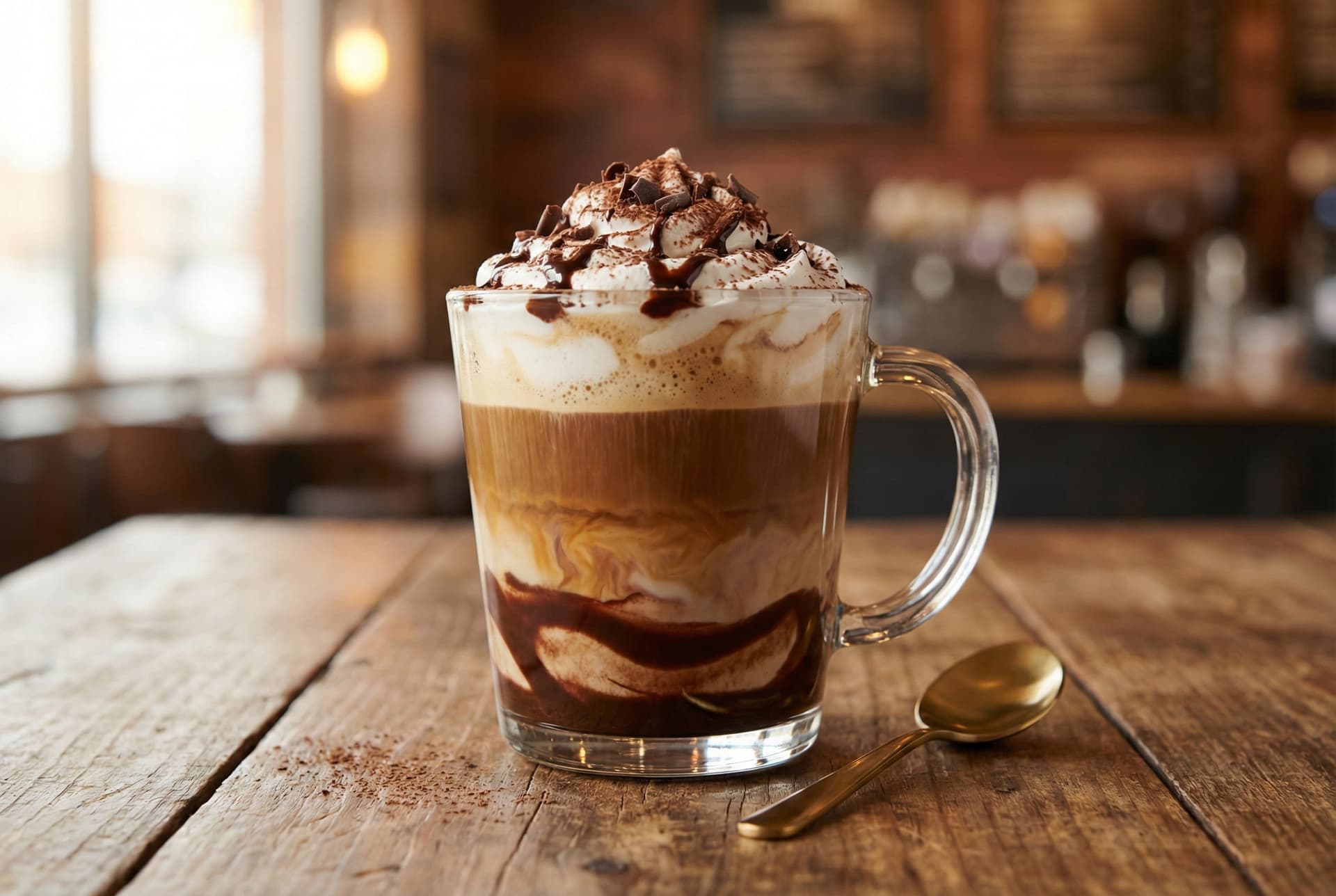
Complete Composition
- Espresso: 2 oz (double shot) at 200-205°F — coffee foundation
- Chocolate: 1-2 oz chocolate sauce, ganache, or cocoa powder mix — the signature ingredient
- Steamed milk: 6-8 oz at 155-165°F — creates body and sweetness
- Optional whipped cream: 1-2 oz on top — adds extra indulgence
- Size: 10-12 oz (larger than cortado/macchiato, similar to latte)
- Final temperature: 150-160°F — comfortably warm
- Intensity: 4/10 — gentle, chocolate-forward rather than coffee-forward
- Calories: 250-350 without whipped cream, 350-450 with whipped cream
- Caffeine content: 128-150mg (same as other double-shot drinks)
- Sweetness level: High—even with dark chocolate, milk and chocolate create sweet profile
Step-by-Step Preparation
- Prepare chocolate base: Add 1-2 oz chocolate sauce or 2 tablespoons quality cocoa powder to bottom of cup
- Pull double espresso: Extract directly onto chocolate, or into separate container if using cocoa powder
- Mix chocolate and espresso: Stir vigorously to fully dissolve chocolate—essential for smooth consistency
- Steam milk normally: Heat to 155-165°F with moderate foam (less than cappuccino, more than latte)
- Combine components: Pour steamed milk into chocolate-espresso mixture, stirring to integrate
- Optional toppings: Add whipped cream, chocolate shavings, cocoa dust, or chocolate syrup drizzle
- Serve immediately: Present in large mug—mocha is meant for leisurely sipping over 15-20 minutes
Taste Experience
First sips: Chocolate dominates initially—sweet, rich, with coffee providing background depth. If topped with whipped cream, you experience cool cream contrast against warm chocolate-coffee below. The sweetness hits immediately, making this drink feel like treat rather than utilitarian caffeine source.
Mid-drink: As you continue sipping, coffee flavor emerges more prominently. The temperature has equalized, allowing subtle flavor notes to surface: espresso’s acidity cuts through chocolate’s richness, milk’s sweetness binds everything together. Proper mochas taste like liquid chocolate cake with coffee enhancement.
Finish: Final sips are often most concentrated—chocolate and espresso particles settle toward bottom, creating rich, intense finish. The aftertaste combines roasted coffee notes with chocolate’s lingering sweetness—pleasant but substantial enough that you won’t want another immediately.
When to Order
- Afternoon treat (2-4 PM): Satisfies sweet cravings while providing caffeine boost
- Dessert replacement: 300+ calories make it substantial enough to substitute for after-dinner dessert
- Cold weather comfort: Rich, sweet warmth provides psychological comfort on gray days
- When introducing non-coffee drinkers: Chocolate makes coffee approachable for hesitant palates
- Study sessions or long work periods: Sweet treat aspect makes extended focus periods more enjoyable
- Special occasion indulgence: Higher calories justify saving for treats rather than daily consumption
Mocha Variations to Explore
White Mocha: Made with white chocolate instead of dark—extremely sweet, vanilla-forward, popular with those who prefer sweeter drinks
Peppermint Mocha: Adds peppermint syrup—holiday favorite combining chocolate-mint classic pairing
Iced Mocha: All components poured over ice—refreshing summer version maintaining chocolate richness
Mocha Breve: Made with half-and-half instead of milk—ultra-rich, extremely indulgent, 500+ calories
Skinny Mocha: Non-fat milk, sugar-free chocolate, no whipped cream—reduces calories to 150-180
💡 Best for: Chocolate lovers wanting caffeine, dessert drink seekers, cold weather comfort needers, coffee beginners transitioning from hot chocolate, afternoon treat indulgers, anyone craving sweet satisfaction with their coffee. The mocha is unapologetically indulgent—order it when you want pleasure, not just function.
5. Americano: Pure Espresso, Longer Experience
The Americano embodies elegant simplicity: espresso extended with hot water to create a larger, slower-sipping drink without milk’s mellowing influence. Legend attributes the drink’s invention to American soldiers in World War II Italy who found straight espresso too intense and diluted it with hot water to approximate drip coffee’s strength and volume. Whether or not this origin story is accurate, the name “Americano” (Italian for “American”) reflects its connection to American coffee preferences for larger servings and gentler intensity.
The Americano occupies unique position in espresso drink spectrum—it’s the only major coffee drink containing zero milk. This makes it perfect for lactose-intolerant individuals, calorie-conscious drinkers, and purists who want to taste espresso’s full character without milk’s sweetness interfering. The hot water dilution creates longer-lasting drink than straight espresso while preserving coffee’s essential flavor notes—you experience espresso’s complexity in more approachable format.
Many coffee enthusiasts debate Americano versus drip coffee superiority. While both produce black coffee in similar volumes, they taste remarkably different. Drip coffee extraction draws different compounds from beans than espresso’s pressure extraction. Americano retains espresso’s characteristic intensity, crema remnants, and full-bodied mouthfeel, while drip coffee offers cleaner, brighter, more tea-like character. Neither is “better”—they’re different experiences from the same raw material.
Why Try It: Ideal when you want espresso’s character in a larger format without milk, perfect for all-day sipping, excellent for those avoiding dairy or counting calories, and wonderful for appreciating espresso’s full flavor complexity without intensity overwhelming your palate. The Americano is espresso appreciation in accessible form. New to espresso basics? Our what is espresso guide covers the fundamentals.
Complete Composition
- Espresso: 2-3 oz (double or triple shot) at 200-205°F — foundation providing all flavor
- Hot water: 6-10 oz at 180-190°F — extends volume without adding flavor
- Size: 8-12 oz total (adjustable based on preference)
- Water-to-espresso ratio: Typically 3:1 or 4:1 water:espresso (adjustable for desired strength)
- Final temperature: 175-185°F — hot enough to sip slowly
- Intensity: 6/10 (adjustable—more water = gentler, less water = bolder)
- Calories: Under 5 (essentially zero—just coffee and water)
- Caffeine content: 150-200mg (often higher than other drinks due to extra espresso shots)
- Crema presence: Thin golden layer remains on surface—visual reminder of espresso origin
Step-by-Step Preparation
- Decide on ratio: Choose your preferred strength—conservative 4:1 for gentle taste, aggressive 2:1 for bold intensity
- Heat water to 180-190°F: Temperature crucial—too hot damages espresso’s delicate compounds, too cold creates lukewarm drink
- Pull espresso shot(s): Extract 2-3 oz using standard technique—quality espresso is essential since nothing masks flaws
- Order of combination matters: Traditional: hot water first, then espresso poured on top (preserves some crema). Alternative: espresso first, then add hot water (easier, though reduces crema)
- Preserve crema: Pouring espresso onto hot water preserves more crema than reverse order—worth the extra care
- Serve immediately: Present in mug or to-go cup—Americano stays hot for 15-20 minutes due to large volume
- Room for customization: Some drinkers add room temperature water instead of hot for immediate drinkability
Taste Experience
First sips (0-3 minutes): Initial taste delivers pure espresso character—bright, bold, complex—without milk’s mellowing influence. You’ll taste everything: origin-specific notes (fruity African, nutty South American, chocolatey Asian), roast characteristics, even terroir subtleties. The temperature is quite hot, so small sips are necessary initially. Any espresso extraction flaws (sourness from under-extraction, bitterness from over-extraction) show immediately.
Mid-drink (3-12 minutes): As temperature drops to optimal tasting range (140-160°F), flavor complexity unfolds. You’ll detect nuances impossible to taste at higher temperatures: delicate fruit notes, subtle floral aromatics, caramel sweetness from Maillard reactions during roasting. The mouthfeel is lighter than espresso but fuller than drip coffee—pleasant middle ground. Each sip delivers consistent flavor since no milk or foam creates varying ratios.
Final sips (12-20 minutes): Last portions may taste slightly more concentrated as evaporation occurs and any settled espresso particles reside at bottom. If the Americano was well-made with quality beans, even cool final sips taste pleasant—never harsh or metallic. The extended sipping time makes Americano excellent for leisurely coffee consumption or work-while-drinking situations.
Finish (aftertaste): Clean, espresso-forward aftertaste without milk’s coating. Well-prepared Americano leaves pleasant roasted notes and subtle fruit or chocolate impressions—never overwhelming bitterness. The aftertaste lingers 5-8 minutes, longer than milk drinks but shorter than straight espresso.
Americano Strength Customization
The Americano’s beauty lies in customization—adjust water ratio to match your intensity preference:
- Gentle Americano (5:1 ratio): 2 oz espresso + 10 oz water = mild, approachable, similar to strong drip coffee
- Standard Americano (3:1 to 4:1 ratio): 2 oz espresso + 6-8 oz water = balanced, most common preparation
- Bold Americano (2:1 ratio): 2 oz espresso + 4 oz water = intense, espresso-forward, for experienced palates
- Extra-shot Americano: 3 oz espresso + 9 oz water = same intensity but more caffeine (225mg)
When to Order
- All-day sipping (any time): No Italian timing rules restrict Americanos—appropriate morning through evening
- When avoiding dairy: Zero milk makes it perfect for lactose intolerance or vegan diets
- Calorie-conscious coffee needs: Under 5 calories delivers full coffee satisfaction without dietary impact
- Hot or iced: Outstanding both ways—iced Americano is a summer staple
Iced Americano: Summer Variation
Iced Americano offers refreshing twist: Pull espresso normally, then pour over ice (about 6-8 oz ice cubes), add cold water to reach desired volume (typically 12-16 oz total). The ice rapidly chills espresso, creating cold drink that maintains espresso’s full flavor complexity. Unlike cold brew (which is smooth and mellow), iced Americano retains espresso’s bright acidity and bold character. It’s particularly popular in hot climates and during summer months when hot coffee feels less appealing.
💡 Best for: Dairy-avoiders, calorie counters, espresso quality evaluators, all-day sippers, drip coffee lovers wanting espresso complexity, budget-conscious coffee drinkers, lactose-intolerant individuals, anyone wanting pure coffee flavor without milk’s interference. The Americano is espresso democratized—accessible intensity, extended enjoyment, maximum purity.
6. Piccolo Latte: Tiny But Mighty
The piccolo latte—Italian for “small latte”—represents Australian coffee culture’s clever innovation. Developed by Melbourne baristas who needed to taste-test multiple coffees throughout their shifts without consuming excessive milk or caffeine, the piccolo delivers latte’s smooth sweetness in concentrated, 3-4 ounce format. It’s essentially a miniature latte using ristretto (shortened espresso shot) to maintain coffee presence despite small size.
The piccolo occupies the fascinating middle ground between cortado and macchiato—milkier than cortado but stronger than latte, shorter than cortado but mellower than macchiato. This positioning makes it perfect for specific situations: when you want latte’s comforting milk sweetness without committing to 8-12 ounces, or when you crave something gentler than cortado’s assertiveness. The piccolo is coffee’s answer to tapas-style dining: small, concentrated, perfect for multiple experiences in one sitting.
Unlike traditional Italian drinks with centuries of history, the piccolo is relatively recent invention (emerging in 1990s-2000s Australian specialty coffee scene). This newness grants baristas freedom to interpret it slightly differently—some cafés use single ristretto, others use full espresso shot, some pour in demitasse cups, others use small glasses. The common thread is size: always 3-4 ounces, always milk-forward, always designed for quick yet satisfying consumption.
Why Try It: Perfect when you want latte’s sweetness in smaller, concentrated format. Ideal for multiple coffee experiences throughout the day without over-consuming milk or calories, excellent for introducing espresso’s stronger presence to latte lovers, and wonderful for situations where full latte size feels excessive but you still crave milky coffee comfort.
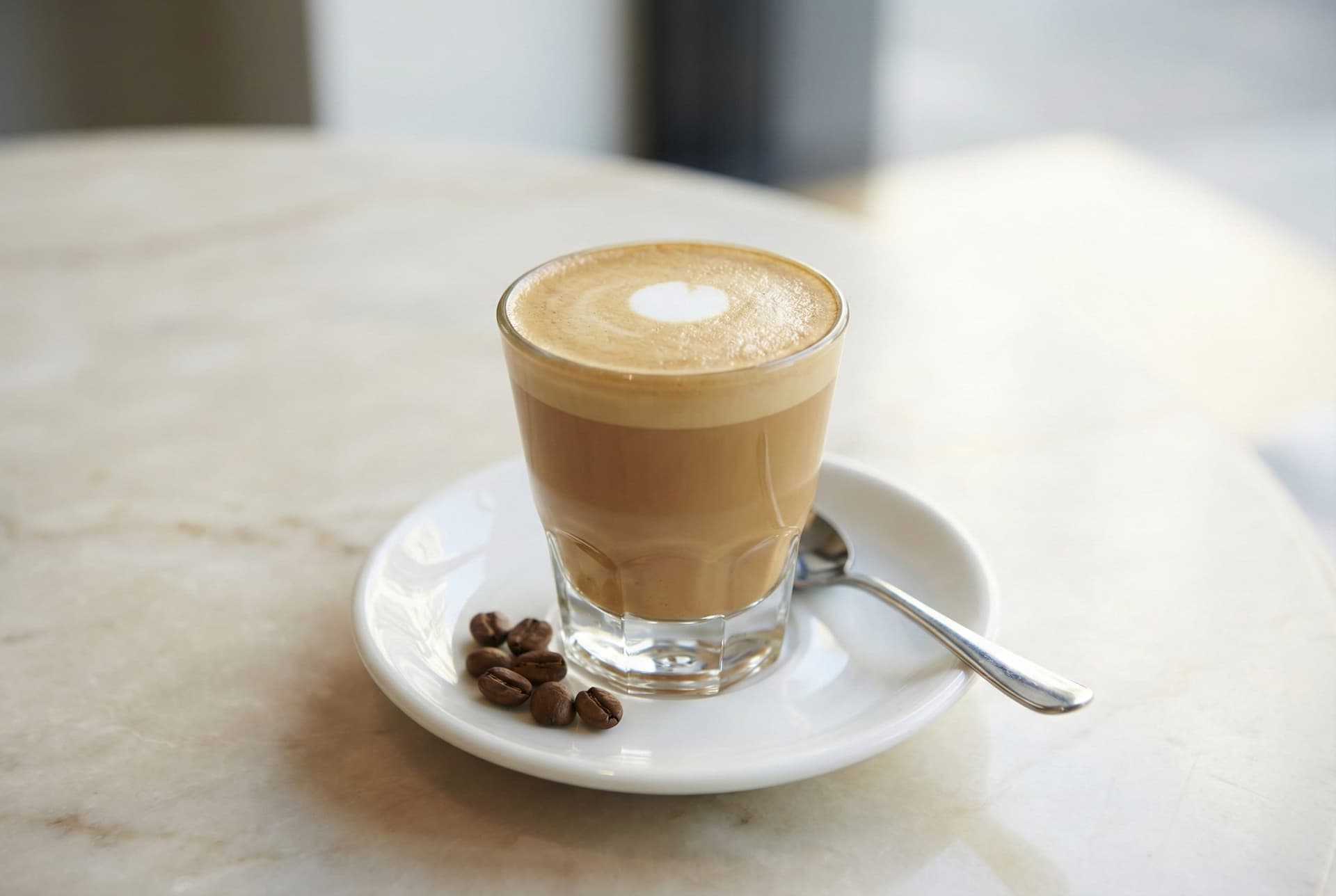
Complete Composition
- Ristretto shot: 0.5-1 oz (shortened espresso extraction) at 200-205°F — sweeter, less bitter than full espresso
- Alternative: Some cafés use full 1 oz espresso shot instead of ristretto
- Steamed milk: 2-3 oz at 150-160°F with thin microfoam layer
- Size: 3-4 oz total in demitasse cup or small glass
- Milk-to-espresso ratio: Approximately 60-70% milk, 30-40% espresso
- Final temperature: 155-165°F — warm and immediately drinkable
- Foam layer: 3-5mm thin microfoam (less than cappuccino, similar to latte)
- Intensity: 5/10 — balanced toward gentler side
- Calories: 30-50 with whole milk — minimal caloric impact
- Caffeine content: 40-75mg (lower than double-shot drinks due to single/ristretto shot)
Step-by-Step Preparation
- Extract ristretto shot: Use standard espresso dose (18-20g) but stop extraction early at 0.5-1 oz output (15-20 seconds)—creates sweeter, more concentrated shot
- Alternative method: Some cafés use full 1 oz espresso shot—check how your local café interprets piccolo
- Steam small amount of milk: Heat 2-3 oz milk to 150-160°F with minimal aeration (2-3 seconds)—similar to latte texture, not cortado
- Create microfoam: Target silky texture with very thin foam layer—think mini-latte, not mini-cappuccino
- Pour milk into espresso: Add steamed milk to espresso shot in demitasse cup or small glass
- Latte art possible: Skilled baristas can create tiny latte art in piccolo’s small surface
- Serve immediately: Small volume means rapid cooling—piccolo is meant for consumption within 3-5 minutes
Taste Experience
First sip: Immediate milk sweetness greets your palate—more milk-forward than cortado, closer to latte’s comforting profile. The ristretto’s natural sweetness (if used) combines beautifully with milk’s lactose, creating gentle, approachable first impression. Temperature is perfect—warm enough to be soothing, not so hot that you must wait.
Second and third sips: Coffee character emerges as your palate adjusts. The espresso/ristretto provides pleasant backbone—noticeable but not aggressive. You’ll taste subtle coffee notes (chocolate, caramel, nut) softened by milk. The silky microfoam texture enhances mouthfeel, making each sip feel luxurious despite small volume.
Final sips (3-5 minutes): Last portions deliver slightly more concentrated coffee as you reach bottom where espresso settled. The finale is satisfying—you’ve experienced complete flavor journey in just a few sips. Small size means you finish while drink is still warm and optimal.
Finish (aftertaste): Clean, mild aftertaste with milk sweetness and subtle coffee notes. Less intense than cortado, much gentler than macchiato. The piccolo leaves you satisfied but not over-caffeinated—perfect for mid-day or multiple daily servings.
Piccolo vs. Cortado vs. Macchiato: The Spectrum
Understanding the small-drink spectrum helps you choose correctly:
- Macchiato (2-3 oz): 90% espresso, 10% foam — most intense, least milk, boldest flavor
- Cortado (4 oz): 50% espresso, 50% milk — perfect balance, equal parts, 1:1 ratio
- Piccolo (3-4 oz): 30-40% espresso, 60-70% milk — milk-forward, gentle, mini-latte character
- Latte (8-12 oz): 15-20% espresso, 80-85% milk — very milk-forward, largest size, gentlest intensity
Choose based on desired intensity and milk presence, not just size preference.
When to Order
- Multiple daily coffees: Small size and moderate caffeine allow 3-4 piccolos daily without excessive milk or caffeine
- Mid-morning or mid-afternoon (10 AM or 3 PM): Perfect between-meal coffee that won’t fill your stomach
- Coffee tasting sessions: Originated as barista tasting tool—ideal for evaluating multiple espressos
- When latte feels too large: Delivers latte’s comforting milk presence in manageable size
- Transitioning from lattes: Introduces stronger coffee presence while maintaining milk-drink familiarity
- Quick coffee break: Consumed in 3-5 minutes—perfect for brief work pauses
- Calorie-conscious milk drink: 30-50 calories delivers milky satisfaction without latte’s 180-220 calorie load
Food Pairings
Piccolo’s gentle nature pairs with: delicate pastries (madeleines, financiers, shortbread), biscotti (for dunking in tiny cup), fruit tarts (berry, lemon), light breakfast items (toast with jam, yogurt parfait), and afternoon tea sandwiches. Avoid heavy, rich foods—the piccolo’s subtle character suits lighter accompaniments. Think delicate flavors matching delicate size.
💡 Best for: Multi-coffee-daily drinkers, latte lovers wanting smaller portions, baristas taste-testing coffees, between-meal coffee needers, calorie counters wanting milk drinks, espresso beginners not ready for cortado intensity, anyone seeking milky comfort in concentrated form. The piccolo is proof that good things come in tiny packages—maximum satisfaction, minimum commitment.
7. Espresso Con Panna: Espresso Meets Dessert
Espresso con panna—Italian for “espresso with cream”—represents coffee’s most elegant indulgence. This drink crowns a shot of espresso with a generous dollop of lightly sweetened whipped cream, creating dramatic visual contrast and surprising taste evolution. Unlike milk-based drinks that dilute espresso throughout, con panna preserves espresso’s intensity initially, then gradually mellows as cream melts into coffee. It’s dessert in coffee form, luxury without excessive complexity.
The con panna belongs to Vienna’s coffee tradition as much as Italy’s—the Viennese “Einspänner” (literally “one-horse carriage”, referring to carriage drivers who needed one-handed drinks) is virtually identical. In both cultures, the drink serves similar purpose: transforming harsh black coffee into civilized indulgence through whipped cream’s moderating influence. It’s particularly popular as afternoon pick-me-up or after-dinner digestif when straight espresso feels too austere but milk-based drinks seem too heavy.
What makes con panna fascinating is its dynamic nature—no two sips taste identical. Early sips deliver pure whipped cream sweetness, middle sips combine cream and espresso in varying ratios, final sips are espresso-heavy with cream’s lingering richness. This progressive taste journey distinguishes it from static drinks like lattes where every sip tastes similar. Con panna is coffee theater: beautiful to see, surprising to taste, memorable to experience.
Why Try It: For those who want espresso intensity with luxurious sweetness and no milk. Perfect for people who love espresso but find it too harsh alone, ideal for dessert replacement without excessive calories (compared to mocha), wonderful for special treat moments when ordinary coffee feels insufficient. The con panna delivers sophistication and indulgence in equal measure.
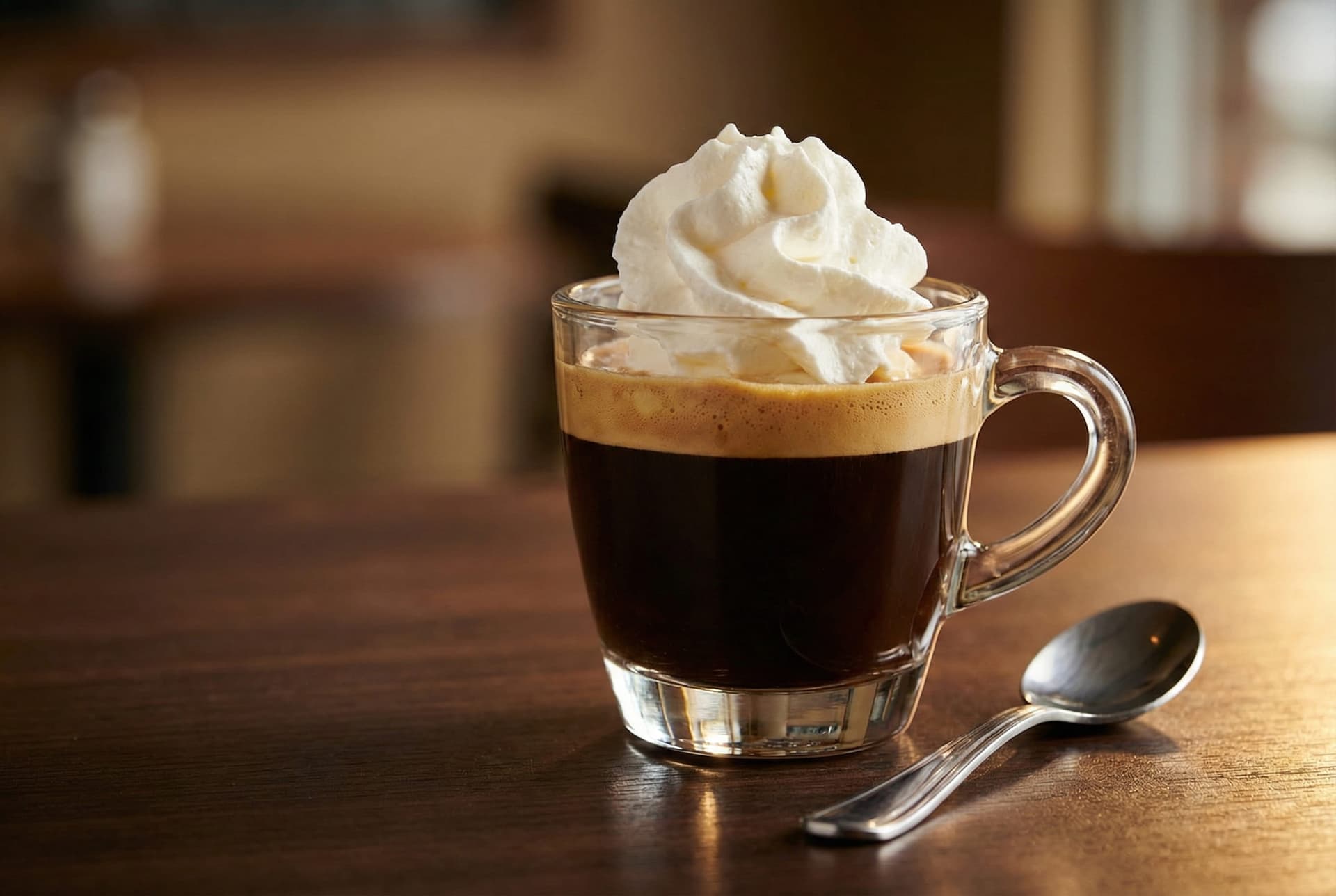
Complete Composition
- Espresso: 1-2 oz (single or double shot) at 200-205°F — the bold foundation
- Whipped cream: 1-2 oz freshly whipped, lightly sweetened — the luxurious crown
- Size: 3-4 oz total in demitasse cup or small glass
- Cream-to-espresso ratio: Approximately 50:50, though cream floats on top initially
- Final temperature: 140-160°F (cream cools espresso slightly)
- Cream texture: Soft peaks, not stiff—should fold into espresso gradually
- Sweetness: Moderate (from cream’s added sugar)—typically 1/2 to 1 teaspoon sugar per serving
- Intensity: 7/10 initially, mellowing to 5/10 as cream integrates
- Calories: 60-90 depending on cream amount and sugar content
- Caffeine content: 64-75mg (single shot) or 128-150mg (double shot)
Step-by-Step Preparation
- Whip cream properly: Use heavy whipping cream (35-40% fat), add 1/2-1 tsp sugar, whip to soft peaks—should hold shape but remain pourable
- Pull fresh espresso: Extract 1-2 oz using standard technique into demitasse cup or small glass
- Top with generous dollop: Spoon or pipe 1-2 oz whipped cream onto espresso surface immediately—cream should dome attractively above cup rim
- Optional garnish: Light cocoa dust or espresso powder sprinkle on cream (traditional) or leave pristine white (modern minimalist)
- Serve immediately with spoon: Provide small spoon for cream enjoyment—drink can be consumed by sipping through cream or stirring cream into espresso
- Consume within 5-7 minutes: Cream begins melting immediately—part of the drink’s charm, but best experienced before full integration
Taste Experience: The Three-Act Drama
Act One—Pure cream (first 1-2 sips): Initial contact delivers cool, sweet whipped cream—almost dessert-like. You’re tasting barely any coffee yet, just cream’s rich dairy sweetness. The temperature contrast is striking: cold cream against warm espresso below creates sensory interest. This phase feels indulgent, almost guilty-pleasure luxurious. Some drinkers actually consume entire cream layer before reaching espresso—perfectly acceptable approach.
Act Two—Cream-espresso fusion (sips 3-6): As you penetrate cream layer or as cream naturally melts, coffee flavor emerges. Each sip now delivers varying cream-espresso ratios—sometimes more cream, sometimes more coffee, creating dynamic experience. The cream’s fat softens espresso’s acidity and bitterness while its sugar adds pleasant sweetness. Coffee’s complex notes (chocolate, fruit, caramel) begin shining through cream’s richness. Temperature has equalized to perfect sipping warmth.
Act Three—Espresso-dominant finish (final sips): Last portions are primarily espresso with cream’s lingering richness coating your palate. You experience espresso’s full character now, but cream’s fat and sweetness prevent any harsh bitterness. These final sips deliver satisfaction—intense coffee flavor cushioned by dairy richness.
Finale (aftertaste): Pleasant, complex aftertaste combining roasted coffee notes with dairy sweetness. The cream’s fat creates lasting mouth-coating that prevents bitter compounds from dominating. Aftertaste should linger pleasantly for 5-8 minutes—never harsh or cloying. Well-made con panna leaves you feeling indulged but not over-sugared, satisfied but not heavy.
How to Drink Con Panna: Two Schools of Thought
Method 1: Sip through cream (traditional): Drink directly without stirring—experience progressive flavor evolution as you move from cream to espresso. This method preserves the drink’s theatrical three-act structure. Provides maximum sensory interest but can be messy (cream on nose/mustache). Most authentic to original Viennese/Italian tradition.
Method 2: Stir cream into espresso (modern): Use spoon to fold cream into coffee before drinking—creates uniform creamy-sweet coffee throughout. This method delivers consistent flavor but loses progressive taste evolution. Easier to drink neatly, particularly in professional settings. Creates drink closer to cappuccino or cortado in character.
Recommended approach: Try traditional sipping method first to experience con panna’s unique progression. If you prefer uniform taste, stir in subsequent servings. Both methods are valid—choose based on whether you value novelty or consistency.
When to Order
- After-dinner treat (dessert replacement): Satisfies sweet craving with less guilt than full dessert—60-90 calories vs 400+ for cake
- When you want espresso without harshness: Cream softens intensity while preserving coffee character
- Special occasions: Afternoon indulgence, celebration moment, or treating yourself
Food Pairings
Con panna’s sweet richness pairs with: Viennese pastries (apple strudel, sachertorte), biscotti (almond or anise—for dunking), dark chocolate (60-70% cacao), simple cookies (shortbread, butter cookies), fruit desserts (berry tart, poached pears), and cheese (aged Gouda, blue cheese for adventurous pairings). Avoid extremely sweet desserts—con panna itself is indulgent enough. Think complementary rather than competing richness.
Con Panna Variations
Espresso con panna freddo: Iced version with cold espresso and whipped cream—refreshing summer treat
Doppio con panna: Double espresso with whipped cream—for serious caffeine needs with indulgence
Con panna affogato hybrid: Con panna poured over small scoop gelato/ice cream—ultimate dessert beverage
Flavored variations: Vanilla extract in cream (traditional), orange zest in cream (modern), cinnamon dust on top (winter)
💡 Best for: Dessert-drink lovers, espresso appreciators wanting softening without milk, special occasion celebrators, after-dinner digestif seekers, afternoon indulgence cravers, anyone wanting theatrical coffee experience, lactose-sensitive individuals (cream often easier to digest than milk). The con panna is coffee’s answer to tiramisu—sophisticated, indulgent, memorable, and surprisingly simple. It transforms ordinary espresso into extraordinary experience with single generous dollop of cream.
Choosing the Right Alternative
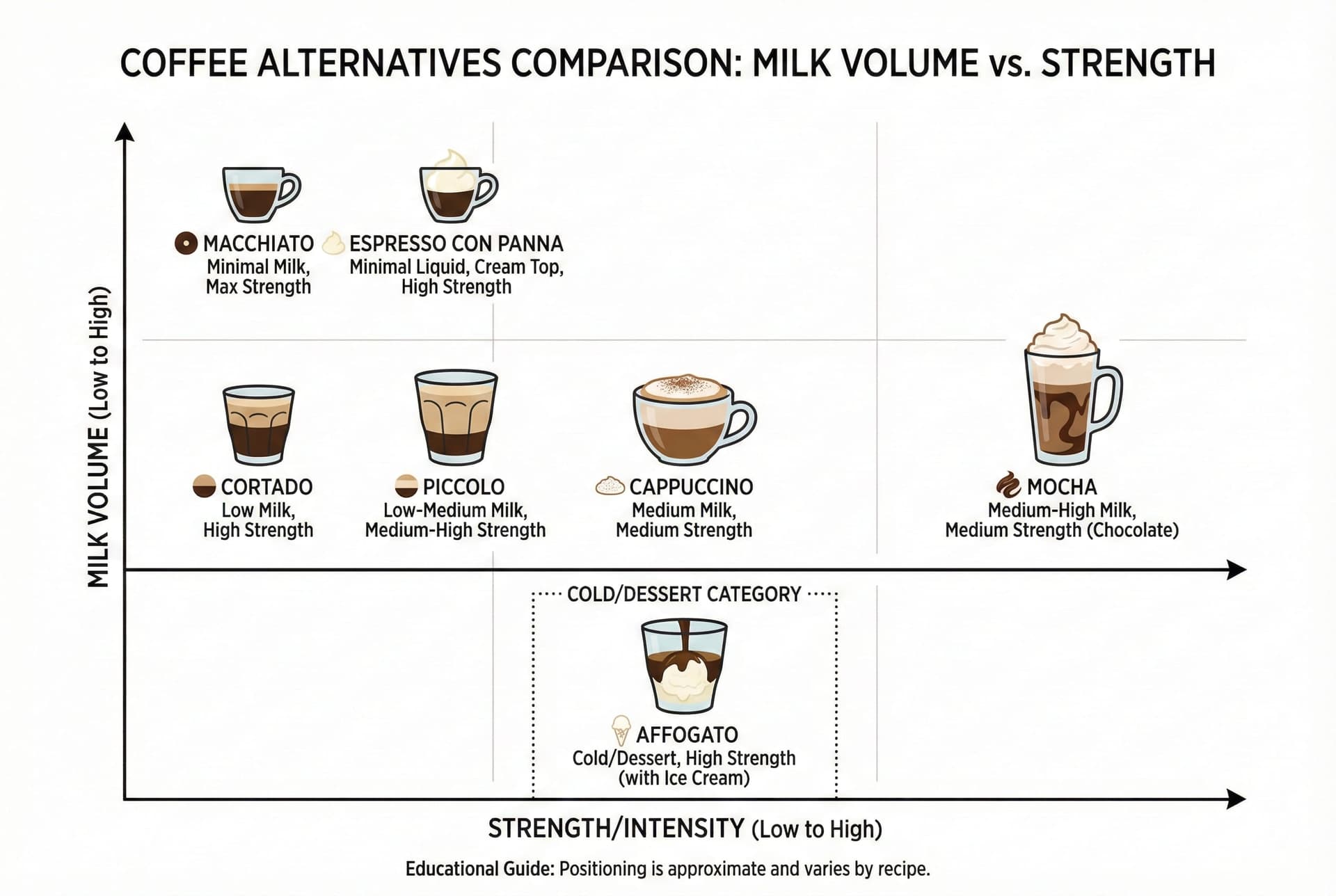
By Strength (Coffee Intensity)
Strongest: Macchiato (9/10)
Strong: Cortado (7/10), Con Panna (7/10)
Medium: Americano (6/10), Cappuccino (6/10)
Gentle: Piccolo (5/10), Mocha (4/10)
By Calories (Low to High)
Lowest: Americano (5 cal)
Low: Macchiato (15-20 cal)
Moderate: Piccolo (30-50 cal), Cortado (35-40 cal)
Indulgent: Con Panna (60-90 cal), Cappuccino (80-120 cal)
Dessert: Mocha (250-350 cal)
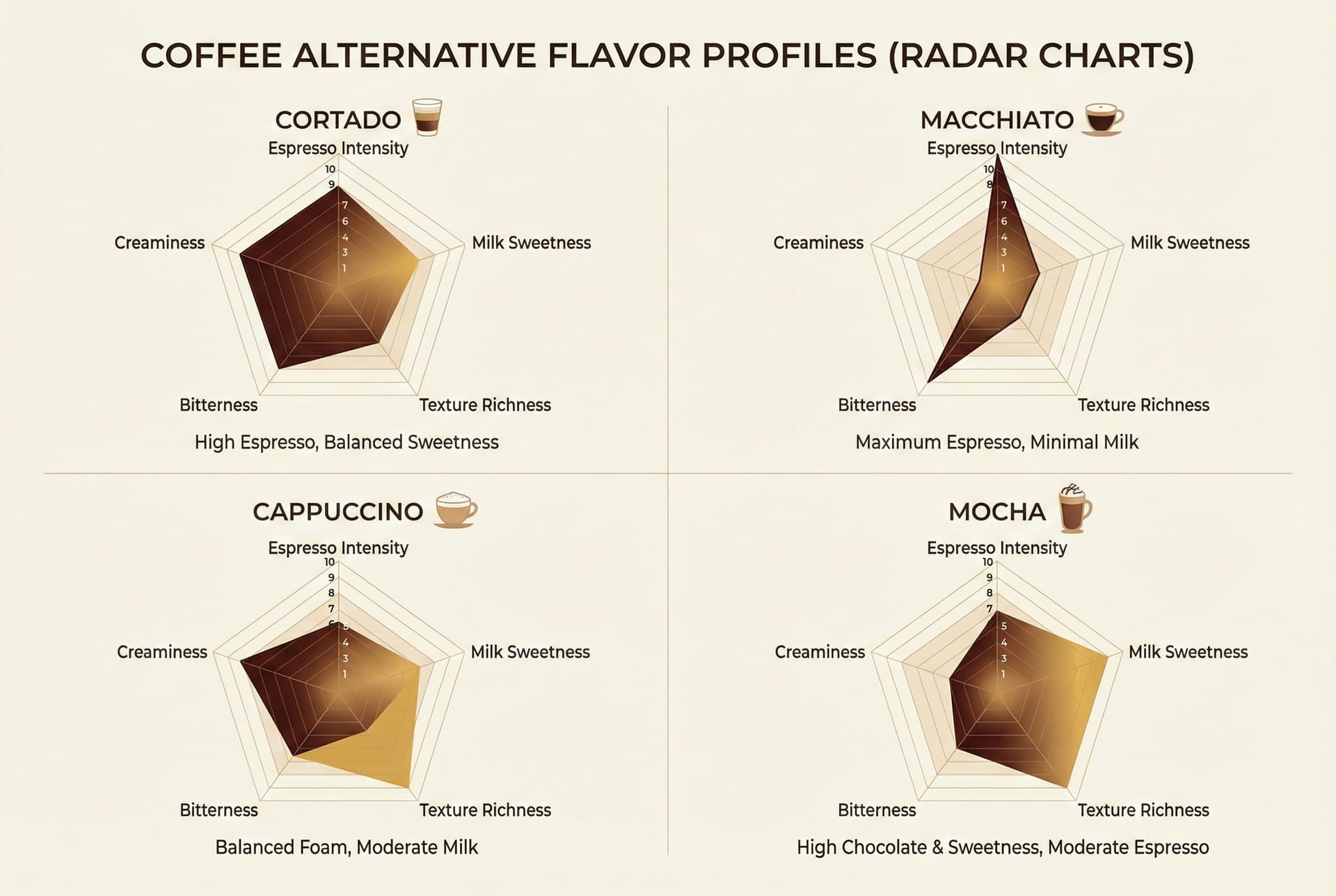
By Sweetness
Sweetest: Mocha (chocolate + milk)
Sweet: Con Panna (whipped cream), Piccolo Latte
Balanced: Cappuccino, Cortado
Coffee-Forward: Macchiato, Americano
Frequently Asked Questions
Very likely yes, particularly starting with cortados and piccolos—both maintain milk's smoothing effect while boosting coffee presence.
Try cortado first, piccolo latte second, cappuccino third, macchiato fourth, then americano last.
Most people find 3–4 of these alternatives become regular orders within a month.
Start Your Exploration
I encourage you to try each of these alternatives over the next month. Order one new drink per week at a quality café. Pay attention to how each drink makes you feel, which flavors you notice, and which occasions suit each style.
You might discover that your “usual latte” was never really your perfect drink—just the safe choice. Perhaps you’re actually a cortado person who never knew it existed. Or maybe you’ll become one of those coffee enthusiasts who orders different drinks for different times of day. When you’re ready to brew at home, our espresso machine types guide can help you find the right setup for any of these drinks.
Start tomorrow morning with a cortado. Your coffee life might never be the same.
Get Coffee Tips
Join our newsletter for expert reviews and brewing guides.